


Historians Condemn Israel’s ‘Scholasticide.’ The Question Is Why.
The historical profession is currently grappling with a range of significant questions. On one side, conservatives urge historians to highlight America’s uniqueness and achievements, while progressives advocate for a focus on its shortcomings and blind spots. How, then, should historians approach the telling of the nation’s story? What role does history play in a society increasingly marked by short attention spans? And how can the discipline reverse the steep decline in history majors, which now represent a mere 1.2% of U.S. college students?

However, at the recent annual conference of the American Historical Association (A.H.A.) in New York, the most urgent discussion revolved around a different topic altogether. The debate centered on what has been described as Israel’s “scholasticide”—the deliberate destruction of Gaza’s educational system—and the appropriate response from the A.H.A., which represents historians across various sectors including academia, K-12 education, public institutions, and museums in the United States.https://wordpress.com/
During Sunday’s business meeting, members voted on a resolution proposed by Historians for Peace and Democracy, an organization established in 2003 in opposition to the Iraq War. The resolution called for three actions: condemnation of Israeli actions that allegedly impede Gazans’ right to education, an immediate ceasefire, and the establishment of a committee to aid in rebuilding Gaza’s educational infrastructure.
Van Gosse, a professor emeritus at Franklin & Marshall College and a co-founder of Historians for Peace and Democracy, emphasized the moral weight of the resolution. Citing previous A.H.A. statements on Iraq and Ukraine, he argued that failing to pass the resolution would signal indifference to the issue of “scholasticide.”
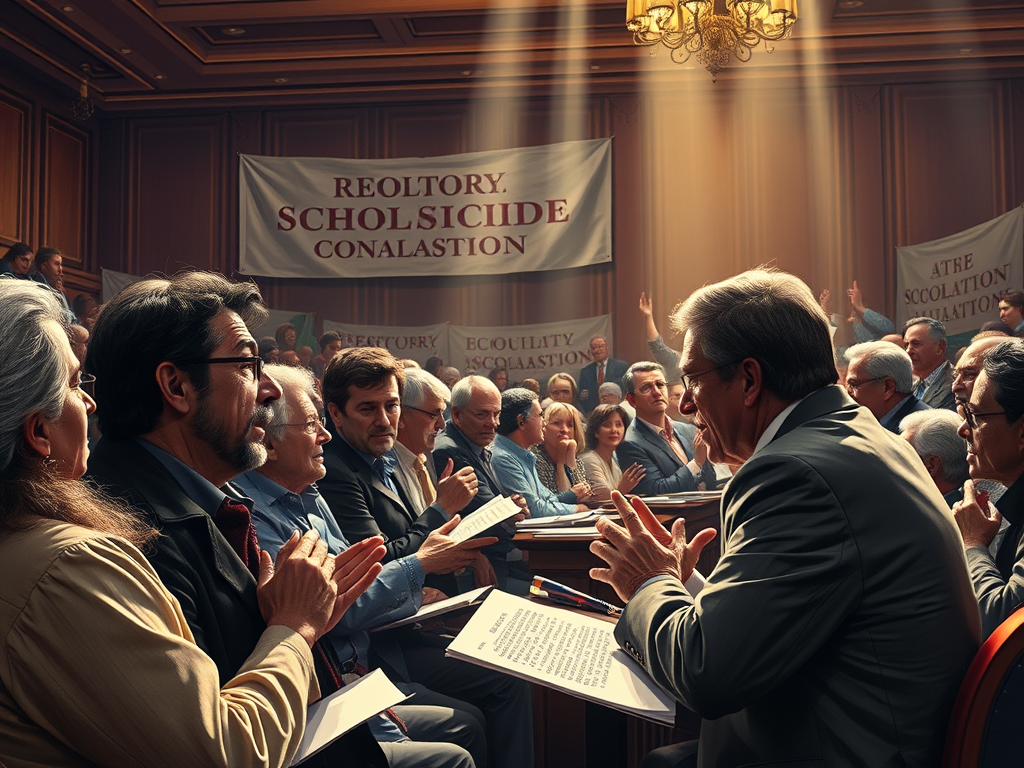
This year’s business meeting, usually a subdued event with modest attendance, saw an unprecedented turnout. Following a rally earlier that day, the meeting was packed, leaving some attendees voting outside the Mercury Ballroom without hearing the full arguments from speakers on both sides of the issue. Those opposing the resolution faced jeers, while supporters received enthusiastic applause. Ultimately, the resolution passed overwhelmingly, with 428 votes in favor and 88 against, amid chants of “Free, free Palestine!”
The resolution reflects a growing consensus among many historians, a profession that has become increasingly diverse and engaged in global issues. Yet, the decision raises important concerns. Critics argue that the resolution undermines the historian’s commitment to evidence-based argumentation by accusing Israel of obliterating Gaza’s education system without addressing claims that Hamas uses schools for military purposes. Furthermore, such resolutions risk polarizing academic organizations and diverting attention from pressing internal challenges, such as declining enrollments and shrinking history departments.
There is also the broader issue of academia’s politicization, which could erode public trust in historians and their work. Jeffrey Herf, a professor emeritus at the University of Maryland, warned that adopting the resolution could damage the A.H.A.’s credibility and reinforce perceptions of it as a political body.
The resolution is not yet final. The A.H.A. Council, which governs the organization, must decide whether to accept, reject, or send the resolution to a full membership vote. For now, the council has deferred its decision, leaving the A.H.A. without an official position.
Executive Director Jim Grossman has stressed the importance of maintaining the organization’s legitimacy and neutrality, cautioning against overreach into contentious issues. Historical precedent shows the A.H.A. has taken nuanced stances before, such as its 2007 statement on the Iraq War and its more measured response to the conflict in Ukraine.
While proponents of the resolution view it as a moral imperative, others argue that the A.H.A. should avoid engaging in political conflicts. As an institution, it might better serve its mission by focusing on promoting historical scholarship and fostering independent thought, rather than venturing into highly divisive issues.




Leave a Reply