

Is Notre Dame football likable now?

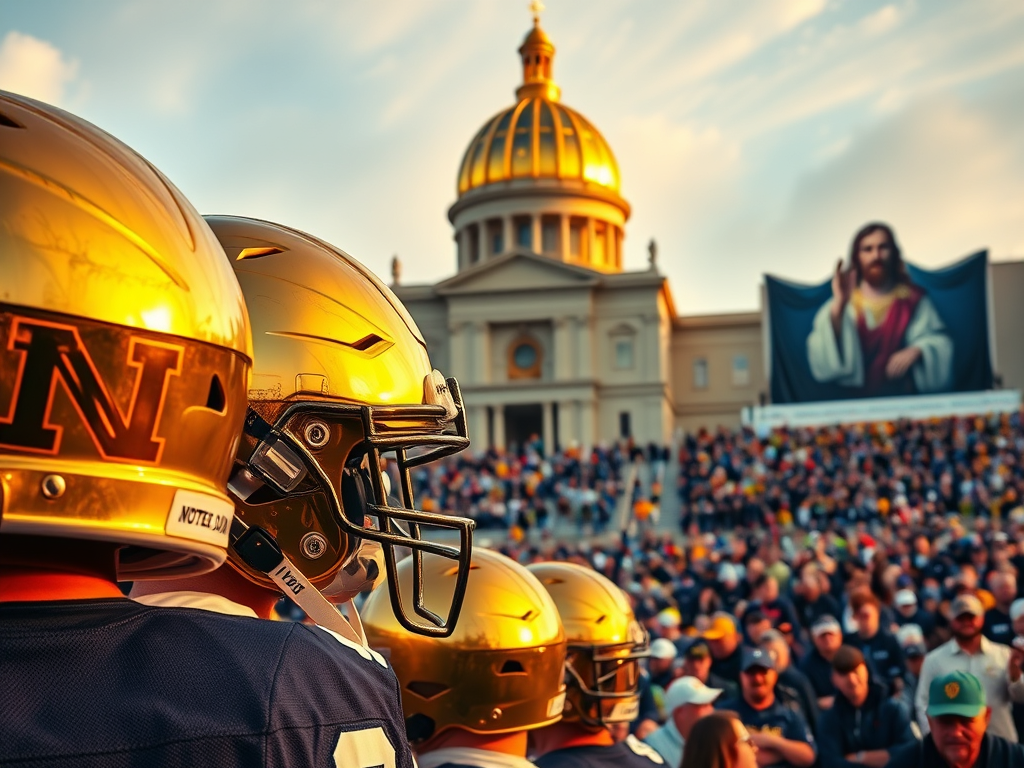
Notre Dame, with its iconic symbols—the golden helmets reflecting the dome on the Main Building and the Touchdown Jesus mural overlooking the football stadium—are globally recognized.
The program is steeped in tradition, rich in history, and filled with nostalgia. “Waking up the echoes,” “Playing like a champion,” and “Winning one for the Gipper”—all part of the lore. Not to mention the legendary “Rudy” story.https://wordpress.com/
Fighting Irish football fans are everywhere, even among those who’ve never been to South Bend, Indiana, or the U.S.
It can be a bit overwhelming, to say the least.
Notre Dame football holds a prestigious place in the sports world, on par with the New York Yankees, Dallas Cowboys, and Duke basketball, with the Los Angeles Lakers and Boston Celtics similarly occupying that elite space in the NBA.
Whether you love them or despise them, it’s impossible to ignore them.
For every Notre Dame supporter, there’s an equally passionate detractor—someone frustrated by the Fighting Irish’s sense of superiority, irritated by their media spotlight, and convinced they receive preferential treatment.
But something’s different this time around in the College Football Playoff.
“First time in my life I’m rooting for ND,” one of my college friends texted in our group chat following Notre Dame’s quarterfinal win over Georgia in last week’s Sugar Bowl. Next up is a showdown against Penn State in the Orange Bowl in Miami Gardens, Florida.
Marcus Freeman’s Fighting Irish are starting to win over some hearts. Or maybe it’s just that fans are relieved by the departure of his predecessor and are eager to see the SEC knocked down a peg. Who didn’t enjoy Irish fan Shane Gillis poking fun at Nick Saban on “College GameDay”?
Whatever the case, Notre Dame is finally starting to seem likable for the first time in ages.
“I’ve noticed it, and it’s honestly pretty uncomfortable for me,” said Mike Golic Jr., former Irish football player and podcaster. “It’s been a strange adjustment not having to defend this team constantly.”
Hating Notre Dame has been a longstanding tradition, and the roots of this animosity are deep. Anti-Catholic sentiments often tied in with anti-immigrant movements during the 19th and early 20th centuries. South Bend even hosted a three-day Ku Klux Klan rally in 1924, sparking a confrontation between Notre Dame students and Klan members.
When Notre Dame was excluded from the Big Ten in the 1920s, some speculated it was due, in part, to anti-Catholic prejudice.
This exclusion helped solidify Notre Dame’s independent path, as they traveled across the country to play top-tier football. The Fighting Irish became a beacon of hope for Catholic immigrants, especially in the Northeast where many had settled.
Though there are no longer standing straps on New York City’s subway, the spirit of Notre Dame’s hardworking alumni lives on. For years, the Yankees’ regional sports network, YES, aired Notre Dame home games. Last November, Notre Dame took its Shamrock Series to Yankee Stadium for a historic game against Army, celebrating the centennial of the legendary “Four Horsemen” game, and packed the stadium.
While no other school cherishes its past as much as Notre Dame, it’s also the source of many eye rolls. That’s because much of their glory days were captured in black-and-white photographs. Notre Dame claims eight national titles since the advent of the college football poll era (1936-present), but half of those came in the 1940s.
The last time Notre Dame won a national championship was in 1988 under coach Lou Holtz, at a time when the Berlin Wall was still standing and the World Wide Web didn’t exist.
In 1991, Notre Dame became the first university to secure its own television deal with a major network, and its home games have aired on NBC ever since. During a time when only a few games were televised nationally each week, Notre Dame consistently had a prime-time slot—whether people liked it or not.
But shortly after this NBC deal, Notre Dame’s football performance began to slide. Between 1994 and 2009, the Fighting Irish had twice as many losing seasons (four) as seasons with double-digit wins.
“The TV deal really irked people for a long time,” said Ryan Nanni, host of the “Who Killed College Football” podcast. “The fact that Notre Dame had this exclusive NBC deal, and they were always on TV, even when they weren’t a top-tier program.”
Now, of course, every average team in a major conference gets national airtime. Heck, Iowa vs. Michigan State was a prime-time NBC game last October. For a generation of college football fans, ignoring Notre Dame became easy.
Brady Quinn, former Notre Dame quarterback, was part of one of the program’s false starts. In 2006, under coach Charlie Weis, the team had a 10-3 season that ended in a 41-14 Sugar Bowl loss to LSU.
Quinn, from Dublin, Ohio, didn’t fully grasp the polarization surrounding Notre Dame until he joined the program.
“I always thought, we’re a Catholic institution, trying to do good things,” Quinn recalled. “But it became clear that many people felt Notre Dame got preferential treatment, and that we weren’t in a conference. That became very apparent the longer I was there.”
After the recent wave of conference realignment, Notre Dame’s independence seems almost nostalgic, like a relic of simpler times. The pride that Notre Dame fans take in their athletes’ rigorous academic schedules seems almost quaint as college football becomes more commercially driven.
“Mentally, it feels like we have eight or nine days to prepare because we don’t have to go to school,” said quarterback Riley Leonard, ahead of the Orange Bowl. “Notre Dame’s academic demands are intense, but we all love going to class.”
In 2012, ESPN’s Rick Reilly declared Notre Dame football irrelevant. Yet, one could argue the fact that Reilly wrote that column proved the point wrong. That year, Notre Dame responded with an undefeated regular season, shattering Reilly’s predictions and marking the beginning of a coaching revival.
Brian Kelly took over as head coach in 2010 and spent over a decade restoring Notre Dame to national prominence. Under Kelly, the Irish won at least 10 games seven times, reaching the BCS Championship Game in 2012 and the College Football Playoff in 2018 and 2020.
However, despite the program’s improvement under Kelly, Notre Dame often faltered on the biggest stages. The Irish lost the BCS title game and their two College Football Playoff semifinals by a combined score of 103-31.
There’s nothing more frustrating than watching a blowout in an exclusive TV slot.
Furthermore, Kelly, for all his success, did little to increase Notre Dame’s likability. His often fiery demeanor on the sidelines did little to endear him to fans.
“It’s the Brian Kelly effect,” said Nanni. “It wasn’t just Kelly. Charlie Weis wasn’t exactly beloved, and Ty Willingham had his own issues. When was the last time Notre Dame had a coach everyone liked?”
In 2024, things seem different. Despite an unexpected home loss to Northern Illinois early in the season, the Irish are showing promise.
“This team feels like it has better talent,” said Golic Jr., who played for the 2012 team that lost in the national title game. “It’s easier for people to believe in them now. They actually belong on this stage.”
Notre Dame’s victory over SEC champion Georgia proved doubters wrong and added fuel to the fire for those eager to see the SEC brought down a peg.
“A lot of college football fans are rooting for anyone but the SEC,” Quinn said.

For Golic, it’s more about the classic enemy-of-my-enemy dynamic.
And then there’s Marcus Freeman, who took over as head coach after Kelly left for LSU in 2021. Kelly left, believing he had a better shot at a national title in Baton Rouge. Who could blame him? LSU has won three titles under three different coaches this century.
Freeman, at just 36, was promoted to head coach in part because the players clearly adored him. Though his tenure has had ups and downs, with some tough losses, Freeman’s laid-back style and adaptability have won him praise.
“Why is Notre Dame so likable right now? It’s because of Marcus,” Quinn said.
Freeman’s youthful appearance and charisma don’t hurt either.
While likability is hard to quantify, an informal poll I conducted on X this week showed a very different response from what I would have expected in past years.
There are still plenty of staunch Notre Dame detractors, but right now, the team with the handsome coach and shiny helmets might just be America’s favorite college football team.mets.




Leave a Reply