
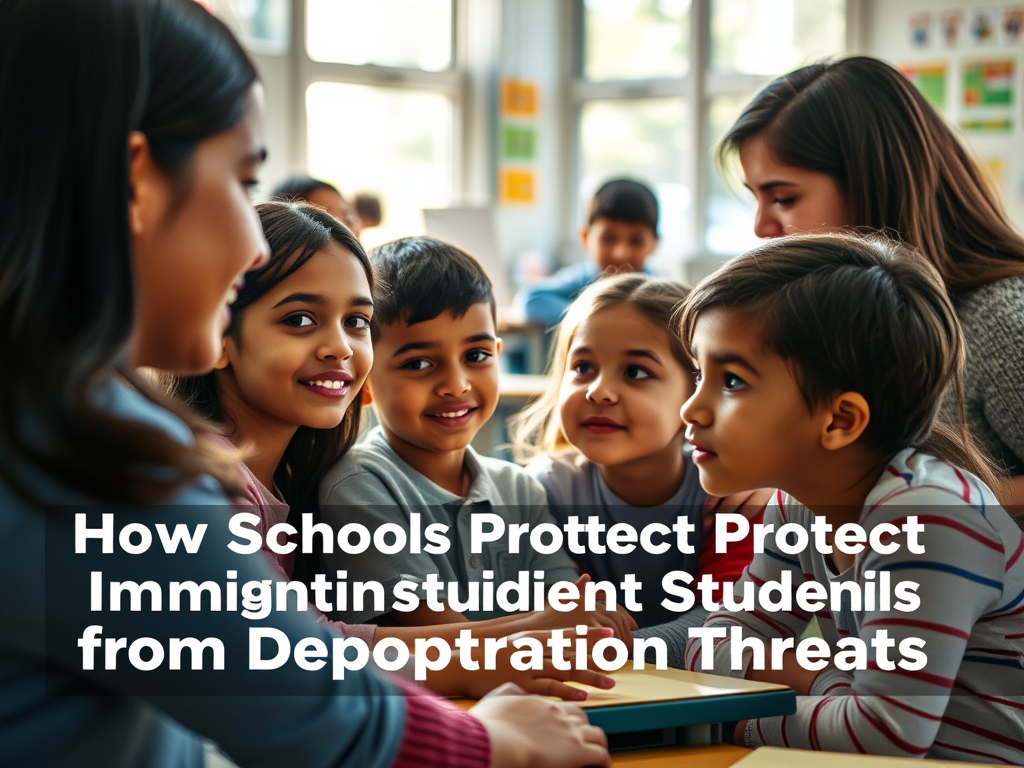

If immigration officers show up at a public school in New York City, principals have been instructed on how to respond. They should ask the officers to wait outside and contact a school district attorney immediately.
What if ICE Agents Show Up? Schools Prepare Teachers and Parents.

Since 2022, the school system has enrolled approximately 40,000 immigrant students. With President-elect Donald J. Trump’s plans to deport millions of undocumented immigrants, the district has provided staff with a protocol to protect students with uncertain legal status.https://wordpress.com/
In a letter to principals sent in December, Emma Vadehra, the district’s chief operating officer, stated, “We hope that this protocol will never need to be used.”
Nevertheless, both New York City and other districts nationwide are preparing teachers and immigrant families for a possible wave of deportations.
Public schools serving large numbers of migrant children have faced numerous challenges in recent years, particularly as hundreds of thousands of migrants crossed the southern border. Some schools are educating children who speak Indigenous languages and have never been formally educated, while others work to keep older students in class despite pressures to earn money. Many schools have also been helping new families secure housing, food, and winter clothing.
Now, these schools are facing a new challenge: convincing parents to send their children to school, especially when some are so fearful of deportation that they are reluctant to have their children attend at all.
“We have parents who are scared,” said Adam Clark, superintendent of Mount Diablo Unified School District in California. “We are working to inform them of their rights.”
In Mount Diablo, about 20% of students are still learning English, likely reflecting a large number of recent immigrants, according to Dr. Clark. Attendance dropped after the election, though he stressed that the exact reasons for the absences are unclear.
To address these concerns, the district will hold a legal information session for parents later this month. Social workers have been educating families on their rights, emphasizing that under current law, undocumented children are entitled to a public education, and federal immigration agents cannot typically arrest students or their families on school grounds. Additionally, public schools do not track students’ immigration status.
However, Dr. Clark acknowledged that his ability to reassure families was limited.
A long-standing policy bars Immigration and Customs Enforcement (ICE) from conducting arrests in schools or other sensitive locations such as hospitals or churches. But advocates for more restrictive immigration policies, including those connected to Project 2025, a plan created for the new administration, argue that ICE agents should be able to arrest individuals in any location to expedite deportations. This shift has left many educators concerned about the possibility of federal agents showing up at their schools.
“We will follow the law, whether we agree with it or not,” Dr. Clark said. “If they have the proper documentation, we will cooperate.”
The Trump transition team did not respond to specific questions about deportations of migrant students. However, Karoline Leavitt, a spokesperson for the president, issued a statement asserting that Trump had a mandate to deport criminals and terrorists.
Across the nation, local governments are grappling with how to collaborate with the incoming administration on deportations. New York City Mayor Eric Adams, a Democrat, has expressed frustration with the number of migrants in the city but has recently taken a more cooperative stance toward Trump.
Though Adams oversees New York City’s school system, officials have advised principals and school security staff to call a district lawyer if ICE agents seek access to a school. This guidance is partly because distinguishing a judicial warrant from other legal documents can be difficult for non-experts.
The official policy states that in the absence of a judicial warrant, the district “does not consent to nonlocal law enforcement accessing school facilities.”

For educators concerned about their students’ safety, the city has directed them to attend online legal sessions hosted by Project Rousseau, a nonprofit that provides legal services to immigrants.
Bethany Thorne from Project Rousseau advised teachers to encourage families fearful of deportation to keep their children in school and not miss any court dates, even if they do not have a lawyer. Missing court, she noted, could significantly increase the risk of deportation.
In Chicago, which has enrolled up to 17,000 recent immigrant students, the influx has influenced contract negotiations between the teachers’ union and the school district. The district faces challenges in maintaining staffing levels amid budget shortfalls, but because of the diverse needs of immigrant students, there are calls for increased investment in smaller class sizes and additional bilingual teachers and social workers.
Rebecca Martinez, campaign director for the Chicago Teachers Union, emphasized that some migrant students “have never been to school, or are in seventh grade but last attended in second grade.” Educators are grappling with this wide range of needs in a single classroom.
Although the school district declined an interview request, it issued a statement affirming its commitment to serving all students, regardless of immigration status or home language. The district also indicated plans to review relevant laws and policies with principals, especially regarding the requirement for federal agents to have a warrant or demonstrate an “imminent threat to public safety” before entering schools.

In Denver, where many recent immigrants reside, Tricia Noyola, CEO of the charter school network Rocky Mountain Prep, said that while many families have been fearful since Election Day, they remain determined to stay in the country and keep their children in school.
Noyola observed that despite President Trump’s rhetoric about immigrants being a threat, many of these families are incredibly vulnerable, with some falling victim to scams involving fake construction paychecks or non-existent apartments.
In Los Angeles, Superintendent Alberto Carvalho expressed hope that schools would remain “protected ground.” District officials are distributing information cards to parents outlining their rights and plan to conduct mandatory training for employees on the limits of federal agents’ access to schools.
Dr. Clark, the superintendent of Mount Diablo, noted that the widespread anxiety about deportation has detracted from the district’s primary focus of educating immigrant children. To accommodate part-time working students, the district has launched a half-day high school program. Although encouraging attendance is crucial, it remains a challenge when families are fearful of the authorities.
“It’s frustrating that we have to engage in these discussions,” Dr. Clark said. “This conversation is a distraction from our real work.”




Leave a Reply