
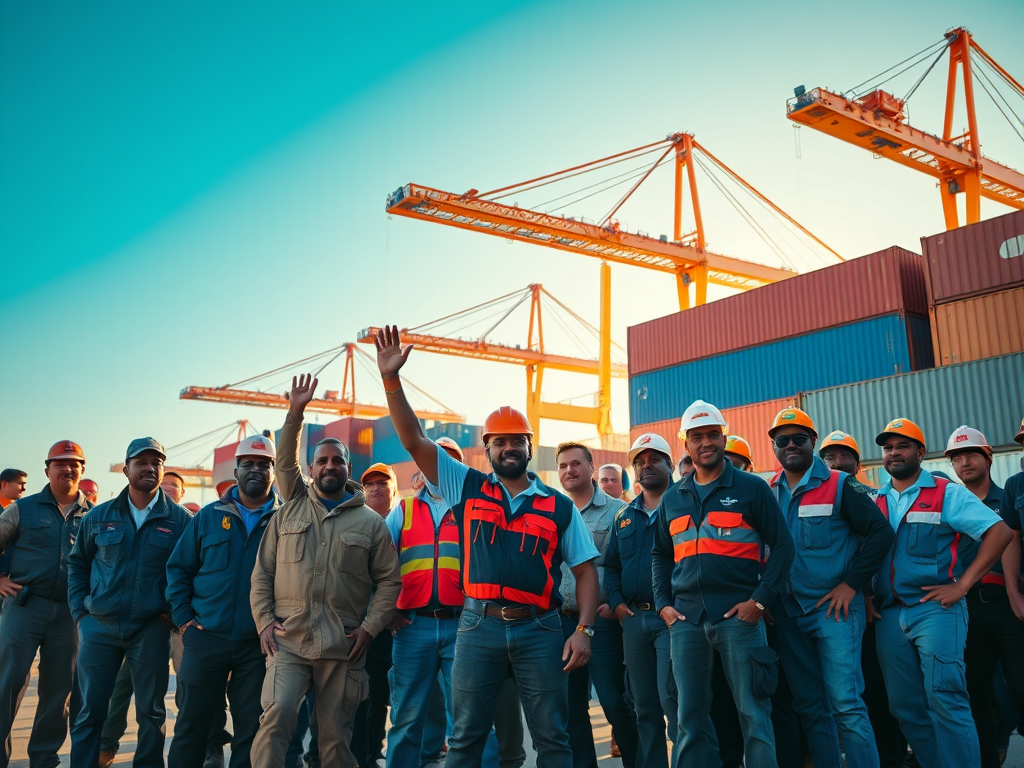

Port Strike Averted With Labor Deal Days Before Deadline

Dockworkers on the East and Gulf Coasts reached a provisional labor agreement with their employers on Wednesday, avoiding a potential strike that could have severely impacted the economy just days before President-elect Donald J. Trump took office.

The International Longshoremen’s Association (ILA), the union representing dockworkers, and the United States Maritime Alliance, which represents the employers, successfully resolved their differences over a key issue in negotiations: the introduction of automated cargo-handling technology at ports.
“This agreement safeguards existing I.L.A. jobs while providing a framework for adopting technologies that will not only modernize ports on the East and Gulf Coasts but also create additional job opportunities,” the two parties stated in a joint release on Wednesday evening.https://wordpress.com/
Following a brief strike by I.L.A. members in October, the maritime alliance had agreed to raise wages by more than 60 percent over six years, contingent upon resolving other aspects of the labor deal—particularly those concerning automation—by January 15.
The union had strongly opposed the use of automation at the ports, arguing that it would lead to job cuts, a stance that was backed by President Trump.
“I’ve studied automation extensively and understand its full impact,” Trump said last month on his Truth Social platform. “The savings it offers don’t come close to justifying the distress it causes to American workers, in this case, our Longshoremen.”
Employers, on the other hand, argue that automation could enhance efficiency in container handling, and they sought more flexibility in the new six-year contract to implement the technology. However, the two sides did not disclose the specific terms of their agreement on automation.
“This is a mutually beneficial agreement that creates jobs for I.L.A. members, supports U.S. consumers and businesses, and reinforces the U.S. economy as a central player in the global marketplace,” the statement noted.
A source familiar with the negotiations, who spoke on condition of anonymity, revealed that the I.L.A. secured assurances that additional jobs would be created as automated machinery is implemented at ports. Meanwhile, the employers gained clearer terms in the contract that would allow for smoother integration of automation technology.
The deal comes as a significant relief to businesses that rely on imports and exports through East and Gulf Coast ports, which handle about 60 percent of U.S. container traffic. Concerned about a potential strike, some companies had rushed to import goods before the deadline and rerouted some shipments through West Coast ports, where workers are represented by a different union.
Major ports in New Jersey, Virginia, Georgia, and Texas handle a wide range of goods, from automobiles and fresh produce to pharmaceuticals.
In October, the I.L.A. and maritime alliance had agreed to raise hourly wages to $63, up from $39, by the end of the contract. With shift work and overtime, many longshoremen at certain East Coast ports could see their annual salaries exceed $200,000. At the Port of New York and New Jersey, nearly 60 percent of longshoremen earned between $100,000 and $200,000 in the year ending June 2020, according to data from an agency that oversees the port.
The wage increase came after President Biden pressured employers to boost their wage offer.




Leave a Reply