

A Fugitive Businessman Samuele Landi, Done In by One Law He Couldn’t Dodge

Around noon on February 2, a powerful wave began its slow approach toward the Aisland 1, an 800-ton deck barge drifting in the waters between Dubai and Iran. On board were the vessel’s inhabitants of over a year: Samuele Landi, a 58-year-old Italian businessman, three sailors, a cook, and five cats.https://wordpress.com/
Landi, the ship’s captain, was a skilled computer programmer who had once served as the CEO of Eutelia, a telecommunications firm. He fancied himself as an Italian version of Steve Jobs, though his life might have been more in line with that of John McAfee, the cybersecurity mogul turned fugitive. A passionate skydiver and motorcycle racer, Landi thrived on living dangerously—pushing the boundaries of both law and life itself. His career had revolved around offshore financial schemes, and now, stranded at sea, he had become one with them.

“I will die at sea for sure,” Landi had told Oswald Horowitz, a filmmaker who had visited him the previous December. “I’m not going back.”
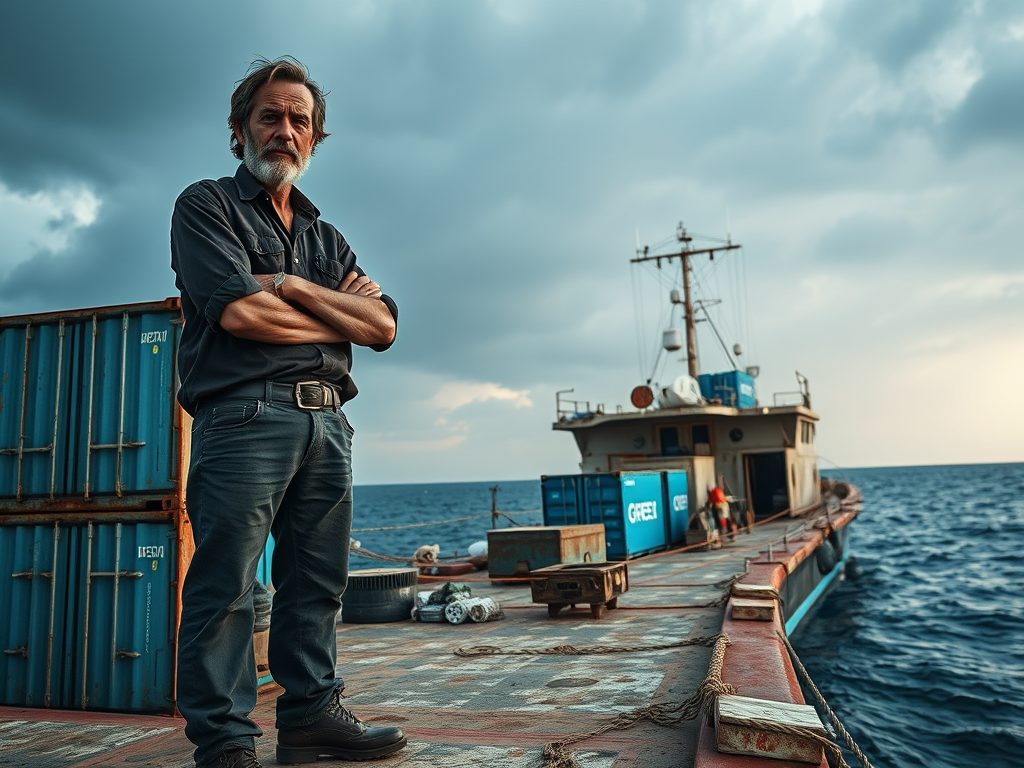
The Aisland was his latest, most audacious adventure. A rusty, rectangular structure, its size comparable to a large commercial plane, the barge was equipped with six blue shipping containers bolted to its deck. These containers housed living quarters, complete with solar-powered air conditioning and a desalination system. The barge was cluttered with supplies: ropes, crates, oil and water tanks, a freezer full of meat, and a sack of reinforced concrete mix for repairs. A Liberian flag fluttered in the breeze.

How Landi ended up living on a dilapidated barge about 30 miles off Dubai’s coast is a story rooted in self-preservation. For over a decade, Landi had been a fugitive. Though not a violent criminal or a highly sought-after figure, his legal troubles began when Eutelia was declared bankrupt in 2010. Along with several executives, including Landi, he was convicted of bankruptcy fraud, which forced him to flee Italy and take refuge on the high seas.

What set Landi apart from the typical fraudster was the sheer audacity of his methods, which exploited every possible loophole. A committed libertarian, he sought freedom from government control and found willing partners in certain nations. Landi hid assets in Switzerland, avoided extradition in Dubai, set up businesses in tax-free zones, obtained diplomatic credentials from Liberia, dabbled in cryptocurrency, and finally took to the open water, where no one could tell him what to do.
Landi’s expertise in offshore financial systems helped him pull this off. His story serves as a vivid example of the myriad ways in which individuals can navigate, and sometimes evade, international laws—whether they be tax, extradition, or regulatory laws. As Vanessa Ogle, a Yale professor working on a book about the history of offshore finance, puts it: “Once you develop a mind for it, a whole range of opportunities opens up.”
While living on the barge, Landi began dreaming of a larger project: a floating, modular, and entirely independent city-state in international waters near Mauritius. This idea, known as “seasteading,” attracted survivalists, libertarians, and would-be pirates.
Despite its decrepit state, Landi kept the Aisland afloat in the calm waters of the Persian Gulf by regularly pumping out water and patching holes when necessary.
However, on that February day, the repairs failed, and the offshore life Landi had carefully constructed was suddenly at risk—not from human laws, but from nature’s own forces.
Tax Havens and a Timely Escape

Samuele Landi’s life as a law-abiding citizen in Arezzo, Italy, ended in his 30s when he entered the telecommunications industry. His first company, Plug It International, bought phone numbers from the Italian government and resold them to fortune tellers, astrologers, and phone sex operators. The company was fined for misleading consumers.
In 2003, Plug It merged with another firm to form Eutelia, a phone and internet provider. Eutelia was a family affair, with the Landis in charge of key management positions, and the company expanded internationally. By 2004, it was listed on the Milan Stock Exchange.
In 2006, Italian financial authorities began auditing Eutelia’s books for possible fraud, uncovering tens of millions of euros in improperly accounted funds. They soon discovered a complex web of offshore financial activity, involving shell companies in Niue, Switzerland, Monaco, and Romania. Landi and his relatives had been funneling money from Eutelia into these tax havens, all while evading tax laws and oversight.

Though not unique—similar offshore tactics were revealed in the Panama Papers and Paradise Papers—Eutelia was a modest business in a small Tuscan town, not a multinational corporation. The Landis’ actions were an example of how even smaller operations could exploit global loopholes to conceal wealth.
In 2009, as investigations into Eutelia’s financial activities deepened, Landi made a dramatic exit, fleeing to Dubai, a city-state with no extradition agreement with Italy and favorable tax laws for foreign nationals.
In Dubai, Landi lived quietly, blending into the expat community. He registered a new company, Kryptotel, a secure mobile-phone software firm, and hired other Italians. He also worked with clients who paid him in cryptocurrencies, which he converted to cash when needed.
Though Landi had access to significant funds, the exact amount of money he had hidden from Eutelia’s bankruptcy remains unclear. He was linked to accounts at Swiss banks known for facilitating tax avoidance, and had power of attorney over several key financial holdings.
In Dubai, Landi was untouchable. In 2015, his relatives were convicted for their roles in Eutelia’s collapse, but Landi continued to live in Dubai without fear of arrest.
Diplomatic Immunity and New Beginnings

In March 2022, Landi took his evasion a step further. He was appointed Liberia’s honorary consul general to Dubai, a move that granted him diplomatic immunity. Though he had no ties to Liberia, this diplomatic status allowed him to avoid prosecution and travel freely.
Landi’s connection to Liberia dated back to his days at Eutelia when the company acquired a stake in a Liberian business. This new role allowed Landi to access diplomatic privileges and conduct business under the guise of diplomacy, including soliciting donations for a hospital in Liberia and using his position to help repatriate trafficked domestic workers.
In 2022, after the revelation of a fake diplomatic credential scam involving a Liberian businessman, the country announced it would recall all diplomatic passports. By then, however, Landi had already begun planning his next move.

A Final Escape
In December 2022, Landi made a surprising move: he relocated to the Aisland 1, a decrepit barge in international waters, accompanied by a stray cat and her kittens. He had kept this move secret from most of his friends and colleagues.
Landi saw his life at sea as an escape from societal control. “I want to escape the Matrix,” he had said in interviews, referencing the 1999 film that symbolizes breaking free from artificial constraints.
Landi’s barge life was self-sustaining. He grew vegetables, made plans to introduce animals, and even ran his company via a satellite internet connection. Despite the precariousness of his situation, he remained determined. His barge was falling apart, but Landi had learned to weld underwater to keep it afloat.
He planned to purchase a new, larger barge and anchor it in the Saya de Malha Bank, an area between Seychelles and Mauritius, where he intended to create his own sovereign state. He envisioned a libertarian community, a utopia free from government interference.

Landi’s ambitions were grandiose. An architect even drew up plans for his envisioned floating nation, which would feature a deck large enough for a Gatling gun—a measure of security, perhaps, against pirates, the state, and his personal enemies.
Despite the absurdity of the plan, Landi remained steadfast. He seemed content in his new life at sea, laughing at his situation with a mixture of irony and determination.
For Landi, living beyond the reach of traditional nation-states had become his ultimate escape—a life built in the spaces between borders, where he could operate free from regulation, laws, and oversight. The offshore world that had once sheltered him had now become his entire reality.




Leave a Reply