
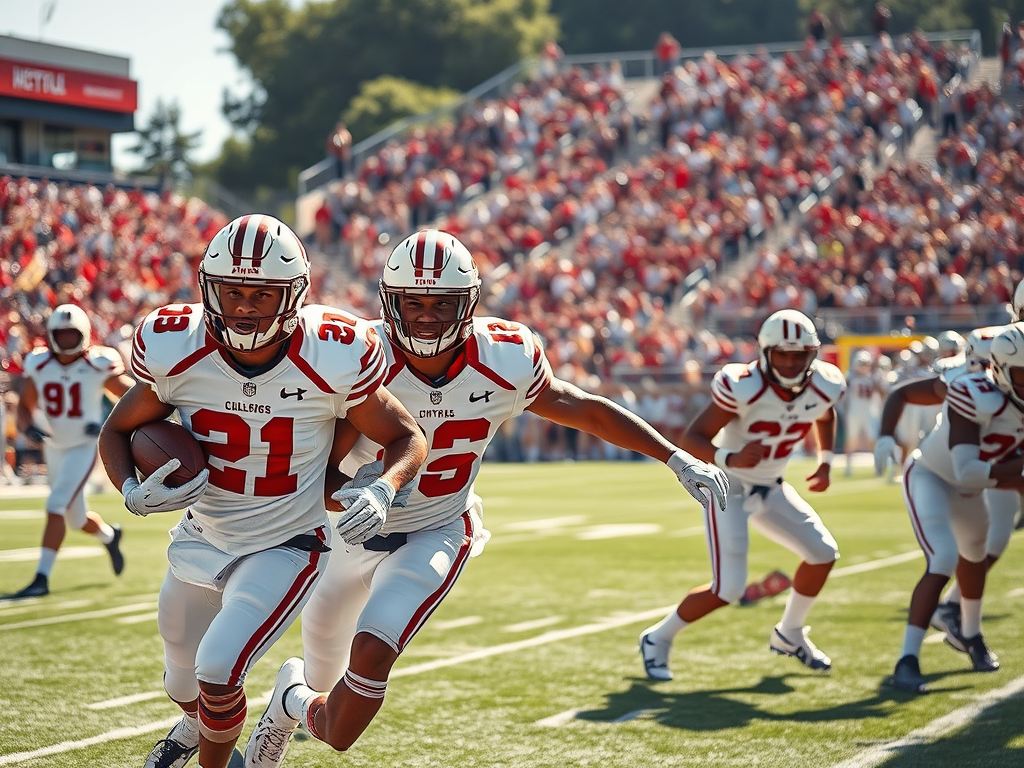

Ivy League Agrees to Let Football Teams Compete in the Postseason Next Year

Among the thousands of college athletes vying for an N.C.A.A. championship, one group has historically been excluded: Ivy League football players.https://wordpress.com/
Since its founding in 1954, the Ivy League has prioritized academics over athletics, resulting in football seasons that end before Thanksgiving, with no participation in bowl games or playoffs.
However, that will change next year. On Wednesday, Ivy League presidents announced that the league’s teams will be allowed to compete in the Football Championship Subdivision’s 24-team playoff, previously reserved for schools classified by the N.C.A.A. as Division I-AA. This makes the Ivy League the last major football conference to adopt such a policy.
“I believe this change is long overdue,” said Dartmouth College President Sian Beilock. “It’s striking that football was the only sport without access to a postseason.”
The decision was welcomed by Ivy League coaches and players, who have long been disappointed by their exclusion from playoff contention. For many, the opportunity to compete in the postseason is a significant step forward.
“That’s what competition is all about,” said Bob Surace, Princeton’s head football coach. “There’s a score, and someone wins, someone loses, and you find out who the better team is.”
Efforts to change the policy had previously been met with little explanation, other than the need for strong evidence to break from tradition. As the risks of football-related brain injuries grew more apparent, it became harder to justify the exclusion from postseason play.
Harvard coach Andrew Aurich, a former Princeton player, reflected, “Not being able to play in the playoffs was simply part of the Ivy League experience. It was surreal. I don’t think anyone thought this day would come.”
The Ivy League has been at the forefront of efforts to reduce the dangers of football. In 2016, it followed Dartmouth coach Buddy Teevens’ lead by banning tackling during practice, a move later adopted by many other colleges and even the N.F.L. The league also advanced kickoffs to the 40-yard line to reduce high-speed collisions and injuries.
Despite its focus on safety, the Ivy League reconsidered its stance on postseason participation after hearing from student-athletes. Yale receiver Mason Shipp, Brown softball player Leah Carey, and Cornell lacrosse player Chloe Maister collaborated on a proposal, which they presented to the league’s presidents this year. With support from Robin Harris, the Ivy League’s executive director, and the Ivy League Student-Athlete Advisory Committee, they made their case for change.
This marked the first formal proposal on the issue, giving presidents the time to consider its implications. “The reason it was significant is that it came directly from us,” said Shipp. “They value our input. It wasn’t just one voice—it was a football player, a softball player, and a lacrosse player.”
Shipp and others felt that the timing was right. Over the past year, several Ivy League presidents, including those from Harvard, Columbia, Cornell, and the University of Pennsylvania, resigned amid criticism of their handling of campus protests regarding the Gaza conflict. Many critics accused them of not listening to the voices of their communities.
“We were aware that the dynamic in the room was different, which could lead to a different outcome,” Shipp said.
The broader context also played a role. As college athletics has increasingly become a more commercialized enterprise, Ivy League institutions have been forced to reassess their approach. Men’s basketball players, once expected to stay within the Ivy system, have started transferring for larger paydays at schools outside the Ivy League. In March, Dartmouth’s men’s basketball team voted to unionize, a decision contested by the school.
“The reason for change is that everything around us is changing,” said Dartmouth quarterback Jackson Proctor, a member of the Ivy League’s student-athlete advisory committee. “Leaders are realizing it’s time to adjust to the changing world.”
But the scope of change remains uncertain. Ivy League football, for example, remains unique in its approach. Players often return to campus later than their peers at non-Ivy institutions, as they finish internships before beginning their training. This year, Ivy teams began their season in late September, well after schools like Georgia Tech and Florida State.
While Ivy League football will likely never compete at the same level as powerhouse programs like Georgia or Notre Dame, some coaches hope that the chance for postseason play will attract better recruits. They hope to replicate the success of Ivy League men’s basketball, where teams like Princeton and Yale made deep runs in the NCAA tournament.
Each Ivy League school had a player in the N.F.L. this season, and the league has had representation on Super Bowl-winning teams in 10 of the last 12 seasons.
Yale head coach Tony Reno heard the postseason news while recruiting at a high school. After checking his phone, he found 50 text messages, including three from players on past Ivy League championship teams that could have fared well in the playoffs. One text was from a player on the 2017 Ivy League champions, which included four future N.F.L. players.
Soon after hearing the news, Reno met with a potential recruit for next season. The player greeted him with an intriguing question: “Coach, playoffs?”



Leave a Reply