
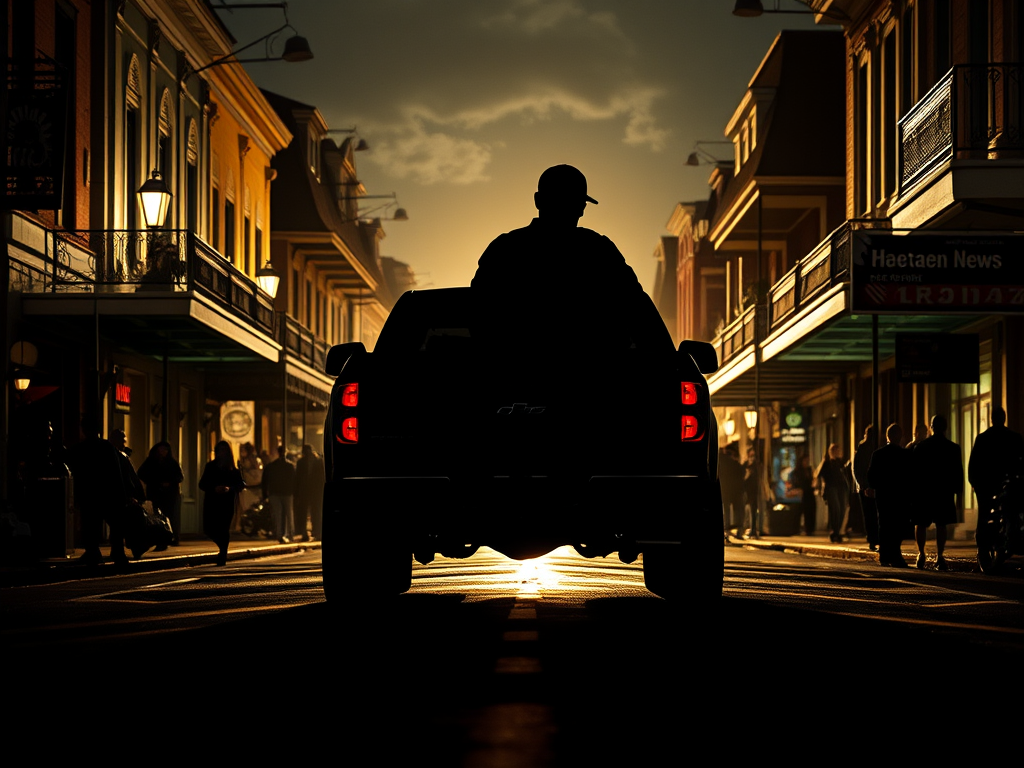

Could Better Security Have Stopped the New Orleans Terror Attack?

Five years before a man in a pickup truck targeted dozens of New Year’s revelers in New Orleans, a confidential security report had already raised alarms about the vulnerability of the iconic Bourbon Street to a “vehicular ramming” attack.https://wordpress.com/
The report, drafted by a security firm in November 2019 for the organization overseeing the French Quarter, highlighted that the bollards intended to prevent vehicle access to Bourbon Street were “ineffective.” The firm recommended immediate upgrades to the barriers and warned that “vehicular ramming and active shooting” were the most likely forms of terror attacks in the area.
The devastating attack early Wednesday morning, which resulted in 14 fatalities and numerous injuries, has forced New Orleans officials to reassess whether they did enough to safeguard one of the nation’s most famous tourist destinations from the threat that had been predicted years ago.
Authorities have pointed out that work to replace the outdated barriers began in November, in preparation for next month’s Super Bowl, and that the installation was still in progress at the time of the attack.
Officials also noted that they could not have anticipated the attacker’s decision to drive up onto the Bourbon Street sidewalk, evading a police cruiser parked as a precautionary measure.
“This was not something we expected to account for,” said Capt. LeJon Roberts, head of the French Quarter police district, during a news briefing after the incident.
However, some security experts argue that New Orleans left Bourbon Street exposed to a potential attack. They pointed to cities like New York and Chicago, where different security measures have been implemented to ensure the safety of crowded areas.
“This should come as no surprise to anyone familiar with protecting pedestrian-heavy zones,” said Don Aviv, CEO of the security firm Interfor International, which conducted the 2019 report. “The French Quarter is an ideal target.”
Following a deadly terrorist truck attack in Nice, France, in 2016, New Orleans installed metal barriers along Bourbon Street in 2017 to prevent vehicles from crashing into pedestrians or buildings. Yet, these bollards were soon rendered ineffective after being clogged with Mardi Gras beads, according to Rafael Goyeneche, head of the Metropolitan Crime Commission.

“Instead of fixing them, they simply ignored the problem,” Goyeneche stated.
After Interfor’s assessment, the French Quarter Management District published a public summary in August 2020, which primarily addressed concerns about crime and rowdiness in the area, with only a brief mention of terrorism risks. The details about malfunctioning bollards and the threat of vehicular ramming remained in the confidential section of the report.
In response to the findings, the district did enhance security, including increasing the police presence, according to Christian Pendleton, the former chair of the French Quarter Management District. Pendleton also noted that while the city was in the process of installing a new bollard system, it is unlikely that even completed barriers would have prevented the attack.
“Evil people do evil things,” Pendleton remarked.
By Thursday afternoon, Bourbon Street had reopened, with a visible but not heavy police presence. Police officers from both local and state departments stood at intersections leading to Bourbon Street, managing barricades and vehicles. Pedestrians strolled by, and a brass band played nearby.
Mary Pond, a bartender at Mango Mango Daiquiris, expressed surprise at the number of people out and about. “It’s like nothing even happened,” she said.

In contrast, nearby streets leading to the Superdome, where the Sugar Bowl was held, were lined with police cars blocking vehicle access.
Security experts agreed that it is impossible to protect every public event from a determined vehicle attack. In recent years, pedestrians have been killed in similar attacks at Christmas markets in Germany, a bike path in Manhattan, and a sports center in China, among others. The Islamic State has encouraged such vehicle attacks.
In response, cities have implemented creative strategies, such as placing dump trucks and fire engines around parades, protests, and public events, or using concrete barriers or water-filled plastic barriers for protection.
In Chicago, salt trucks block vehicles from certain areas, while large concrete flowerpots on the Magnificent Mile help prevent vehicle access while also beautifying the space. “We want it to be aesthetically pleasing,” said Daniel O’Shea, a former Chicago police official.
New York uses concrete blocks and police vehicles to guard streets during major events like the Thanksgiving Day Parade and New Year’s Eve, with sand trucks blocking major thoroughfares. The city has also installed permanent bollards along Times Square since 2018, following a $50 million initiative announced by former Mayor Bill DeBlasio.
Despite these efforts, security experts admit that defending against lone-wolf attacks is extremely difficult. “It’s very hard to prevent a lone wolf-style attack,” said Kenneth Corey, former chief of department at the New York Police Department.

Washington, D.C. has also taken steps, including the creation of a $25 million fund for cities to install bollards as part of the 2021 bipartisan infrastructure law. However, the fund has not been distributed, according to Jake Parker, senior director for government relations at the Security Industry Association.
Following a deadly vehicle attack at a Christmas parade in Waukesha, Wisconsin, in 2021, the city invested in bollards but faced high costs. The city also revised its parade logistics to minimize risks.
Despite the challenges, many believe that communities are not willing to give up on large public gatherings. “People want to be part of their community and enjoy events,” said Waukesha Mayor Shawn N. Reilly. “We’d be in a bad place if we stopped having public gatherings.”
The recent attack in New Orleans, however, has shaken public safety officials across the country, prompting them to reconsider whether their current measures are sufficient to stop determined attackers using vehicles.
“Every community,” Mayor Reilly said, “is going to be re-examining what they do now.”




Leave a Reply