
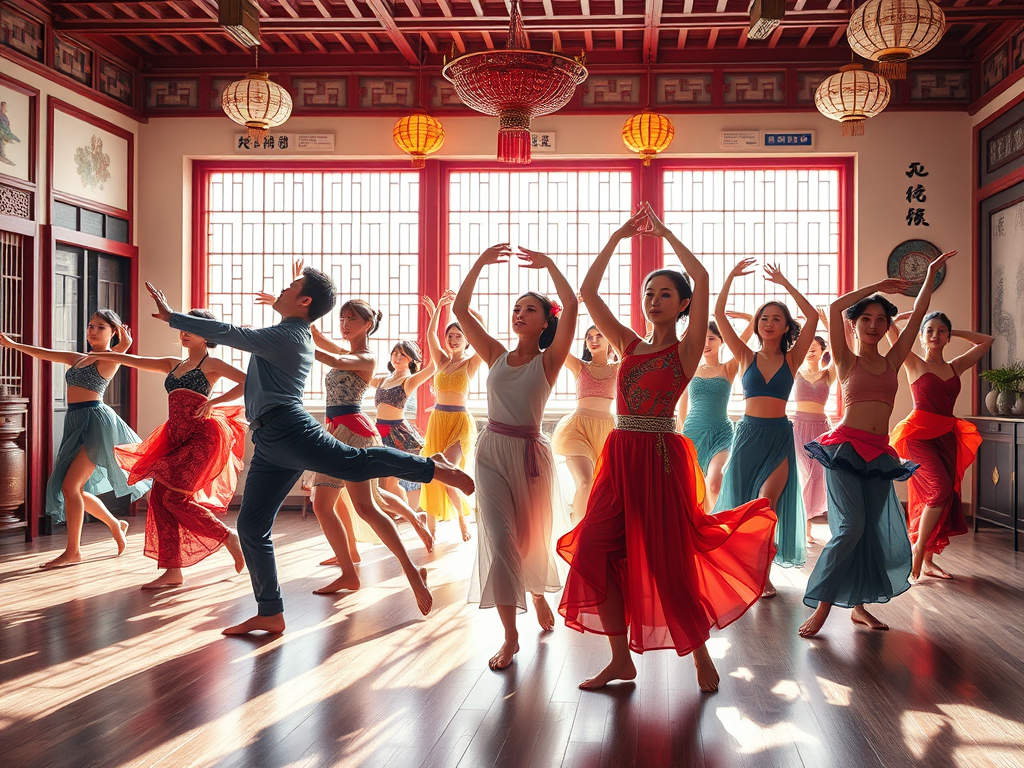

Bringing Modern Dance, Once Forbidden, to China

“Why do they fall down?”
This question was posed by Yang Meiqi, a Chinese dance educator, as she watched a modern dance class in Durham, North Carolina, in 1986.
She asked Charles Reinhart, the long-time director of the American Dance Festival, the event she was attending. His response was simple: “Why not?”https://wordpress.com/
A few days later, Yang had another question: could Reinhart help her establish a modern dance training program in China? Reinhart agreed to assist.
With support from organizations such as the Asian Cultural Council, the Rockefeller Foundation, and the U.S. State Department, Reinhart sent American dance instructors to the Guangdong Dance Academy, where Yang served as principal. After four years, this program gave rise to the Guangdong Modern Dance Company, often mistakenly referred to as the first modern dance troupe in China. From this pioneering effort, many influential figures emerged, including choreographer Shen Wei.
Reinhart, now 94, has shared this story many times. However, he recently added a poignant postscript. Later that same summer of 1986, while Yang and Reinhart were watching an avant-garde performance by the duo Eiko and Koma, Yang leaned over to ask him, “Why do they…?” before pausing to answer her own question: “Why not?” She was already learning.
Reinhart shared this extra anecdote during an interview for Planting Seeds: ADF and Modern Dance in China, an oral history project the festival launched online in November. In video interviews available in both Chinese and English, with bilingual captions, 16 people involved in Yang’s initiative reflect on its history and ongoing influence. Even well-known aspects of the story, like its inception, are given new depth and detail.
Emily Wilcox, a professor of Chinese studies at the College of William & Mary who conducted the interviews, was careful to challenge the notion that modern dance didn’t exist in China before the American Dance Festival’s involvement. In the 1930s, Wu Xiaobang studied German modern dance in Japan and introduced it to China by founding the Sky Horse Dance Art Studio. In the 1950s, Guo Mingda studied modern dance in the United States, learning from choreographers like Martha Graham, José Limón, and Alwin Nikolais, and attempted to introduce it in China.
“But ultimately, modern dance was too connected to American capitalist bourgeois culture,” Wilcox explained. Ballet, supported by the Soviet Union, was favored instead. After the Cultural Revolution of the 1960s, modern dance was nearly eradicated.
This began to change in the 1980s, during China’s “reform and opening up” period. As early as 1980, American modern dance representatives, including Reinhart, began visiting China. In 1986, Chiang Ching, a dancer and actress who had settled in the United States, returned to China to judge a competition. One of her fellow judges was Yang. Chiang arranged for Yang and three choreographers to attend the American Dance Festival’s International Choreographers Workshop in Durham on scholarship.
During this 1986 trip, Yang also visited New York City and explored its dance scene, most notably the Graham school. In her Planting Seeds interview, Yang shares the surprising detail that her interpreters during this trip were composer Tan Dun and artist Ai Weiwei. Learning how “backward” China was moved her to tears, and she saw modern dance as a path to “achieve freedom.”
The goal, as both Reinhart and Yang envisioned it, was not to import American modern dance, but to use it as a catalyst to develop a Chinese version of the art form. Some Americans were skeptical that a dance style focused on individual expression could thrive in a collectivist society. Yang, however, described the outcome as “something unimaginable.”
Planting Seeds reveals the immense determination required to bring this vision to life. Yang had to navigate layers of bureaucracy, securing approval from provincial councils and propaganda departments while contending with shifting political landscapes. She relentlessly pursued Ralph Samuelson, then associate director of the Asian Cultural Council, until he agreed to fund her project. Ou Jianping, a leading Chinese scholar of modern dance, recalls in his interview that Yang was so committed to her vision that she told him she would die if she couldn’t have her company.
Yang sought out the best dancers, many of whom came from military-affiliated troupes. Some had to audition in secret. To join the Guangdong Modern Dance Experimental Program, these dancers had to leave stable careers and high salaries. American teachers visited for three-month stints, offering classes six days a week, while students worked late into the night creating their own choreographies.
After three years, the students graduated. Following a year-long internship, the Guangdong Modern Dance Company was officially founded. In 1991, the company made its American debut at the Durham festival, with ongoing support from the festival through the 1990s. Touring internationally, the company performed works by its own dancers and by Willy Tsao, a Hong Kong choreographer who served as artistic director and subsidized dancer salaries using his family’s wealth. Despite Chinese policies forcing Yang to retire at age 55 in 2000, the company continued to thrive.

Shen Wei, a founding member of the company and its most internationally recognized figure, joined the training program in its second year. Yang made an exception for him because his paintings impressed her as modern. He was drawn to the program, he explained, because Chinese opera had lost its audience due to the sudden rise of pop music. He quickly began choreographing his own works, with his 1999 piece Folding becoming the company’s first international success.
In 1995, Shen received a scholarship to study in New York at the Nikolais/Louis Dance Lab. Reinhart, upon learning that Shen was in the U.S., invited him to create a piece for the American Dance Festival. This led to more commissions, critical acclaim, and the eventual founding of his own company in New York in 2001. Shen’s global recognition was further cemented by a MacArthur Fellowship in 2007 and his role choreographing the opening ceremony for the 2008 Beijing Olympics.
In China, however, Jin Xing became a more prominent figure. In her Planting Seeds interview, Jin recalls how the Guangdong program opened her mind, transforming her from a puppet into a thinking individual. As part of the program, the American Dance Festival brought Chinese students to the U.S. on one-year fellowships. Jin was the third and final student in this program; she chose not to return to China. “I wanted to go to the U.S.,” she said, “and modern dance was the means.”
Upon her return, Jin made waves by becoming the first openly public figure in China to undergo gender confirmation surgery in 1995. She began conducting modern dance workshops for performers and choreographers. In 1996, she helped establish the Beijing Modern Dance Company and, three years later, founded Jin Xing Dance Theater, China’s first private dance troupe.
To fund her company and an international dance festival in Shanghai, Jin mortgaged her house and capitalized on her public persona by becoming a popular talk-show host. More recently, she has found success selling products on TikTok, ensuring the continued survival of her company.
Beyond Jin and Shen, Wilcox credits the Guangdong program with creating a network of influential figures central to modern dance in China. “So many people trace their lineage to it,” she said.
Wang Mei, a member of the first graduating class, went on to develop a modern dance program at China’s premier dance school, the Beijing Dance Academy. Hou Ying, another former member of the Guangdong troupe, became an early dancer in Shen’s company and later founded her own company in 2008.

After her forced retirement, Yang started another dance program in Guangzhou. She trained choreographer Tao Ye, who went on to form the Tao Dance Theater in 2008 and became internationally successful, second only to Shen Wei.
The legacy of Yang’s initiative is still thriving today. Shen Wei described the Guangdong company as “still the best in China for modern dance.” For his recent projects in China, he has hired members of the troupe.
While modern dance in China remains, in Wilcox’s words, “still niche,” it is gaining traction. In 2019 and 2020, Shen served as a judge on Dance Smash, a popular Chinese TV dance competition. Modern dancers have become celebrities with millions of followers, akin to pop stars, selling tickets and filling opera houses.
The Planting Seeds project aims to further these developments by raising awareness of the movement’s rich history in China. Jodee Nimerichter, current director of the American Dance Festival, noted that one of the project’s goals is to highlight the achievements of the past to nurture modern dance’s future in China.
Another goal, she added, was to capture the memories of those who were part of the movement while they are still able to share them. Yang is now 79, and Sarah Stackhouse, the first American teacher sent to Guangzhou, gave her interview in 2022 before passing away in January 2024.
For Reinhart, both the original project and the new one have brought immense joy. “It’s a little flame of hope,” he said. “It gives us a sense of connection across cultures, and boy, do we need those now.””

Leave a Reply