
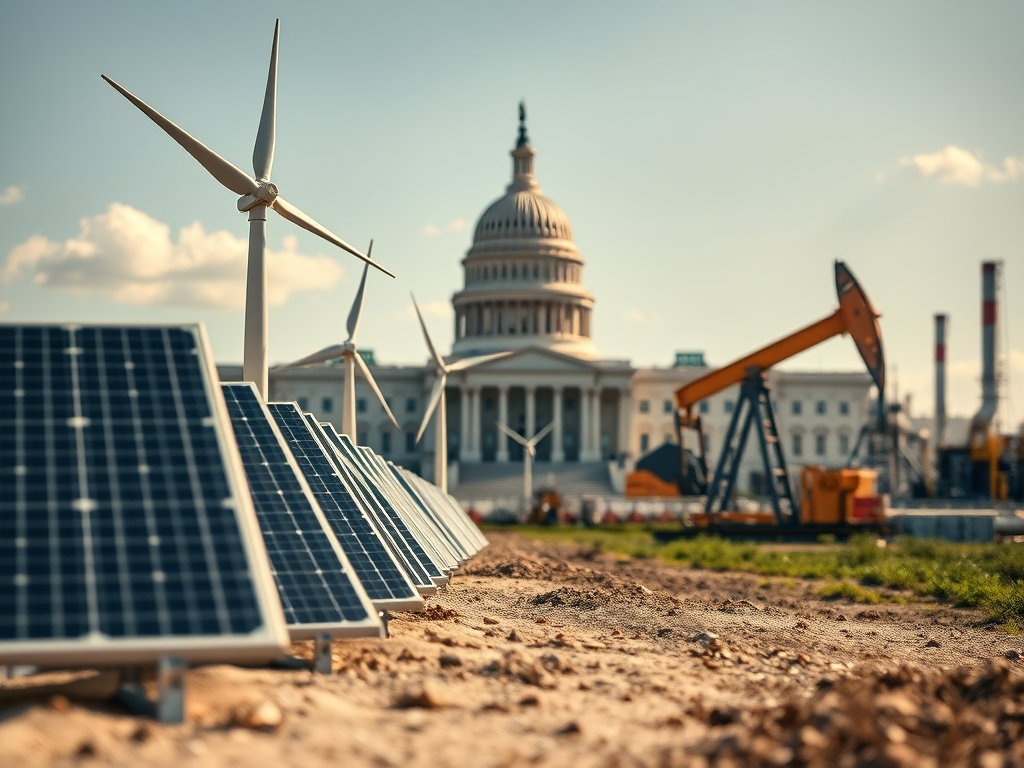

Will Trump Cut Short the Biden Clean-Energy Boom? Investors Are Nervous.

Money plays a central role in politics, but the results of elections also influence where that money flows. Last month’s election, in particular, had significant implications for the energy sector.
Clean energy investments—spanning renewable energy, electric vehicle production, battery manufacturing, and solar panel production—have surged following the passage of the 2022 Inflation Reduction Act, which was strongly supported by President Biden. According to Rhodium Group, an energy-focused research firm, and M.I.T., clean energy investments reached an all-time high of $71 billion in the third quarter of 2024.https://wordpress.com/
The big question now is whether President-elect Donald Trump, who has referred to Biden’s policies as the “green new scam” during his campaign, will scale back subsidies and regulations enough to significantly alter the financial dynamics of decarbonization investments.
Initial market reactions after the election seemed to point in a clear direction. Clean energy stocks dropped, while oil company stocks rose, suggesting a divergence in how the two sectors might perform in the coming years.
One of Trump’s top priorities for the next year is extending his 2017 tax cuts, likely requiring cuts in other areas. Clean energy tax credits—estimated to be worth around $350 billion over the next three years according to the Congressional Joint Committee on Taxation—could become a prime target for reductions. Cutting these subsidies would make some clean energy projects financially unviable.

Renewable energy advocates have found some hope in the fact that funding linked to the 2022 law has disproportionately flowed to Republican-led states, which might protect these projects from being cut. Additionally, the growing demand for energy—driven by electric vehicles, heat pumps, new manufacturing plants, and artificial intelligence—has bolstered the argument for a broad, diversified energy strategy. Solar power, in particular, has become one of the cheapest energy sources available.
“Renewable energy enjoys a certain level of bipartisan support,” said Nils Rode, Chief Investment Officer at Schroders Capital, a Swiss firm managing $97 billion, including wind farms in the U.S. “Even with potential risks, we don’t foresee drastic changes.”
However, subsidies are not the only policies that could influence where investment dollars go. Trump and his team have signaled their intent to ease the regulatory path for fossil fuel projects, making them more appealing to investors.

His nominee for Secretary of the Interior, Doug Burgum, has promised to open more federal lands for oil and gas drilling. Chris Wright, CEO of a fracking company and Trump’s choice for Energy Secretary, may redirect the department’s research agenda and funding away from low-carbon energy. At the EPA, Trump’s nominee, Lee Zeldin, has discussed rolling back power plant emission regulations, which could reduce incentives for utilities to shift to cleaner energy sources.
These changes would make fossil fuel investments more profitable relative to renewables.
“The core issue is economics,” explained Ben King, Associate Director of Climate and Energy at Rhodium Group. “Currently, wind, solar, and batteries are competing against natural gas on the margins. A slowdown in deploying these technologies would create more room for gas on the grid.”

Additionally, Trump’s promise to impose new tariffs on foreign goods could raise the cost of components used in building solar farms, wind turbines, car batteries, and long-duration energy storage systems. A reduction in the corporate tax rate might also weaken the renewable energy tax credit market, which developers use to access subsidies under the Inflation Reduction Act.
These potential policy shifts have led some banks and investors to delay new renewable energy projects until the political climate becomes clearer. Financial institutions are also making sure new contracts include clauses that protect them from any changes that might lower their returns.
“They won’t invest unless the economics are clear, or unless the deal is structured to account for the worst-case scenario,” said Keith Martin, a lawyer at Norton Rose Fulbright, who handles complex financing for renewable energy projects.

Some of Trump’s proposals could have unexpected consequences. For example, promoting the export of natural gas could raise domestic prices, reducing the attractiveness of building new U.S. gas-fired power plants, according to Bloomberg New Energy Finance. Expedited permitting for new electricity transmission lines could benefit some renewable energy projects, and mining for materials used in battery production might become easier.
Furthermore, the repeal of some of Biden’s climate regulations might not have as large an impact as expected. For instance, the SEC’s rule requiring companies to disclose carbon emissions is currently tied up in the courts, and the new administration could simply drop it. However, many companies already comply with similar European Union regulations, and the EU is implementing a carbon border adjustment mechanism, effectively imposing a tariff on carbon-intensive goods.
“They won’t be able to ignore it if they want to do business in Europe,” said Jason Britton, president of Reflection Asset Management, a firm specializing in socially responsible investing.
Europe also competes with the U.S. for companies seeking the most favorable conditions to scale up operations, offering incentives such as research assistance.
Dan Goldman, managing partner at Clean Energy Ventures, an early-stage venture capital firm, warned that if U.S. federal funding dries up, companies may look elsewhere.
“We want our companies to go global,” Goldman said. “That was true before the election, and now it’s even more critical to speed up those plans.”

One thing seems certain: financial firms are likely to stop emphasizing “climate” or “sustainability” in their investments. This shift has already been underway as Republican state officials have targeted asset managers like BlackRock for their climate commitments.
Instead, terms like “transition finance,” “resilience,” and “critical technology” are gaining prominence. The argument for supporting low-carbon energy will increasingly focus on “energy security” and staying ahead of Chinese companies.
Banks and asset managers have been stepping away from international coalitions aimed at divesting from fossil fuels and funding decarbonization. But some experts believe these alliances may not have had a significant impact in the first place.
“They’ve been sending mixed signals for the past five years—claiming to be partners in the energy transition, yet simultaneously saying they’re agnostic,” said Lisa Sachs, Director of the Columbia Center on Sustainable Investment. “They’ve created the impression that something important was happening when, in reality, it wasn’t.”
Ultimately, macroeconomic factors may have a greater influence than policy changes. Oil and gas companies won’t increase production unless global prices justify it. Even under the previous Trump administration, renewable energy investments grew, largely because low interest rates allowed investors to profit without heavy subsidies.
That’s why the recent news that the Federal Reserve may not cut interest rates as much as previously expected in 2025 is concerning for the sector. Higher capital costs would make construction more expensive, and a full repeal of the energy law would significantly dampen the outlook for clean energy investments.
“That’s a tough scenario,” said Quinn Pasloske, Principal at Greenbacker, a fund manager focused on clean energy. “If one of those three factors doesn’t fall into place, the fundamentals are still there, and things should be fine.”




Leave a Reply