

It Can Be Lonely to Have a Middle-of-the Road Opinion on the Middle East

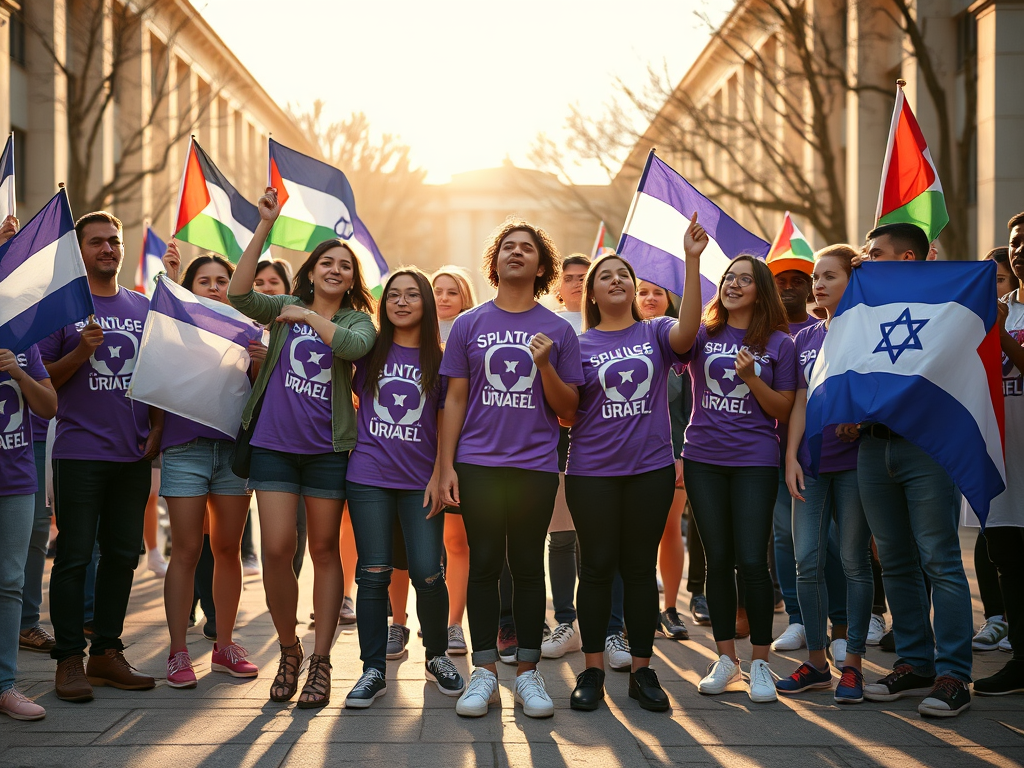
Since the start of the Israel-Hamas conflict, scenes like these have become common on American college campuses: students holding Palestinian flags clash with those waving Israeli flags, their chants provoking anger on both sides.https://wordpress.com/
Amid the commotion, however, there is sometimes a quieter group standing between the two.
Last spring at the University of California, Los Angeles, Mikey Aboutboul, an Israeli-born senior, joined about 30 others to position themselves in the middle of opposing protests. They began chanting messages challenging both sides, wearing purple T-shirts to make their stance distinct.
“Palestinians and Jews, war and killing we refuse,” they chanted, inspired by a grassroots Israeli peace movement. “In Gaza and Tel Aviv, all the children want to live.”

Their presence caught the attention of onlookers, with some participants from both sides eventually joining in, Aboutboul recalled. “That was an amazing moment,” he said. “These messages resonate because they are human.”
Aboutboul is a founding member of Students for Standing Together, a new UCLA group uniting Israelis and Palestinians in calling for a cease-fire in Gaza. Their long-term goal is a peaceful, fair resolution to the conflict.
This group reflects a broader movement of students and faculty nationwide advocating for coexistence, occupying the nuanced middle ground between the extremes. Although modest in number, their efforts are gaining traction despite the challenges of taking a balanced stance during a time of intense polarization.
Both Jewish and Palestinian advocates face significant pressure to unequivocally support their communities in the conflict. For left-wing progressive Jews, this can mean navigating partisan divides—criticizing the Israeli government while affirming a belief in a Jewish state. Palestinians calling for empathy on both sides struggle with chants promoting zero-sum narratives.

Zahra Sakkejha, a Palestinian-Canadian UCLA alumna, shared her perspective. Her 18-year-old cousin, born to a Palestinian father and Israeli Jewish mother, was kidnapped by Palestinian militants in 2023 but later released. This personal connection underscored the intertwined fates of both communities for her. “I support a free Palestinian state, but I also want a peaceful path forward,” she said.
At Columbia University, Israeli-American student Aharon Dardik formed CU Jews for Ceasefire, bringing together over 100 members with diverse viewpoints. Despite opposition from both pro-Israel and pro-Palestinian camps, Dardik remains focused on valuing all human lives equally. “Our care for life doesn’t align with areas that prioritize one side exclusively,” he noted.
Similarly, George Washington University junior Celia Little restarted J Street U’s campus chapter to create a space for Jewish students devastated by the war to discuss and learn without hostility. “It’s tough to be a progressive in Jewish spaces and pro-Israel in progressive spaces,” she explained. “I want to foster a space where nuance is valued.”
Some students have become more entrenched in extreme views as the conflict continues. However, efforts to encourage balanced perspectives persist, exemplified by professors like Sa’ed Atshan of Swarthmore College. Raised as a Quaker pacifist in the West Bank, Atshan challenges expectations, fostering complex discussions in his classes.
At UCLA, Professor Dov Waxman, who will step down as director of the Nazarian Center for Israel Studies, also sought to create an inclusive space for understanding Israel. Despite his efforts, he faced backlash from both sides, reflecting the difficulty of maintaining a neutral stance.
“It can feel isolating,” Waxman admitted, adding, “As someone dedicated to understanding Israel, I never anticipated how much this would affect me.”
These stories highlight the challenges and resilience of those striving to bridge divides and promote dialogue in the midst of conflict.


Leave a Reply