
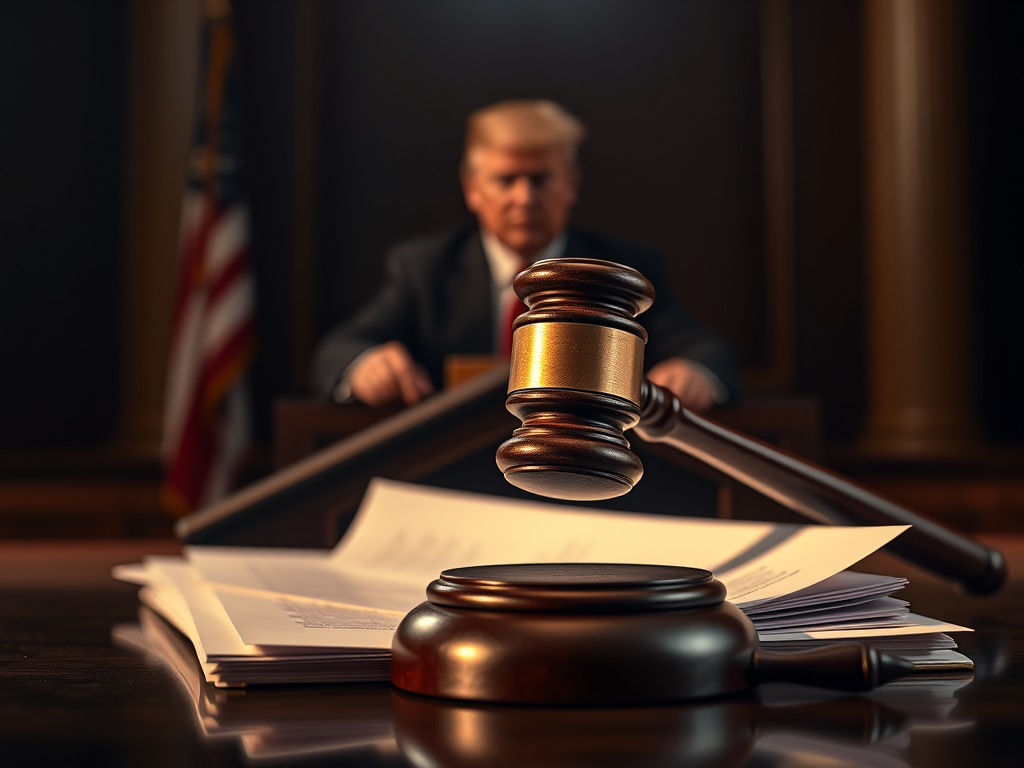

Judge Denies Trump’s Bid to Throw Out Conviction Over Immunity Ruling

On Monday, a judge dismissed former President Donald J. Trump’s claim that a recent Supreme Court ruling had rendered his criminal case in New York invalid. The judge upheld his felony conviction for falsifying records to cover up a sex scandal.https://wordpress.com/
This ruling ensures that, for now, Mr. Trump’s criminal conviction remains intact. If the decision withstands an appeal, Mr. Trump could become the first convicted felon to ever serve as president.
The ruling came in response to the Supreme Court’s decision granting presidents broad immunity for their official acts. It blocked the first of several legal strategies Mr. Trump had used to try to erase his 34 felony charges before making another bid for the presidency.
Prosecutors contended that the Supreme Court’s ruling had no impact on the case, emphasizing that Mr. Trump was convicted for a scheme involving personal and political issues that occurred before he became president.
However, Mr. Trump’s defense team focused on a controversial segment of the Supreme Court’s decision, which restricted prosecutors from using evidence related to a president’s official duties in cases involving private misconduct. They argued that testimony from former White House staff had tainted the verdict.
In the first major interpretation of that ruling, New York judge Juan M. Merchan sided with the prosecution. He concluded that the testimony in question pertained to Mr. Trump’s private actions, not his official duties.
“The use of these acts as evidence of personal actions related to falsifying business records does not intrude upon the authority or functions of the executive branch,” Judge Merchan wrote in a 41-page ruling.
Even if the evidence had been admitted incorrectly, the judge added, any mistake was harmless due to the “overwhelming evidence of guilt” presented during the trial.
A spokesperson for Mr. Trump, Steven Cheung, criticized the decision, calling it “a direct violation of the Supreme Court’s decision on immunity.”
“This lawless case should have never been brought, and the Constitution demands that it be immediately dismissed,” Cheung said.
A spokeswoman for the district attorney, Alvin L. Bragg, declined to comment.
While Justice Merchan’s ruling is significant, it is not final, and Mr. Trump can appeal. Even if the decision stands in New York’s appellate courts, he could take the matter to the Supreme Court, a body with a 6-3 conservative majority, which includes three justices Mr. Trump appointed during his first term.
Immunity is not the only avenue Mr. Trump is pursuing to reverse his conviction. He has also sought to leverage his electoral victory to dismiss the case, citing a 1963 law promoting a smooth presidential transition and a longstanding Justice Department policy that shields sitting presidents from federal prosecution.
Although the New York case was initiated by state prosecutors and has already resulted in a conviction, Mr. Trump’s legal team argues that continuing the case would create “unconstitutional impediments” to his ability to govern.
Prosecutors in Manhattan, however, oppose any efforts to overturn the jury’s verdict, arguing that such a move would be an “extreme remedy.” They have suggested an alternative solution: pausing the case for four years while Mr. Trump holds office, effectively delaying his sentencing.
“This type of time-limited accommodation is far more appropriate than the sweeping relief that defendant requests here,” prosecutors wrote, stressing that such a measure would prevent rendering the jury’s verdict a nullity and hold Mr. Trump accountable for the crimes the jury found him guilty of beyond a reasonable doubt.
Judge Merchan has already delayed sentencing several times, and could rule soon on Mr. Trump’s request to dismiss the case due to election-related issues. Mr. Trump faces up to four years in prison, but legal experts suggest that any actual jail time would likely be only a few weeks or months.
Mr. Trump cannot be incarcerated while serving as president, and Judge Merchan could choose to defer sentencing until after his term ends. Alternatively, he could uphold the conviction without imposing jail time or other penalties.
If Mr. Trump avoids any punishment in this case, it would represent a striking reversal from earlier this year, when he faced four indictments in different jurisdictions.
The special counsel overseeing two of those cases, one in Washington, D.C., and the other in Florida, recently closed both investigations, citing the Justice Department’s policy against prosecuting sitting presidents.
In Georgia, where a local prosecutor has accused Mr. Trump of attempting to interfere with the state’s 2020 election results, he has managed to delay the case indefinitely.
The Supreme Court’s immunity ruling stemmed from the special counsel’s case in Washington, where Mr. Trump is accused of attempting to overturn the results of the 2020 election. The 6-3 decision, made along partisan lines, granted former presidents “presumptive immunity” from prosecution for their official acts.
Almost immediately after the decision, Mr. Trump’s attorneys sought to link it to his Manhattan conviction, claiming it invalidated the case. Although the two cases seem unrelated at first glance, they share a connection.
In May, a jury in New York found Mr. Trump guilty of 34 counts of falsifying business records related to a scheme to silence adult film star Stormy Daniels, whose story threatened his 2016 presidential campaign.
To suppress the story, Mr. Trump’s former lawyer, Michael D. Cohen, arranged a $130,000 hush-money payment to Daniels. Mr. Trump eventually reimbursed Cohen, who testified that his former boss had orchestrated a scheme to falsify records and conceal the true nature of the reimbursement.
Mr. Trump’s legal team argued that, in light of the Supreme Court’s immunity ruling, prosecutors had improperly relied on evidence that involved “official communications” during his presidency, including tweets he posted while in office.
One key piece of testimony came from Hope Hicks, a former White House aide, who described a conversation she had with Mr. Trump after the hush-money story broke. Hicks testified that, following the Wall Street Journal’s reporting, she and Mr. Trump discussed how to respond.
However, prosecutors maintained that these discussions were entirely related to personal matters, not official presidential duties. They invoked the Supreme Court ruling to support their position, citing Justice Roberts’ statement that a president can speak “in an unofficial capacity,” a point Judge Merchan echoed in his ruling.
Even if Hicks’ testimony had crossed a line, prosecutors argued, there was so much other evidence presented that “any error was harmless” and the guilty verdict should stand. Judge Merchan agreed, highlighting a range of other evidence, including Cohen’s testimony and Mr. Trump’s own statements in books he authored.
The judge also pointed out that others had reached similar conclusions, citing a federal judge who had previously ruled that the evidence overwhelmingly suggested the case was about Mr. Trump’s personal actions, not his presidential duties.




Leave a Reply