
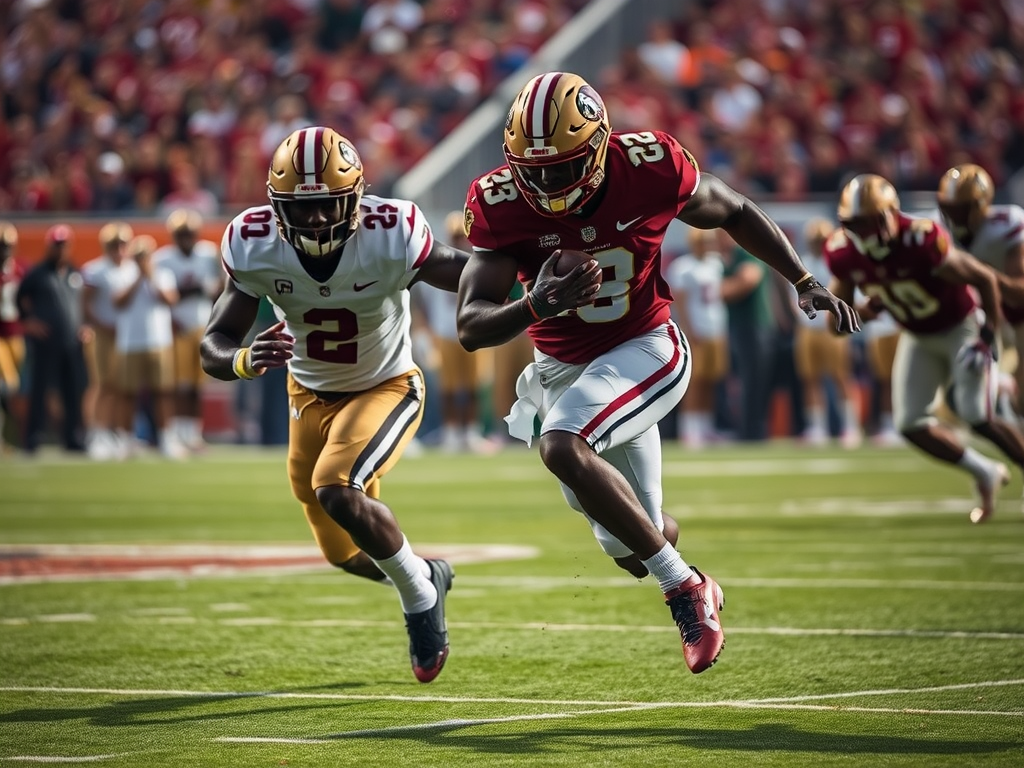

Even with just 40 minutes remaining in a season that seemed lost, Florida State still clung to a shred of hope. That hope flickered on Saturday when defensive tackle Darrell Jackson Jr. powered through a blocker and wrapped up Florida quarterback DJ Lagway inside the Gators’ 25-yard line. A sack by the Seminoles could have shifted the momentum in a 7-0 game.
Inside Florida State’s historic fall from 13-0 to its worst showing in 50 years

However, it ended up as a 10-second snapshot of Florida State’s worst season in five decades.https://wordpress.com/
A promising transfer couldn’t complete the play; Lagway managed to escape Jackson’s grasp. Another member of FSU’s $2 million defensive line, Patrick Payton, prematurely celebrated a sack that never happened. Linebacker Omar Graham Jr. was visibly frustrated, stomping his feet and clapping his hands after Lagway connected with a receiver for a first down. The rest of Mike Norvell’s Seminoles either didn’t react or couldn’t respond, and a competitive game slowly turned into their seventh double-digit loss of the year. As the final whistle blew, the stadium was filled with derision as visiting fans chanted “D-J LAG-WAY,” while Florida State staggered to another embarrassing three-touchdown defeat at the hands of their in-state rivals.
When Florida State’s 31-11 loss concluded, it marked the completion of one of the most dramatic collapses in college football history.
The Seminoles’ dramatic fall from a 13-1 season and the cusp of the College Football Playoff to a dismal 2-10 record represents the second-largest drop in wins in history. Only Southern Miss’s fall from 12-2 in 2011 to 0-12 the following year after a coaching change was worse. Florida State now shares a dubious distinction with Illinois in 1954, Notre Dame in 1956, and Maryland as the only teams to start a season ranked in the AP top 10 and fail to win at least three games.
FSU’s offense allowed the most sacks in the nation and ranked among the bottom six in scoring, rushing, and completion percentage. The defense forced the third-fewest turnovers, and the special teams ranked second-to-last in punt return average.
What makes this decline even more perplexing is the lack of an obvious, external cause. There’s no scandal to blame, no catastrophic injuries or bad luck to point to. The coaching staff that led the Seminoles to an ACC championship last year with a third-string quarterback is the same group that lost to Duke for the first time in the program’s history.
Instead, Florida State’s demise is the result of a combination of unresolved issues that built up gradually and then converged all at once, according to interviews with more than a dozen people familiar with the program. Most spoke on condition of anonymity to provide candid insights. Florida State did not make Coach Norvell available for comment, and he did not respond to multiple requests for interviews.
“Terrible” recruiting, a former staff member said, along with overconfidence in player evaluation. High-profile quarterback misses due to NIL bidding wars. A misplaced sense of loyalty and a failed recruiting battle. A perception that players had given up, or lacked leadership. These underlying problems had been easy to overlook as the Seminoles enjoyed a steady rise from Norvell’s rocky 3-6 start to a 19-game winning streak in 2022-2023.
“High tide covers up ugly rocks,” FSU athletic director Michael Alford told The Athletic, “and low tide exposes them.”
The high tide reached its peak one year ago, when Florida State defeated Louisville to win its first ACC title in nine years. But the low tide began less than 13 hours later, setting off a free fall that the program has yet to recover from.
The Beginning of the Fall: The Playoff Snub
The turning point of this historic collapse came with a historic snub.
Despite finishing the regular season 13-0 in a Power 5 conference, the College Football Playoff selection committee controversially placed the 12-1 Alabama Crimson Tide ahead of Florida State for the final playoff spot. The reason—Florida State’s star quarterback, Jordan Travis, had broken his leg in Game 11—was defensible, yet it struck a painful blow.
When the playoff bracket was revealed on ESPN, Coach Norvell froze for a moment. By the time he stood up to speak, many players had already walked out of the room.
“What happened had never, ever happened before in the history of college football, where you went undefeated at a big-name school and don’t make the Playoff,” a former staff member remarked. “They got the Playoff taken away, and haven’t recovered from that.”
That disappointment was evident at the Orange Bowl, where Norvell admitted that the team’s emotional fallout “definitely affected” them in a humiliating 63-3 loss to Georgia. In February, one of last season’s captains, Fabien Lovett, confessed that he didn’t think he’d ever fully recover from the snub. In April, during a hearing about FSU’s lawsuit against the ACC, the school’s legal counsel described the Seminoles as “what should have been the national champions.” Even in September, receiver Kentron Poitier said the snub was still something players occasionally discussed.
Florida State prides itself on being one of college football’s elite programs—three-time national champions with a rich history and a loyal fan base. It was a team built to bounce back from setbacks, not one to crumble after a single devastating blow.
With an established coaching staff and ample resources, including an NIL budget of around $12 million, Florida State should have been poised to recover. The program spent over $1 million boosting the salaries of its 10 assistant coaches, while Norvell was given a new eight-year contract, one of the highest-paying in the sport, to keep him from joining Alabama.
“If this is a tailspin that started at 40,000 feet,” said someone familiar with the program’s decision-making, “you’ve had numerous opportunities to recover from it.”tunities to recover from it.”




Leave a Reply