
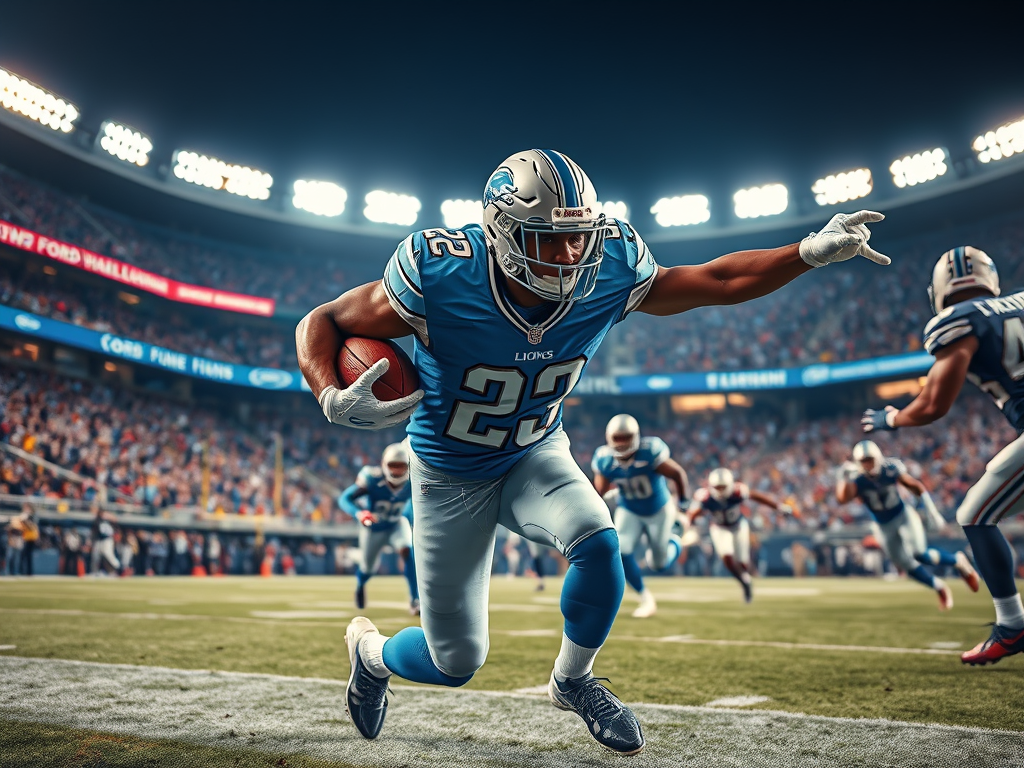

In one of the most unforgettable moments of his career, Penei Sewell stiff-armed Bears linebacker Jack Sanborn to the ground, an action that quickly went viral. He then shrugged off a tackle attempt by linebacker Tremaine Edmunds, only to be wrestled out of bounds by three defenders — one of the most impressive plays ever seen in NFL history.
The NFL’s best athlete was made in Samoa, but Penei Sewell is a perfect fit in the Motor City

That rugged, fearless style of play is something Sewell grew up with in Samoa. While many of his future Lions teammates honed their skills with cutting-edge virtual reality technology and expensive coaches, Penei and his brothers used a makeshift water bottle filled with sand and water as a football. On days when that wasn’t available, they’d improvise with coconuts.https://wordpress.com/
Their “fields” were made of sea foam. They played three-on-three or four-on-four, leaving marks in the sand and on each other’s bodies. Their games weren’t about finesse; they were about toughness. As Penei recalls, “It was more like rugby than actual football. We focused on hitting, not just skills.”
For a moment, it was as if Penei had returned to those roots during a game at Ford Field last week.
In the early 1990s, Tropical Cyclones Ofa and Val devastated American Samoa, including the village where Gabe Sewell, Penei’s father, lived with his family. Their house was torn apart, leaving only half of it standing. Gabe and the boys gathered the debris and used it to build a small 400-square-foot home on the property, which they called “The Shack.” Over time, they fortified and expanded it.
The Shack became the family home for Gabe, his wife Arlene, and their five children, including Penei, their third son. The house had no sink in the kitchen, so the boys would wash dishes in the shower. When it rained, they wouldn’t use the water because the roof leaked so badly. There was no air conditioning, washer, dryer, or vacuum cleaner. The family only had a few TV channels, and getting reception required slapping the back of the set.
The Shack had just one bedroom, which was used for storing clothes. The family slept in the living room, where a thick mattress was laid out. Sometimes, it wasn’t just the immediate family; cousins and other village children often joined them, and up to 11 people would sleep there.
Despite the hardships, Gabe says, “There was so much laughter, so much playing, so many chores… we didn’t think anything of it. We were always busy and enjoyed being together.”
They grew breadfruit (ulu) in their yard and used machetes to cut their grass. They fished with homemade hooks, ran up Matai Mountain, and slid down the slopes. Gabe’s father, a farmer, would prepare kalua pig for community gatherings, a simple but rich life full of love, as Arlene recalls.
Samoa, an American territory since 1900, was introduced to football in the 1960s, sparking a football culture that has produced more than 40 NFL players born on the islands. Some, like Hall of Famers Junior Seau and Troy Polamalu, became some of the NFL’s brightest stars. Today, the Polynesian Football Hall of Fame reports that over 60 NFL players are of Polynesian descent.
In 2011, Polamalu visited Samoa with other NFL players, including Ryan Clark, Deuce Lutui, Rey Maualuga, and Shaun Nua. Gabe’s coaching role at Marist High School allowed 11-year-old Penei to attend a football camp hosted by the pros. The experience left a lasting impression on Penei, especially meeting Polamalu, whose leadership and humility inspired him. Five players from that camp, including Penei and his brothers Nephi and Noah, now play in the NFL.

In 2012, Gabe and Arlene moved their family to Utah for better medical care and opportunities for their children. Penei, however, wanted to stay in Samoa, but his parents insisted on the move. It was a pivotal moment in Penei’s life, and six years later, he was one of the most sought-after linemen in the country. After 23 scholarship offers, he chose Oregon, where he immediately started at left tackle. As a sophomore, Penei became the first Polynesian to win the Outland Trophy, awarded to the best interior lineman in college football.
His journey took another significant step in 2020 when he played in the Rose Bowl. He was locked in a mental zone, but a voice called his name. It was Isabelle, a cheerleader he had known for a year. Their eyes met, and in that moment, everything felt right. After the game, Oregon beat Wisconsin, and Penei walked away with both the win and the girl. A few months later, he opted out of the next season due to COVID-19 and declared for the 2021 NFL Draft.
Sewell was the first draft pick for the Detroit Lions under Brad Holmes and Dan Campbell. Since moving to right tackle, he’s been considered one of the NFL’s best at his position. Quarterback Jared Goff has even called him “the best athlete in the NFL.” Coach Campbell, a former tight end, has joked that if he had another Sewell, he’d play him at tight end. Sewell’s versatility has made him a unique weapon in Detroit’s offense.

His work ethic and leadership have also earned him respect. Lions center Frank Ragnow believes Sewell is “one of one” in terms of what he brings as a tackle, and Campbell has said Sewell is the foundation of the team’s mentality. Some have even suggested Sewell should be in the conversation for Offensive Player of the Year, a title never before awarded to an offensive lineman.
At just 24, Sewell is already a two-time team captain. He’s taken on the role of delivering pregame speeches, speaking passionately and from the heart. His competitive spirit is matched by his caring nature off the field. Coach Campbell describes him as a “grizzly bear” on the field but a “good man with a good heart” in life.
After a Monday night victory over the Seahawks, Sewell’s mother, Arlene, found him still awake early in the morning, studying game tape. Arlene works as the chief information officer at Brigham Young University-Hawaii, and whenever she travels to watch her sons play, she brings a Ti leaf lei, symbolizing her love and prayers for their protection.

Penei’s tattoo tells the story of his heritage. Waves represent the power within, while a centipede reminds him of the significance of all living things. Birds symbolize spiritual guidance, and the word “Samoa” on his biceps is a constant reminder of where he comes from.
Like Polamalu before him, Sewell has become a role model for younger players, particularly those of Polynesian descent. He mentors his younger cousin, Kingsley Suamataia, a rookie offensive tackle for the Chiefs, and supports his Polynesian teammates, such as Gio Manu, Netane Muti, and Sione Vaki.
Penei and his siblings haven’t returned to Samoa since leaving, but they hope to one day. For now, Sewell’s focus is on his family and career. He recently signed a four-year, $112 million contract extension with the Lions, making him the highest-paid lineman in the NFL. He bought a new home, significantly larger than The Shack, and is now married to Isabelle. They have two children, Malaki and Mila, with another on the way.
Penei continues to carry the lessons of his childhood, taking his son to the park every day, singing the same song his parents sang to him before bed. “Fa’afetai I Le Atua” — a song of gratitude and love — echoes the values of his Samoan heritage, now passed down to the next generation.




Leave a Reply