
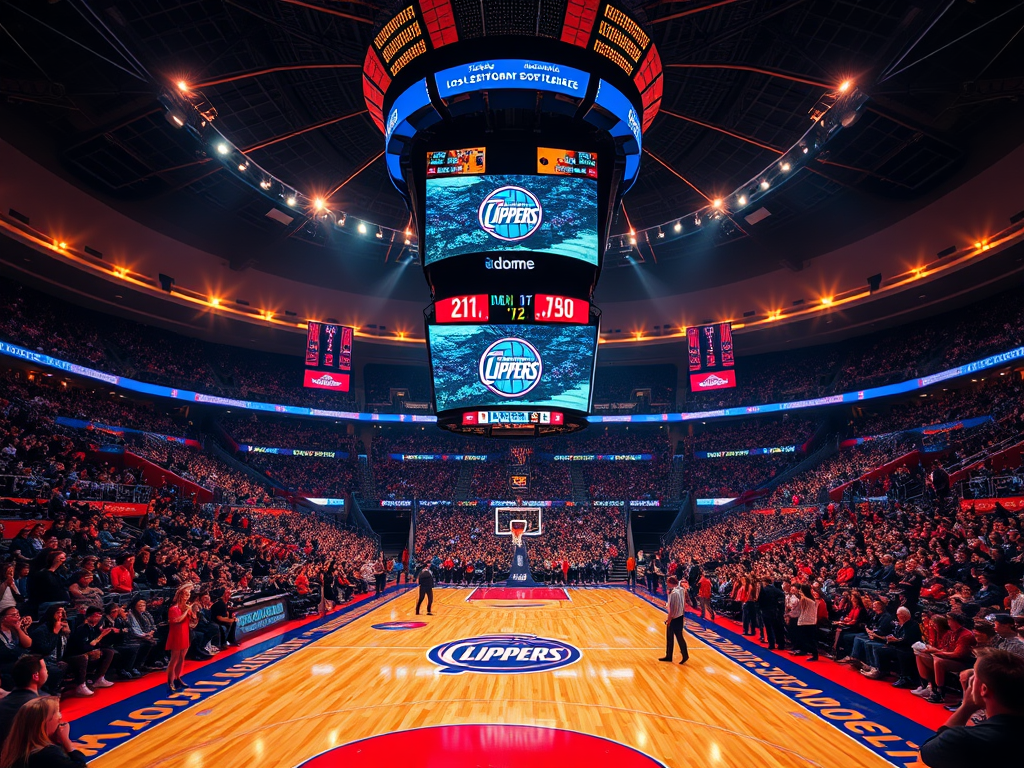

Los Angeles Clippers fans

Fans of the Los Angeles Clippers are being treated to an unforgettable experience this season, with the team’s new $2 billion home, the Intuit Dome, offering cutting-edge features. They can catch replays on the world’s largest double-sided scoreboard, enjoy exclusive seating in a 51-row section reserved for the most devoted fans, and shop for merchandise in a massive 5,000-square-foot team store.https://wordpress.com/
However, despite all these luxuries, it’s the court that’s drawing the most attention—a story in itself.


The journey of the court begins 2,200 miles away in Amasa, Michigan, a small mill town. There, Connor Sports, a leading manufacturer of hardwood basketball courts, spent nearly a year sourcing trees and building the court. This meticulous process involved numerous logs, hundreds of workers, and thousands of hours. At the company’s plant in Michigan’s Upper Peninsula, workers navigate a maze of conveyors, saws, and other machinery, drying, cutting, planing, and shaping strips of wood during long shifts that last six days a week.

Each year, Connor manufactures around 800 courts, mostly for high school gyms and recreational centers across the U.S. and beyond. The majority of these courts are made from northern hard maple, a strong, durable wood harvested from forests above the 35th parallel—an industry standard set by the Maple Flooring Manufacturers Association. The same company also crafts courts for the N.B.A. and many top college basketball programs. Each court consists of about 250 interlocking 4-by-7-foot panels, complete with shock-absorbing subfloors for added stability. These portable courts can be assembled and disassembled in a few hours, allowing arena operators to quickly convert the space for other events like concerts and hockey games.

Jason Gasperich, technical director at Connor Sports, shared, “This job has taken me all over the world, including a 30,000-square-foot installation in Azerbaijan. For some customers, if it’s good enough for the N.B.A., it’s good enough for them.”
Over the past decade, demand for hardwood courts has remained fairly steady. While the floors can last up to 40 years (sometimes even longer), schools are constantly being built, and damaged courts are replaced. Portable courts, however, have shorter lifespans due to greater wear and tear, with the N.B.A. requiring its courts to be replaced every 10 years.

The pandemic caused a temporary downturn, with school districts cutting budgets and construction projects stalling. However, demand is rebounding, though the total square footage of flooring shipped by the Maple Flooring Manufacturers Association, which includes Connor, dropped by 17.8% in 2023 compared to 2019. While supply chain issues have improved, contractors are still facing a flood of court installation orders.

The cost of a 60-by-120-foot N.B.A.-size portable court can reach up to $250,000, depending on the finish, while permanent installations are about half that price. While portable court sales make up a smaller portion of the market, they are growing steadily. Connor recently signed a five-year deal with the N.C.A.A. to provide courts for both the men’s and women’s basketball Regionals and Final Fours. The company also supplies about a quarter of the courts used by N.B.A. teams, with the remainder produced by Robbins Sports Surfaces.
As any basketball enthusiast knows, today’s college and professional courts are more visually striking than ever. Court designs are created by finishing companies that sand, paint, laminate, and seal the floors for Connor and other manufacturers. With sponsor logos and color schemes frequently changing, courts are repainted and rebranded. Many N.B.A. teams now have multiple game courts, plus practice courts, often customized to suit different designs. For example, the Brooklyn Nets have three courts: one with a classic look, one retro, and one featuring a modern City Edition design. Teams can further highlight sponsor logos by using removable vinyl decals or swapping out 200-pound panels on the court’s interior.

Zach Riberdy, marketing director at Connor, explained, “To the fan, it looks like a brand-new floor, but they just changed the center panels. About 85% of the court stays the same.”

Almost all of Connor’s hardwood comes from forests within 100 miles of Amasa. The company sources lumber from about 40 local sawmills, favoring wood from the center of logs, which is better suited for flooring. After the trees are felled, most of the wood is delivered green, dried outdoors, and then placed in kilns heated by waste wood from the factory. The drying process varies depending on the season.

Once dried, the wood is sent to Connor’s flooring mill. There, it is cut to a width of about 2.5 inches, planed to a consistent thickness of roughly an inch, and scanned for defects. Any strips with knots or imperfections are discarded or trimmed. The wood is then shaped to interlock, with grooves and tongues added to the long edges. Each strip is labeled with the mill’s name and number.

Erica La Bonte, a wood grader at Connor, said, “I never expected it to be so chaotic, but a lot of it becomes second nature—you learn to tell by looking at it.”


To meet the Maple Flooring Manufacturers Association’s standards, Amber Emerson inspects sample bundles for quality. If she spots consistent errors, she alerts the operators, who recalibrate the machines.

The finished strips are sorted by grade, with the highest-quality wood being light-colored with few blemishes, while lower-grade strips may have deeper colors and more imperfections. Any strips with significant flaws are sent back for trimming.

The portable court components are sent to another section, where subfloors are attached. In nearby Iron River, Holm Builders produces the subfloors, which can be customized for different dimensions, thicknesses, and padding to affect ball bounce and floor sound. As demand has increased, the Holm factory has expanded, now producing up to 18 subfloors a week.

Once the wood strips are nailed to the subfloors, they are sent to finishing companies in Ohio and Texas. At Ohio Flooring in Shreve, a team of workers assembles and paints the courts, applying logos and finishes based on client specifications. The process typically takes about two weeks, with the final steps involving sanding, buffing, and applying the final coat of paint and sealant.

Jason Irias, a finishing specialist, spends hours perfecting intricate designs, such as the Florida State Seminoles logo. Afterward, the completed court is disassembled, dried for at least 10 days, and then shipped to its destination, ready to make its mark on another basketball season.
“I’ll see one of our courts in a sports bar and point it out to my wife,” said Irias. “But we’ve done so many now, it’s not as exciting for her anymore.”




Leave a Reply