
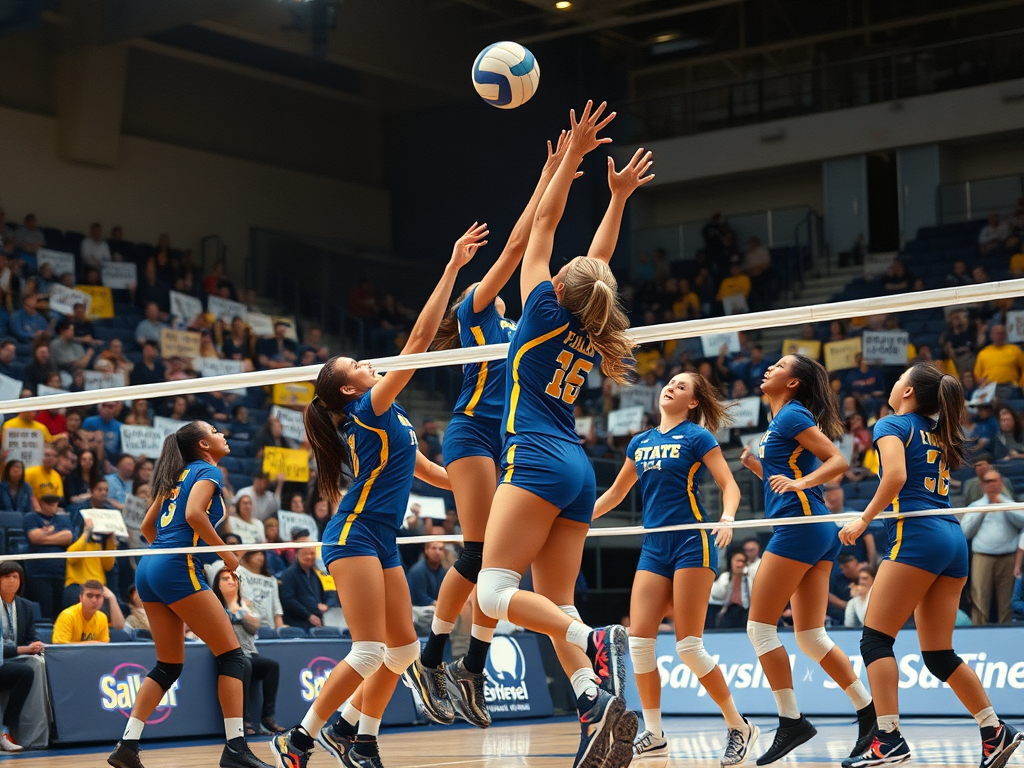

On the volleyball court, the women’s team from San Jose State University looks like any other collegiate squad. At a recent game, the players displayed precise coordination, spiking and setting the ball with rhythmic precision, leaping like pogo sticks to block shots, all while donning their signature blue and gold uniforms.
However, off the court, the team is navigating a turbulent season filled with emotions — frustration, confusion, and division. They find themselves at the center of a national controversy surrounding one of the most contentious debates in America: whether transgender women should participate in women’s sports.
The controversy began in April when a conservative website identified one of the Spartans’ players as transgender, catching many of her teammates off guard.
Earlier this month, a senior team co-captain and the assistant coach initiated a lawsuit to bar the transgender player from competing in the Mountain West Conference tournament. They argued that her participation violates Title IX provisions for gender equity in federally funded institutions.

Joined by a coalition of 10 female volleyball players from other teams that compete against San Jose State, the plaintiffs sued the Spartans’ head coach, two university administrators, the Mountain West Conference, its commissioner, and the California State University system’s board of trustees. Their objective: to exclude the player from the tournament, the team, and ultimately, women’s collegiate sports.
The transgender athlete, however, has chosen to stay silent, and aside from co-captain Brooke Slusser, other teammates declined interview requests. The New York Times opted not to name the player, as she has neither confirmed her identity publicly nor responded to inquiries.
“We just don’t think it’s fair for a man to compete in women’s sports,” Ms. Slusser said in a recent interview, referencing her transgender teammate. She described the lawsuit as a difficult decision, one she wrestled with because of its potential impact on her team.
“But I kept thinking about the future — about my own kids possibly competing in a similar situation,” she added. “I knew I had to take a stand.”
The turmoil has created fractures within the team. Some players no longer speak to each other during practice or outside of games. Head coach Todd Kress, who supports the transgender player’s inclusion, has also distanced himself from certain players. Meanwhile, at matches, the stands are filled with supporters and opponents, some waving signs or wearing shirts that clearly express their positions. Campus police have been stationed at games to ensure safety.
Coach Kress, who has led the team for two years, acknowledged the strain on the players. “They’re good people placed in an incredibly challenging situation,” he said.

This week, a federal judge dismissed the lawsuit, allowing the transgender player to participate in the Mountain West Conference tournament. On Tuesday, a subsequent appeal was also rejected.
San Jose State advanced to the semifinals after a first-round bye, but their opponent, Boise State University, declined to compete, marking the third forfeit this season over the inclusion of the transgender athlete. Four other teams have similarly boycotted matches against the Spartans.
Boise State issued a statement calling the decision to forfeit difficult but necessary. “We believe a better system is needed to serve all athletes fairly,” the statement read.
In response, San Jose State emphasized their disappointment but affirmed their focus on preparing for upcoming matches and competing for the championship.
The Spartans are now on the verge of securing a spot in the N.C.A.A. tournament, where their participation is likely to draw even more attention.
Bonnie Sugiyama, director of San Jose State’s Pride Center and Gender Equity Center, highlighted the pressure on the transgender athlete. “Imagine being thrust into the national spotlight just for playing a sport and following the rules,” she said.
Navigating Complex Rules
Sports have traditionally separated men’s and women’s categories to account for biological differences that give males physical advantages in strength and speed, particularly after puberty. Balancing fairness in women’s sports with inclusivity for transgender athletes remains a significant challenge for governing bodies.

The N.C.A.A. allows each sport’s national governing body to set eligibility rules. For volleyball, athletes assigned male at birth must undergo hormone therapy, and their testosterone levels must meet specified thresholds. Critics argue that these thresholds often remain within the range of adult males, raising concerns about competitive fairness.
The debate has also caught the attention of politicians. President-elect Donald J. Trump and other conservative figures have pledged to bar transgender women from competing in women’s sports. Governors from several states, including Idaho and Utah, have publicly supported forfeiting teams, with some lawmakers attending games in protest.
Amid the uproar, parents of players, like Kevin O’Sullivan, have expressed mixed feelings. “The rules allow it, and I’ve told my daughter to focus on teamwork,” he said. “But I feel empathy for the transgender athlete — she’s a human being at the center of a very public debate.”
For Ms. Slusser, the fight is personal and rooted in her beliefs. She revealed that she had been close friends with her transgender teammate before learning about her identity. “I don’t care how someone lives their life, but I believe fairness and safety should come first,” she said.




Leave a Reply