
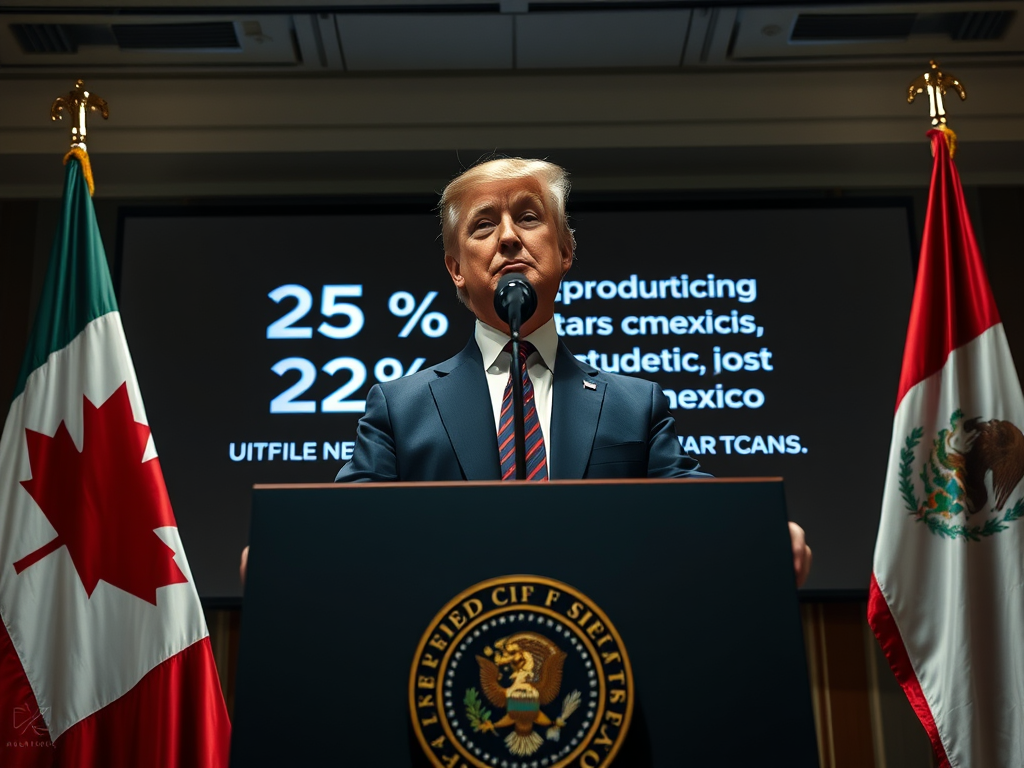
On Monday, President-elect Donald J. Trump announced that he would impose a 25% tariff on all goods imported into the United States from Canada and Mexico, effective on his first day in office. This bold move would disrupt North American supply chains and impose significant financial burdens on businesses throughout the continent.
In a post on Truth Social, Trump referenced a caravan of migrants heading toward the U.S. from Mexico and stated that the tariffs would remain in place until the flow of drugs and migrants across the border stopped.
“This Tariff will stay in effect until drugs, especially fentanyl, and all illegal aliens cease this invasion of our country!” the president-elect wrote.
He further added, “Both Mexico and Canada have the absolute authority and capability to easily resolve this long-standing issue. We demand that they use this power, and until they do, they will have to pay a very steep price!”
In a separate message, Trump also threatened to impose an additional 10% tariff on all goods from China, accusing the country of sending illegal drugs into the U.S.

“Chinese officials promised me they would impose their harshest penalty, the death sentence, on any drug dealers caught doing this. Unfortunately, they failed to follow through, and drugs, particularly fentanyl, continue to flood into our country, mostly via Mexico, at unprecedented levels,” he said.
Such tariffs would have far-reaching consequences for key American industries, including automotive manufacturers, farmers, and food packaging companies, all of which rely on cross-border trade for parts, materials, and finished goods.
For industries heavily dependent on an integrated North American market, a 25% tariff could make many imports prohibitively expensive, potentially paralyzing trade across the region. This, in turn, could lead to rising prices and shortages for U.S. consumers and beyond.
During his first term, which began in 2017, Trump implemented significant tariffs, including up to 25% on global metals and various goods from China.
In 2019, he threatened to impose tariffs on all imports from Mexico and even shut down the U.S.-Mexico border entirely unless Mexico took action to curb illegal immigration. However, he eventually backed down from these threats.
While campaigning for a second term, Trump escalated his tariff proposals, including suggesting a 60% or higher tariff on Chinese goods and tariffs of 10% to 20% on products from other countries.
Mexico, China, and Canada are the U.S.’s three largest trading partners, accounting for $830 billion in U.S. exports in 2022.




Leave a Reply