
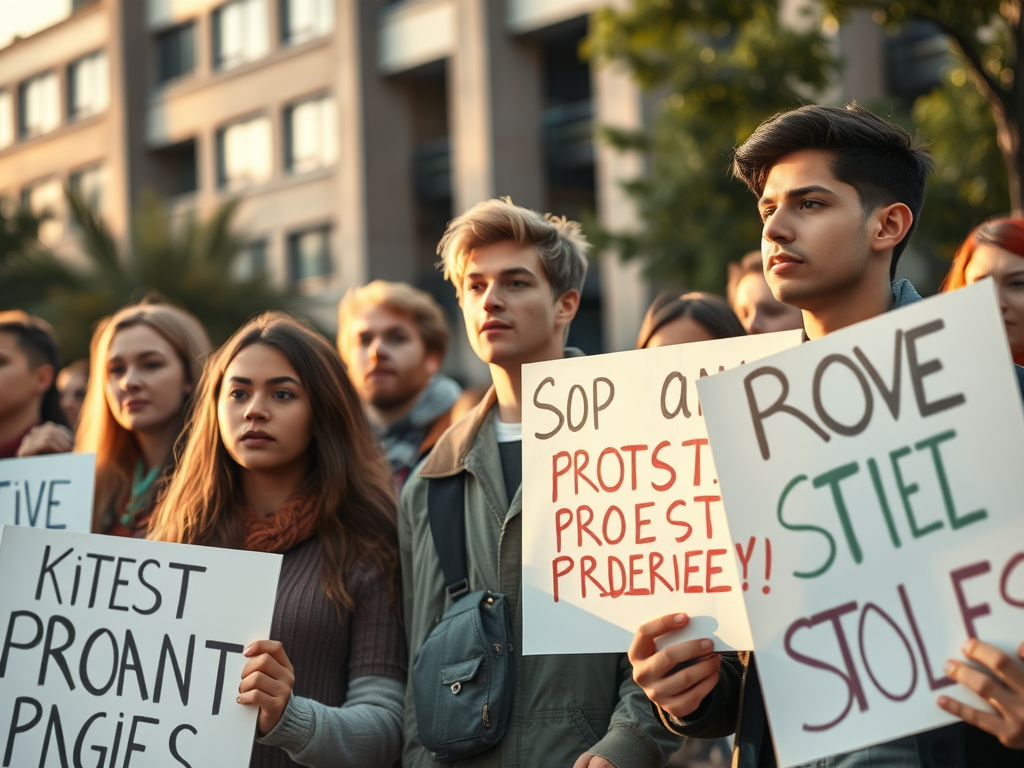

Colleges and universities have implemented stricter policies regarding protests, including locking campus gates and enforcing harsher penalties, following last spring’s disruptions caused by pro-Palestinian demonstrations and encampments.
These measures appear to be having an effect.
According to data from the Nonviolent Action Lab at Harvard University’s Ash Center, there have been fewer than 950 protest events this semester, compared to around 3,000 last semester. Additionally, about 50 individuals have been arrested during protests on college campuses this school year, compared to over 3,000 last semester, as reported by The New York Times.
This fall, when protests have occurred, administrators have closely followed the new rules introduced after last spring’s unrest. These actions have led to situations that would have been difficult to imagine at universities known for their history of student activism.
At Harvard, dozens of students and faculty members were temporarily banned from libraries after participating in silent “study-ins,” where protesters sat at library tables with signs opposing the war in Gaza. This followed a similar protest in December 2023, which did not result in any disciplinary action. At Indiana University Bloomington, some students and faculty members who attended candlelight vigils were referred for discipline due to a new rule banning expressive activities after 11 p.m. Meanwhile, University of Pennsylvania administrators and campus police officers, holding zip ties, instructed vigil participants to disperse for not reserving space in accordance with new regulations.
At Montclair State University in New Jersey, police often outnumber the participants at weekly protests, where demonstrators hold photos of children killed in Gaza along with the words “We mourn.”
“They claim it’s to ensure our safety, but I believe it’s really about control,” said Tasneem Abdulazeez, a student in the teaching program.
These changes come in response to federal civil rights complaints, lawsuits, and intense scrutiny from Congress accusing universities of tolerating antisemitism after some protests included praise for Hamas and calls for violence against Israelis.
While some students and faculty appreciate the calmer atmosphere on campuses, others see the relative quiet as the result of a crackdown on pro-Palestinian speech. They are concerned that President-elect Donald J. Trump, who previously urged universities to “eliminate the radicals,” might intensify the pressure.
Many universities are enforcing rules that were established before the start of the school year. These rules typically limit where and when protests can occur and the forms they can take.
Todd Wolfson, president of the American Association of University Professors and an associate professor at Rutgers, said the restrictions have created a climate of fear.
“There’s a strong sense of self-censorship,” he said. “People feel like they’re being monitored.”

Jewish students who felt targeted by some protests have praised the rules and the speed at which they are being enforced, seeing them as a way to restore order and safety. Naomi Lamb, director of Hillel at Ohio State University, expressed her appreciation for the school’s new protest policies, which she believes are helping to reduce antisemitic rhetoric.
Some of the tactics used by protesters last semester have led to harsher responses this year. At the University of Minnesota, 11 people were arrested for occupying a campus building. In contrast, last year, some universities allowed protesters to occupy buildings overnight or even for days.
At Pomona College, the president invoked “extraordinary authority” to bypass the usual disciplinary process and immediately suspend or ban pro-Palestinian protesters who took over a building on October 7. A college spokesperson justified the action by stating that the occupation had caused property damage, posed safety risks, and disrupted classes, although students were given the chance to respond to the allegations.

Some protesters have altered their tactics to challenge the new restrictions. For example, “study-ins” similar to those at Harvard have also taken place at Ohio State, Tulane University, and the University of Texas at Austin. In these protests, students wear kaffiyehs and tape signs to their laptops with messages like “Our tuition funds genocide.”
“It’s designed to put the administration in a difficult position: either ignore it or enforce the rules and risk looking harsh,” said Jay Ulfelder, research project manager at Harvard’s Nonviolent Action Lab.
A Harvard spokesperson noted that a January 2024 statement from the university’s leadership clarified that demonstrations are not allowed in libraries or other academic areas.
During Sukkot, the Jewish holiday that celebrates the harvest, the anti-Zionist organization Jewish Voice for Peace set up “solidarity sukkahs” at about 20 universities, including Northwestern and UCLA. These sukkahs, which commemorate the structures Israelites lived in while wandering in the desert, were decorated with gourds, fruit, and lights, along with signs reading “Stop Arming Israel.” At nine universities, administrators removed the sukkahs, citing new rules prohibiting unauthorized structures.

At Northwestern, when facilities workers arrived to dismantle the sukkah, JVP members objected, saying it was wrong to do so before the end of the holiday. “They don’t care about our right to practice our religion,” said Paz Baum, a senior. “They only care about limiting Palestinian speech.”
The new restrictions may not be the only reason for the decrease in protest activity this semester. Some protest groups have adopted more violent rhetoric, such as praising Hamas’s October 7 attack on Israel, which has alienated some students who previously supported their cause.
However, some issues remain unresolved, such as the ongoing debate over what constitutes a safe campus and where criticism of Israel crosses the line into antisemitism.
At Montclair State, where pro-Palestinian demonstrators have criticized the heavy police presence at their events, President Jonathan Koppell said he was trying to balance “competing priorities.”
“There’s a desire for some to say whatever they want, wherever they want, whenever they want, and others want a limit on protest activity,” Koppell said. “Anyone seeking an extreme on either side will be unhappy.”
Even with the increased restrictions, university leaders and faculty remain uncertain about how the federal government under Trump might further influence campus policies.
Abed A. Ayoub, executive director of the American-Arab Anti-Discrimination Committee, said he doesn’t believe Trump could make campuses more hostile to pro-Palestinian protests than they already are. “Universities have already started cracking down on anti-Israel speech,” he said. “That’s been happening regardless of who’s in office.”
Leave a Reply