
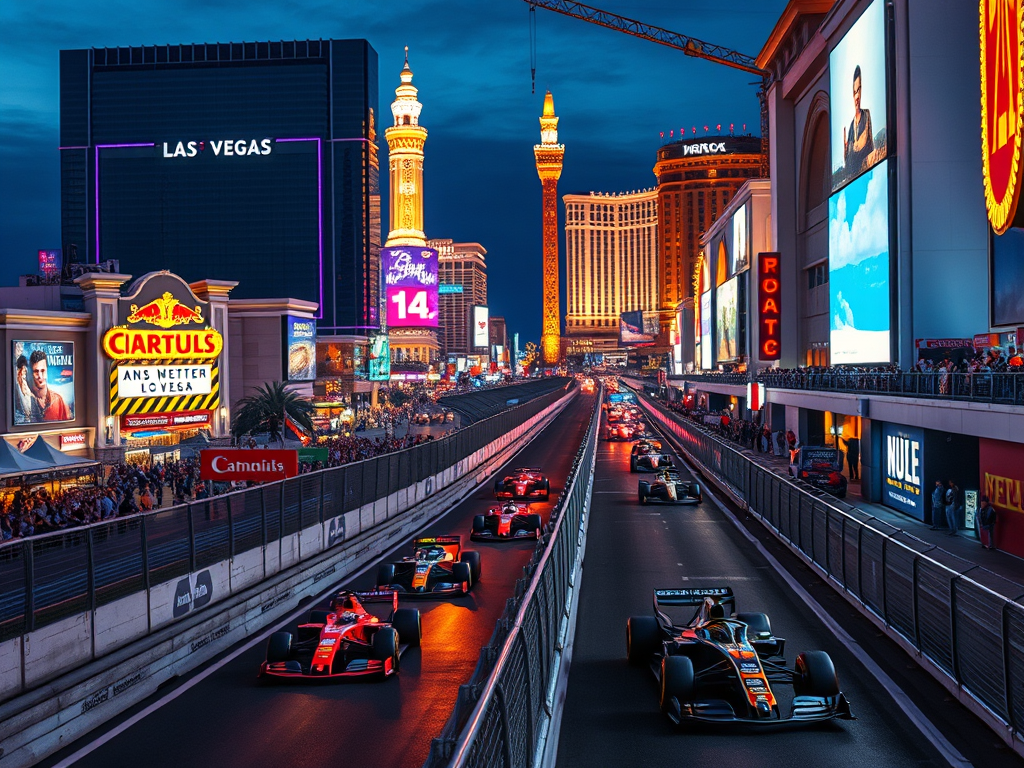

LAS VEGAS — Organizing a Formula One street race is among the most challenging logistical tasks for any Grand Prix organizer.
Each year in cities like Monaco, Singapore, and Baku, Azerbaijan, months of meticulous planning transform urban centers into temporary racetracks for just a few days. These street circuits present unique challenges to drivers with their uneven surfaces and tight barriers, setting them apart from traditional circuits.
However, the Las Vegas Grand Prix takes these challenges to a new level. Its circuit, a favorite among drivers last year, incorporates the iconic Las Vegas Strip—one of the world’s most famous roads.
Emily Prazer, Chief Commercial Officer of F1 and the Las Vegas Grand Prix, recounted a conversation with a Singapore Grand Prix promoter. “They couldn’t believe how we managed to open and close the track so quickly,” she said. “In Singapore, the roads remain closed for seven days. Imagine trying to propose a similar plan to the Las Vegas council—it’s simply not feasible.”
When F1 announced its return to Las Vegas after nearly 40 years, it insisted that the Strip be part of the 3.8-mile track layout. This requirement demanded a strategy to keep the Strip operational as much as possible, while preparing it nightly for racing.
Terry Miller, General Manager of the Las Vegas Grand Prix, is responsible for the event site, which spans 450 acres. “It’s a massive area, with over 45 major businesses around the track,” Miller explained. “One of these businesses alone owns five resorts. Managing the logistics for such a setup is no small feat.”
Construction of the circuit, including barriers, fencing, and lighting, began after Labor Day weekend. This year, Miller’s team adopted a new approach to the track build, working sequentially around the circuit as a driver might complete a lap.
“We focused on a more systematic process this year,” Miller said. “Track lighting had to go up first, followed by barriers, and then electronics, all in a specific order.”

To minimize disruption, local authorities required that no barriers be placed on the Strip until 12 days before the race. “They wanted to keep Las Vegas Boulevard as undisturbed as possible for as long as possible,” Miller noted. The barriers are removed promptly after the race, with the Strip cleared before Thanksgiving, just four days later.
Miller described the process of preparing the track each night as highly calculated. “We analyzed last year’s operations in detail,” he said. “Using spreadsheets and stopwatches, we determined how long it takes to move a single barrier, how much equipment is needed, and how many crews can operate simultaneously without interference.”
A team of 140 workers manages the opening and closing of the track, operating across 42 designated locations. Together, they move 3,500 barrier blocks, which, when lined up, stretch 7.6 miles—double the track’s lap distance. At night, the circuit is illuminated by 1,750 temporary light units.
Each worker has a specific role, supported by detailed training that began in June. This preparation ensures the team operates efficiently and accounts for potential absences. “We don’t leave anything to chance,” Miller emphasized. “It’s a well-coordinated process.”
The transformation of the track from “open” to “closed” happens in three stages. Initially, the track is in a “warm” state, allowing public traffic to pass. This phase ends at midnight on Thursday, giving time for safety car testing. By 3 p.m., a transition period begins, preparing the track for evening activities. The “hot” phase starts at 5 p.m., lasting until 2 a.m. Friday, after which the track returns to “warm” status.

“We plan everything down to the minute,” Miller said. “For instance, moving and securing a single barrier might take three minutes, with an additional five minutes to install fencing and connections. We work with a two-hour window but aim to complete tasks in one hour and 45 minutes to allow for a buffer.”
This year’s schedule also includes the Ferrari Challenge as a support race. Despite this addition, the organizers have confidence in their ability to manage transitions smoothly, thanks to lessons learned from 2023. Unexpected incidents, like last year’s loose water valve cover that delayed sessions until 4 a.m., are accounted for through contingency plans developed with local authorities and the FIA.
After Sunday’s race, dismantling begins immediately. By 4 a.m. Monday, the track returns to “warm,” allowing traffic to resume. “We aim to have everything cleared by Christmas,” Miller said.
For Miller, this project stands out even after decades of experience in sports event planning. “I’ve worked on NFL stadiums, Major League Baseball facilities, and even Olympic venues,” he reflected. “But nothing compares to the complexity of the F1 project in Las Vegas.”




Leave a Reply