
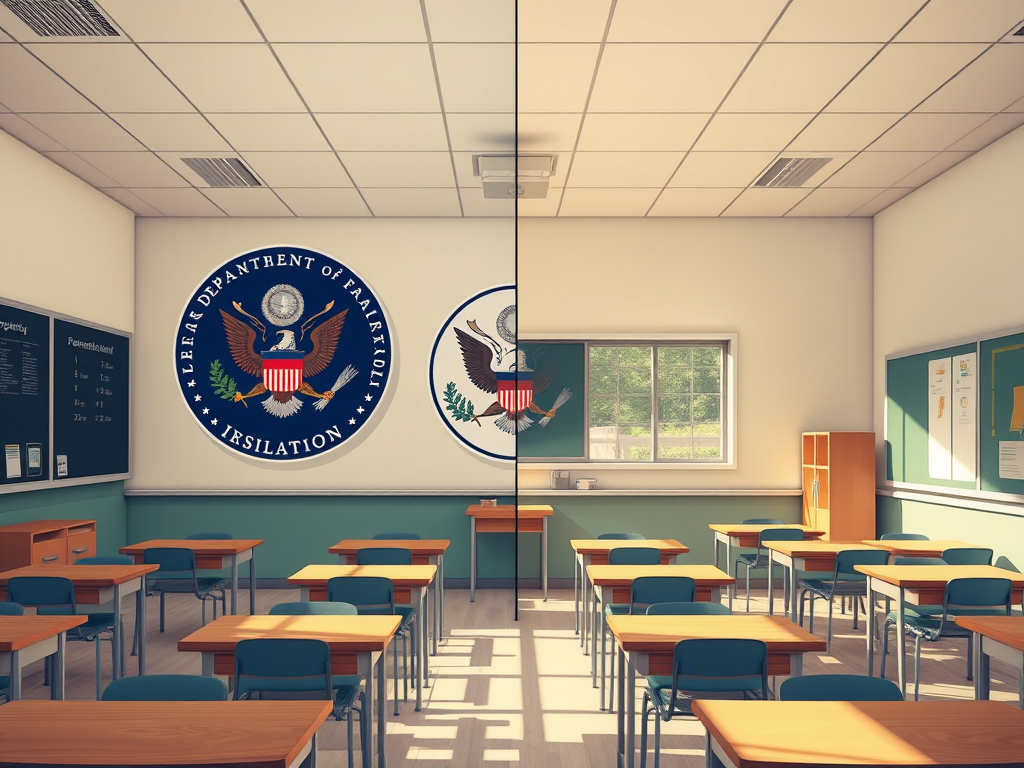

During his campaign, Donald J. Trump characterized the nation’s public schools as disseminators of radical ideologies on gender and race. One of his proposed solutions has been to reinstate a call from the Reagan era to dismantle the federal Department of Education, which was established in 1979.
“We’ll return everything to the states, where it belongs,” he stated in one speech. “States can tailor education to their communities with love and care for their children.”
Democrats have vowed to oppose this move.
But is it even feasible to eliminate the department? If not, how might Mr. Trump use it to further his policy objectives?
Is the Department of Education in jeopardy?
Project 2025, a conservative roadmap for a second Trump term, outlines a strategy for dismantling the Department of Education. While Mr. Trump has distanced himself from the project, many of its key proponents are close to his campaign.
The plan suggests transferring much of the department’s responsibilities to other federal agencies, such as Health and Human Services, and then decentralizing the federal government’s primary funding for K-12 schools, known as Title I, to the states. The process, which could span 10 years, would likely result in significant cuts to public education funding. These reductions would primarily impact low-income students and those with disabilities, as federal funding for K-12 schools is heavily targeted at these groups.
However, any attempt to dismantle the department would require congressional approval. Lawmakers would need to vote to eliminate the agency, a scenario deemed highly unlikely by education experts across the political spectrum. Republican members of Congress, especially those in districts that rely on federal aid for schools, would likely face strong opposition from local education leaders.
“I don’t think it’s feasible to eliminate the U.S. Department of Education. That’s more of a talking point,” said Derrell Bradford, president of 50CAN, an organization that advocates for school choice policies such as charter schools and vouchers.
He added, “But the idea that local authorities should control education at the community level? That’s something both Democrats and Republicans support.”
What powers does the department have?
Ironically, even as Mr. Trump has pledged to close the Department of Education, he has suggested using its investigatory powers to examine local schools’ policies on gender and race.
He aims to prevent schools from acknowledging transgender identities and has promised to reward schools that adopt a curriculum centered on patriotism, while defunding those that teach critical race theory or “gender indoctrination.”
While it is possible for a president to create funding incentives aligned with specific educational priorities, less than 10 percent of K-12 school funding comes through the department. The majority of school funding comes from state and local sources.
Moreover, the department doesn’t control local educational standards or curricula.
It does, however, issue regulations regarding how civil rights laws apply to various student groups, including LGBTQ+ students, racial minorities, and girls. Under President Biden, the department’s Office for Civil Rights issued guidelines affirming that gay and transgender students must have equal access to school programs and facilities.
These regulations have been put on hold in several states after Republican lawsuits sought to prevent their implementation. Mr. Trump would likely work to reverse these regulations.
Earlier this fall, the Trump campaign did not address questions about how exactly Mr. Trump would propose to close the Department of Education while still utilizing its powers.

In a written statement, Karoline Leavitt, a spokesperson for the campaign, emphasized, “President Trump has always supported returning education to the states, closest to parents and educators, where it truly belongs.”
What does the department actually do?
Although the Department of Education’s involvement in K-12 issues often makes headlines, its largest budget allocation—over 70 percent of its annual $224 billion budget—is dedicated to federal student aid.
Under President Biden, the department forgave more than $167 billion in student loans for nearly 4.75 million borrowers, approximately 10 percent of federal student loan holders. Mr. Trump and many other Republicans have opposed this initiative, viewing it as an unfair benefit to college-educated individuals and an overreach of the agency’s authority.
Federal funding for K-12 education primarily supports special education aides, school social workers, tutoring programs, and additional teachers to reduce class sizes. The department also conducts research on student achievement and best practices for teaching. However, following its recommendations is voluntary.
It is not easy for a president to withhold federal funds from schools, as the distribution of money is governed by formulas established by Congress.
Has the department always faced opposition?
Opposition to the Department of Education is now primarily associated with Republicans, but the agency has faced criticism from both sides of the aisle since its inception.
President Jimmy Carter created the department in 1979 as part of a campaign promise to the National Education Association, the nation’s largest teachers’ union. However, the move was opposed by many, including members of his own presidential transition team and some in Congress—many of whom were fellow Democrats.
Some liberal figures, such as Marian Wright Edelman, founder of the Children’s Defense Fund, opposed the department’s creation, arguing that all issues affecting children—including education, health care, and welfare—should fall under one federal agency, the Department of Health, Education, and Welfare. Al Shanker, leader of the American Federation of Teachers, also opposed the new department. Despite this, the Department of Education became firmly embedded in Washington’s policy infrastructure over the next four decades, gaining support from both Democrats and many Republicans. Programs the department oversees, such as vocational education funding, enjoy bipartisan backing.
Gareth Davies, a historian who has written about the department’s founding, said the resurgence of conservative opposition to the agency illustrates how far the GOP has shifted in recent years, from compassionate conservatism to a focus on cultural issues.
While this shift resonates with the conservative base, he noted, “It also gives Democrats an opening to claim that the GOP is attacking teachers and public schools.”
Frederick Hess, director of education policy at the conservative American Enterprise Institute, argued that pushing for the Department of Education’s closure is a “dead end” for Republicans like Mr. Trump, who should instead prioritize helping students recover academically from the disruptions caused by pandemic-related school closures, which were largely championed by Democrats.
“If we’re going to challenge misguided ideologies, what positive policies are we going to support in their place?” he asked.
4o




Leave a Reply