
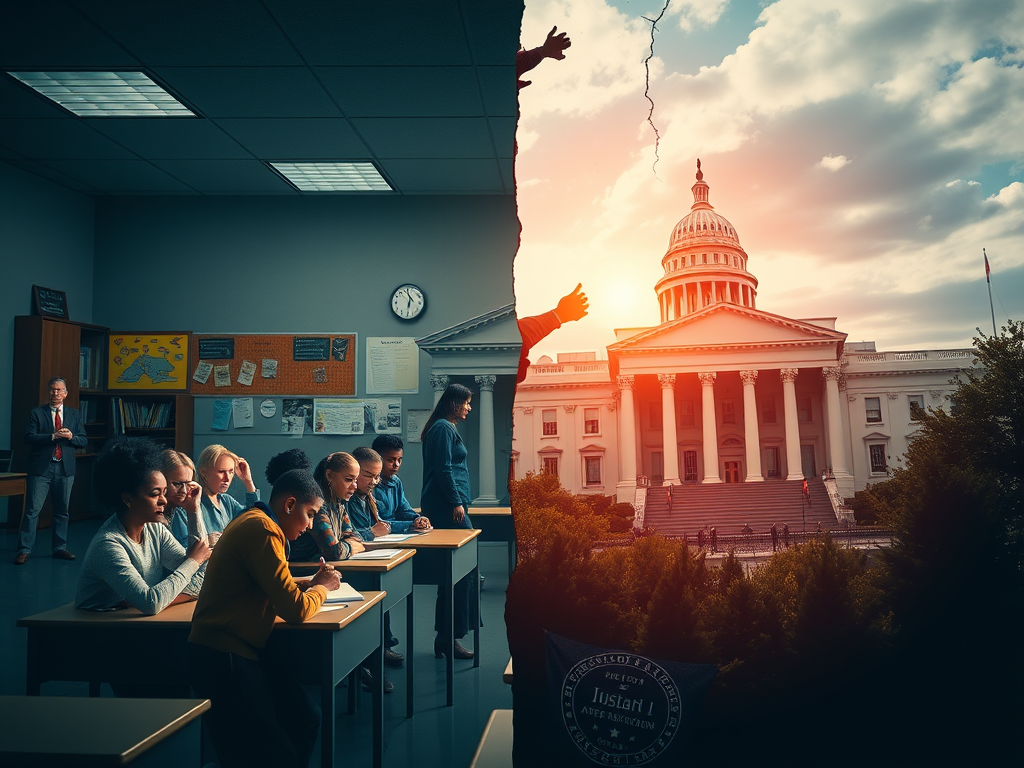
During his campaign, Donald J. Trump portrayed the nation’s public schools as promoting extreme ideologies related to gender and race. One of his key proposals was to revive the Reagan-era idea of dismantling the federal Department of Education, established in 1979.
“We will return everything to the states, where it belongs,” he declared in one of his speeches. “They can tailor education to local needs, with the love and care for their children.”
Democrats have vowed to resist these efforts.
But is shutting down the department even feasible? And if not, how could Trump use its existing powers to further his policy agenda?
Is the Department of Education in jeopardy?
Project 2025, a conservative roadmap for a second Trump term, presents a detailed plan for dismantling the Department of Education. Although Trump has distanced himself from the project, many of its architects have strong ties to his campaign.
The proposal suggests moving much of the department’s responsibilities to other federal agencies, like Health and Human Services, before eventually transferring the federal K-12 funding (known as Title I) to state control. This process could take up to 10 years, potentially leading to significant cuts in public education funding. These budget reductions would disproportionately impact low-income students and those with disabilities, as federal education funds are primarily allocated to support these groups.
However, any attempt to eliminate the department would require Congressional approval. Lawmakers would need to vote to disband the agency—an unlikely scenario, according to education experts from both parties. Republican lawmakers would likely face opposition from school superintendents and education leaders in their districts, as schools in Republican areas, much like those in Democratic areas, rely on federal funding.
“I don’t think it’s possible to eliminate the Department of Education. It’s just a talking point,” said Derrell Bradford, president of 50CAN, a nonprofit that advocates for school choice policies such as charter schools and vouchers.
But he added, “The idea that local entities should control education at the local level? That’s popular across both parties.”
What power does the department wield?
Ironically, even as Trump has called for the department’s closure, he has suggested he would use its investigatory powers to scrutinize local school practices on gender and race.
Trump wants to prevent schools from recognizing transgender identities and has vowed to reward those that adopt a patriotic curriculum while defunding schools that teach critical race theory or what he calls “gender indoctrination.”
It is certainly within a president’s power to create funding incentives to prioritize certain educational goals. However, less than 10 percent of K-12 school funding flows through the Department of Education. The bulk of funding comes from state and local taxes.
The department does not dictate local learning standards or reading materials. However, it does regulate how civil rights laws apply to different student groups, including LGBTQ+ students, racial minorities, and girls. Under President Biden, the Department’s Office for Civil Rights issued guidelines that ensure gay and transgender students have equal access to most school programs and facilities.
Yet, those regulations are currently suspended in half the states after Republican-led lawsuits sought to block their implementation. Trump would likely attempt to reverse these regulations.
Earlier this fall, when asked how Trump would close the Department of Education while still using its powers, the campaign did not provide a detailed response. Karoline Leavitt, a campaign spokesperson, issued a brief statement: “President Trump has always supported returning education to the states, where it belongs, closest to parents and educators.”
What is the department’s actual role?
While much of the department’s involvement in K-12 education is politically charged, its largest budgetary commitment is actually to higher education.
More than 70 percent of its $224 billion annual budget goes to the federal student aid program.
Under President Biden, the department canceled more than $167 billion in student loan debt for 4.75 million borrowers, about 10 percent of those with federal student loans. Trump and many other Republicans opposed this, arguing it unfairly benefits college-educated individuals and oversteps the agency’s authority.
Federal funding for K-12 schools is primarily used for special education services, school social workers, tutoring, and additional teachers to reduce class sizes. The department also funds a research division that collects data on student achievement and provides recommendations for classroom best practices, although adherence to this guidance is voluntary.
It is not easy for a president to withhold federal funding from schools, as the money is allocated according to formulas set by Congress.
Opposition from the start
The Department of Education has had critics since its inception. Today, opposition to the agency is largely associated with Republicans, but it faced fierce resistance from both sides when it was created.
President Jimmy Carter established the department in 1979 as part of a promise to the National Education Association. His decision was met with opposition from his own transition team, as well as from many members of Congress, including fellow Democrats.
Prominent liberals, such as Marian Wright Edelman, founder of the Children’s Defense Fund, argued that all child-related issues, including education, should be handled by a single federal agency, the Department of Health, Education, and Welfare. Another skeptic was Al Shanker, head of the American Federation of Teachers. Despite these objections, the department grew to become a fixture in Washington over the following decades, with support from both Democrats and many Republicans. Programs managed by the department, like vocational education funding, became sources of bipartisan agreement.
Historian Gareth Davies noted that the resurgence of conservative opposition to the department reflects the GOP’s shift over the past two decades from “compassionate conservatism” to focusing on culture wars. While such rhetoric may resonate with the conservative base, Davies argued that it also gives Democrats the chance to accuse Republicans of attacking teachers and public schools.
Frederick Hess, director of education policy at the right-leaning American Enterprise Institute, contended that the focus on closing the Department of Education is a “dead end” for Republicans like Trump. Instead, he believes they should concentrate on helping students recover academically from the long school closures during the pandemic, which were largely advocated by Democrats.
“If we’re going to push back against problematic woke ideas, what positive policies are we going to advocate for instead?” he asked.




Leave a Reply