
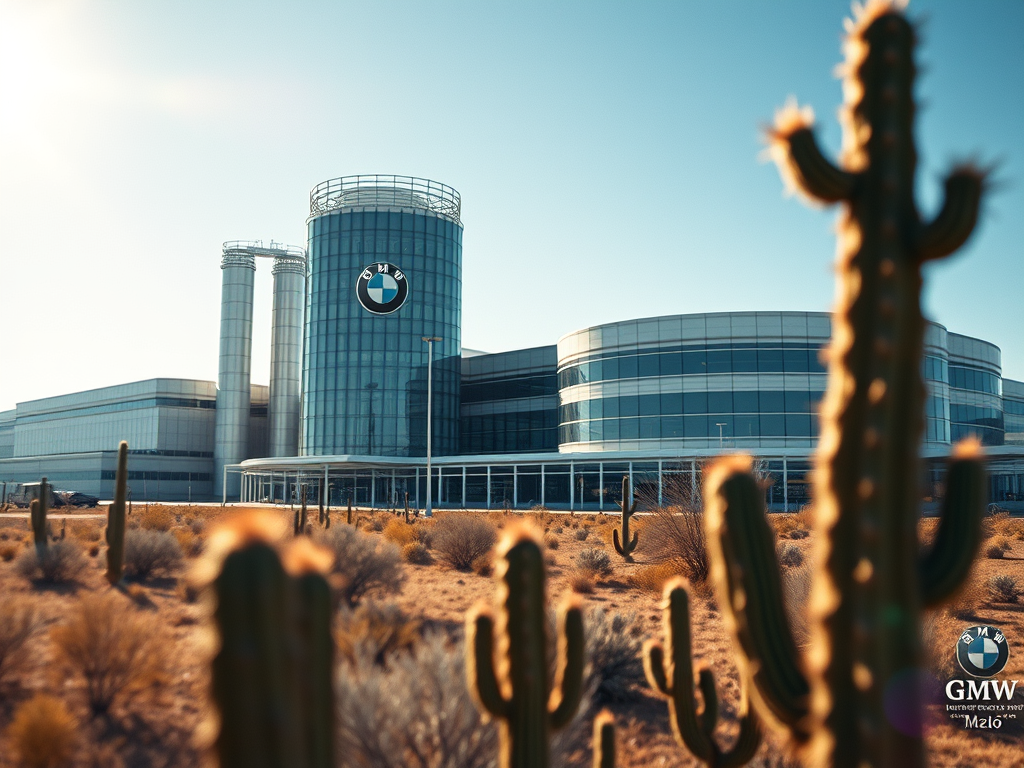

A few years ago, the stretch of desert located 250 miles north of Mexico City was home mainly to rattlesnakes, coyotes, and cactus. Today, however, it stands as a shining example of Mexico’s growing prominence as an auto manufacturing hub.
In 2019, BMW completed a massive factory complex in the area, near San Luis Potosí. The facility, as clean and advanced as any in Bavaria, produces luxury sedans that are sold in markets across the United States, Europe, China, and many other countries.
San Luis Potosí is one of several Mexican cities that have emerged as auto production powerhouses, often compared to Detroit, with factories producing cars for Volkswagen, Audi, Mercedes-Benz, Ford, Nissan, and Chevrolet. In the first three quarters of the year, Mexican factories produced over three million vehicles, with two million of those vehicles exported to the U.S., according to the Mexican Automobile Industry Association.
But Mexico’s crucial role in the global automotive industry is now under threat. President-elect Donald J. Trump has threatened to impose punitive tariffs on cars coming from Mexico, potentially as high as 100%, a move that would violate the trade agreement negotiated with Canada and Mexico by his administration.
Such tariffs would have a significant impact on the auto industry, raising prices on popular U.S. models like the Ford Maverick pickup, Chevrolet Equinox SUV, and various Ram truck variants.
Trump has argued that the tariffs would incentivize more car production within the United States. While BMW’s executives acknowledge that the tariffs would hurt their operations, they believe the San Luis Potosí plant would still make financial sense because a significant portion of the cars produced there are destined for other markets.
However, the tariffs could disrupt global supply chains, forcing suppliers to shift production between countries, which could lead to job losses and financial instability. The BMW plant in San Luis Potosí employs 3,700 people.
“If you undermine the agreement, you’ll create more unemployment in Mexico, and what will those people do?” said William Alan Reinsch, a senior advisor at the Center for Strategic and International Studies, specializing in trade issues.
The tariffs could also deal a blow to the already-slowing electric vehicle market. Ford manufactures its Mustang Mach-E in a plant near Mexico City, while Chevrolet builds electric versions of the Equinox and Blazer in Monterrey.
Even Tesla, led by one of Trump’s staunchest supporters, Elon Musk, might feel the impact. Tesla has acquired land in Monterrey for a new plant aimed at producing affordable vehicles, although that project is currently on hold, according to local officials.
BMW’s San Luis Potosí facility highlights what’s at stake for automakers. Last month, construction crews worked on a new building designed to assemble battery modules for the company’s electric cars. These electric vehicles will be produced there starting in 2027 and exported to the U.S. and other markets. The factory currently produces the BMW 2 Series and 3 Series sedans.
San Luis Potosí, a sprawling mix of cinder-block and brick buildings, doesn’t exactly evoke the image of a high-tech manufacturing hub. Makeshift taco stands line the roads leading to the BMW complex, while metal factory buildings churn out auto parts. Like many Mexican cities, San Luis Potosí has experienced violence related to drug cartels.
Still, BMW executives highlight Mexico’s deep pool of skilled and motivated workers. “You don’t just have skilled workers; you have highly motivated workers,” said Ilka Horstmeier, a BMW board member responsible for labor relations, in an interview in San Luis Potosí.
Suppliers in Mexico are able to meet BMW’s stringent production timelines, delivering parts like bumpers and axles just hours before they are installed on assembly lines, said Oliver Haase, a senior vice president responsible for BMW’s supply chain in the Americas.

Despite the high level of automation at the San Luis Potosí plant, where robots handle much of the work, manual labor remains integral to operations. Workers still assemble parts by hand, connecting components like front hoods to hinges on the assembly line.
Trade barriers could disrupt this efficient supply chain, which benefits both Mexico and the U.S. Many of the parts used in BMW’s Mexican-made cars come from the United States. For example, the batteries for the upcoming BMW electric vehicles will be sourced from a factory in South Carolina that also supplies BMW’s Spartanburg plant.
Some labor advocates in the U.S. have argued that Mexico’s lower labor costs and weaker worker protections have made the country an attractive destination for manufacturers. Historically, Mexican unions have been more aligned with management than with workers, which has led to concerns over labor rights.
The Trump administration’s policies have drawn criticism from labor experts, but officials did push for provisions in the United States-Mexico-Canada Agreement (USMCA) that aim to make it easier for Mexican workers to form independent unions.

Labor leaders in Mexico have used these reforms to organize workers at companies like General Motors and Goodyear, which has a large factory in San Luis Potosí. “The law gives us tools to organize for better conditions,” said Pablo Franco, a lawyer representing an independent labor group, during a meeting with Goodyear executives in San Luis Potosí.

However, Franco also lamented that the government has not done enough to ensure that workers are fully aware of their rights. At companies like BMW, workers are not represented by independent unions.
Under the USMCA, companies that do not comply with labor standards can face penalties, including a 2.5% tariff on vehicles exported to the U.S.
Chinese automakers, including BYD, have been exploring locations in Mexico to set up manufacturing operations for Latin America and potentially the U.S. Some have been waiting for the outcome of the U.S. election to determine whether to proceed with their plans.
Factories in Mexico could offer Chinese carmakers a way to circumvent U.S. tariffs on Chinese-made cars. However, the Trump administration is unlikely to make it easy for Chinese companies to access the U.S. market.
Mexican officials are actively courting Chinese investors, but they are also mindful that the U.S. remains Mexico’s largest trading partner.
The three countries are scheduled to review the USMCA in 2026, and officials will decide whether to extend the agreement.

“We’re committed to respecting the trade agreements with the United States and Canada,” said Walter Ángel, head of Mexico’s energy regulator. “We will review the treaty, but we will not renegotiate it.”
BMW executives argue that the San Luis Potosí plant makes business sense regardless of the decisions made by U.S., Mexican, or Canadian officials. They point out that a large portion of the factory’s output is destined for Brazil, other Latin American nations, and China. The BMW 2 Series coupe sold in Europe is also produced in San Luis Potosí. Mexico’s free trade agreements allow manufacturers to export to 50 countries with little or no tariffs.
“Our decision on where to build plants is a long-term strategic choice, made for at least 40 years,” said Horstmeier of BMW’s board. “But we prefer open borders. Whenever you impose trade barriers, you harm yourself.”




Leave a Reply