
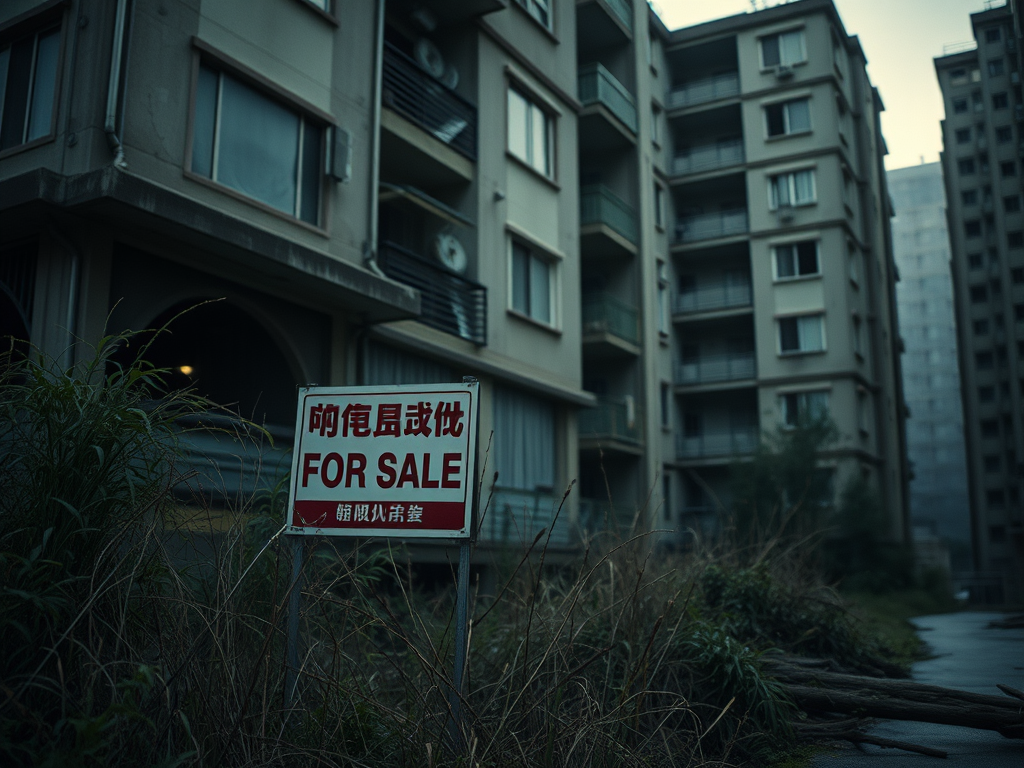

Banks in China are increasingly seizing homes due to rising mortgage defaults, as the nation’s housing downturn poses a growing risk to its financial stability.
Official data reveals a 43 percent surge in the number of properties seized and put up for auction last year. Numerous Chinese banks have reported an uptick in mortgage defaults in the first half of this year, further driving the decline in apartment values.
The judicial system is struggling to keep pace with the rise in evictions. In cities like Qingdao, foreclosed properties are being sold at auction before the previous owners have vacated. Buyers are then required to negotiate with the residents to vacate the premises, according to specialists in finance and foreclosure.
While the uptick in foreclosures and evictions remains modest by Western standards, it adds additional strain on China’s banks, which are already dealing with other losses tied to the real estate collapse. These include loans to local governments, defaulting property developers, and buyers of unfinished homes.
To compound the issue, many Chinese businesses have used real estate holdings as collateral for loans, and bank executives are finding that the collateral is now worth far less than when the loans were initially made.
In response, the Chinese government has encouraged banks to increase lending to real estate developers and other borrowers as part of its economic stimulus plan, introduced in late September. However, banks face significant challenges.
“Banks have long been key allies for Chinese policymakers, but they could soon become the country’s largest financial headache,” said Alicia García-Herrero, Chief Economist for Asia at Natixis, a French financial institution.
China’s largely state-owned banking sector is well-capitalized, generating over $600 billion annually in pre-reserve profits. This allows banks to gradually absorb losses over time.
“They will slowly write off these losses over the coming years,” said Yan May, a banking analyst at UBS.

However, the banks’ role in funding the national government’s budget is crucial. The lenders contribute income taxes, transaction fees, and dividends that make up about 1 percent of China’s GDP. Significant losses could erode both bank profits and government revenue.
Foreclosures are a delicate issue in China, where the government closely controls social unrest. Regulators are pressuring banks to avoid actions that could provoke public protests.
Despite the country’s oversupply of 90 million vacant homes, evictions aren’t leading to widespread homelessness. Many of the foreclosures involve secondary homes, often occupied by relatives or friends, and not primary residences.
Four years ago, China strengthened homeowner protections against eviction. At the time, the housing market was booming, and foreclosures were nearly nonexistent.
Now, these protections are making it harder for banks to evict defaulting homeowners. Buyers at foreclosure auctions often have to purchase homes without inspecting them, then work with local officials to persuade the occupants to vacate, according to Martin Zhang, an advisor to buyers of foreclosed homes.
This has led many prospective buyers to be cautious about foreclosed properties.
“Unless there are no other viable options, most people won’t opt for foreclosures,” said Mr. Zhang, who works in Qingdao, a coastal city in Shandong Province.
Despite this, the number of homes being auctioned continues to grow. Many properties are being auctioned multiple times. Banks initially attempt to sell at a government-regulated 20 percent discount to the appraised value. If no bids are placed, they then lower the price by half.
Last year, 389,000 residential properties in China were auctioned due to mortgage defaults, a number similar to foreclosures in the United States, which has a quarter of China’s population. The U.S. had over 2.8 million foreclosures in 2009 and 2010 during the height of its housing market collapse.
In China, the critical question is how much worse the situation could get. Real estate prices have already fallen nearly 30 percent from their 2021 peak.
Alongside the rise in foreclosures, at least seven million apartments remain unfinished across the country. UBS analysts estimate that four million of these units were purchased with mortgages amounting to approximately $350 billion.
This accounts for nearly 7 percent of the total mortgage debt held by Chinese banks. Regulators have advised banks to refrain from foreclosing on properties that remain incomplete.
One potential factor that could temper the foreclosure issue in the coming years is that many homeowners have paid down part of their mortgages or made significant down payments. Even with the steep drop in apartment values, many still owe less on their mortgages than the current value of their homes.

Lin Chen, a 32-year-old chemicals salesman in Qingdao, bought his apartment for $200,000 in 2017. Now, he estimates its value has dropped to around $135,000 to $150,000, but he still owes only $84,000 due to making extra payments when possible.
While he envies older relatives who bought homes two decades ago and have seen substantial price gains, Mr. Chen plans to hold onto his apartment, hoping prices will recover.
“Those of us born in the ’80s and ’90s are the unlucky generation,” he said.
Prepaying mortgages or making large down payments is a common practice in China, where mortgage rates were close to 6 percent until recent cuts.
Many Chinese homeowners have borrowed money through small businesses at low rates to pay down mortgages. However, regulators are concerned that many of these businesses are failing due to the economic slowdown, and the use of small-business loans to pay for home mortgages is raising alarms among bankers and regulators.
If a foreclosed property is auctioned for less than the mortgage balance, the borrower is personally responsible for covering the shortfall. However, banks and regulators, fearing social unrest, have been reluctant to pursue this in cases where the borrower is not engaged in speculation or fraud.
In Western countries, mortgage insurance helps cover these gaps, but in China, fewer than 1 in 200 mortgages are insured, leaving banks vulnerable if real estate prices continue to fall and foreclosures rise, as many economists predict.
Even with the government’s intervention, real estate markets in cities like Qingdao could face years of correction. Prior to their recent decline, apartment prices there had doubled from 2016 to 2021 due to speculative demand for vacation homes. Qingdao Rural Commercial Bank, a local lender, has reported significant increases in mortgage defaults.
Lei Wang, a homeowner in Qingdao, regrets his decision to buy an apartment.
“I thought I bought it at a reasonable price, but I didn’t expect the market to drop so much,” said Mr. Wang, a chemicals salesman. “If I hadn’t bought it, and housing prices were this low, I think renting would have been the better option.”




Leave a Reply