
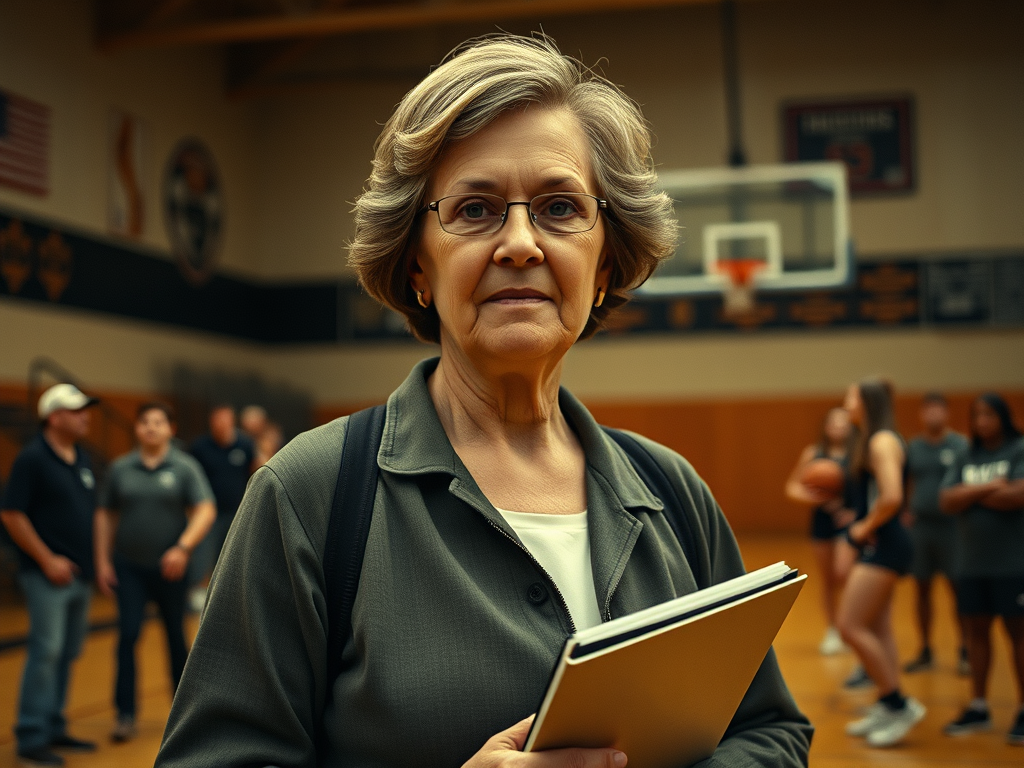
In 1990, 34-year-old Carol Stiff, a basketball enthusiast who had spent years coaching small college teams in the Northeast, decided to take a leap. She put away her coaching clipboard and accepted an entry-level programming job at what she thought was a “small company” in Bristol, Connecticut—ESPN.
Basketball had always been a significant part of Stiff’s life. Her uncle, Don Donoher, was an assistant coach under Bobby Knight on the 1984 U.S. Olympic gold medal team that featured Michael Jordan. By middle school, she was already playing youth basketball in Bernardsville, New Jersey, and one of her fondest memories was watching Carol “Blaze” Blazejowski at Madison Square Garden in 1977. It was part of a doubleheader at the Hanover Classic, a rare chance to watch top-tier competitors play a game Stiff loved.
Despite the early start time, there were more than 10,000 fans in the arena that day to see Blazejowski, whose exceptional scoring and versatile play had earned her comparisons to Pete Maravich. Blaze could shoot, pass, and played with a flair that made her stand out. She scored an impressive 52 points, even without the three-point line.

Stiff recalled how witnessing Blaze’s performance lit a spark in her. “It was a moment that made me realize that women’s sports could thrive—given the right opportunities,” she reflected. Although Title IX had given her high school girls’ team Converse Chuck Taylors, like the boys’ team, Stiff realized the sport was still struggling to gain recognition on its own. However, in the right setting, its greatness could shine through.
Stiff continued her athletic journey at Southern Connecticut State University, playing both basketball and field hockey. She then went on to coach at Brown, Rensselaer Polytechnic Institute, and Western Connecticut, before joining ESPN.
One of her first roles at ESPN involved inputting four-digit codes for the network’s programming, essentially cataloging the shows. It was there that Stiff noticed a glaring issue: there was no distinction made between men’s and women’s sports. In her third year, as the network revamped its software, Stiff persuaded her superiors to introduce a gender code—marking the first time ESPN tracked when women’s sports were broadcast.

Fast forward to April 2023, when the NCAA women’s basketball championship game between undefeated South Carolina and Iowa attracted nearly 19 million viewers—setting a record for the largest audience in women’s college basketball history. This moment was the culmination of years of hard work by people like Stiff, who had long believed that media biases and structural barriers were preventing the women’s game from gaining the attention it deserved. They fought for more visibility, paving the way for stars like Caitlin Clark.
Clark, a player from Iowa, became the face of the growing interest in women’s basketball. “There’s (Michael) Jordan, Tiger (Woods), and Caitlin,” said Mike Mulvihill, Fox’s president of insight and analytics, illustrating the immense popularity she brought to the sport.
But before Clark’s meteoric rise, a solid foundation had to be laid, and Stiff was one of the key players in building it. “The stigma that women’s sports weren’t as athletic or entertaining is being erased,” said Sue Maryott, the Big Ten Network’s VP of remote productions. “It all began with exposure. People didn’t watch because it wasn’t televised.”
In her third year at ESPN, Stiff was tasked with scheduling the network’s women’s basketball broadcasts. She initially had limited time slots, often competing with the NFL or major PGA events. However, she lobbied for more prime slots, such as a 3 p.m. Sunday game on Martin Luther King Day in January, which was seen as a modest timeslot at the time. Stiff made a bold move by persuading Pat Summitt, the legendary coach of Tennessee, to play a game against the rising UConn team, leading to the creation of one of the greatest rivalries in women’s college basketball.
Over time, ESPN’s investment in women’s sports grew. In 1996, ESPN secured the broadcast rights to the NCAA women’s championship, beating CBS, which had failed to grow the women’s game. As ESPN continued its commitment, the exposure grew, and the WNBA was launched in 1997. Stiff’s work in helping to secure rights for both NCAA women’s games and the WNBA became a pivotal moment in the advancement of women’s sports media coverage.
Fast forward to 2021, when Caitlin Clark’s games were drawing impressive viewership on platforms like BTN, ABC, and ESPN. Clark’s visibility changed the landscape of women’s sports broadcasting. In her junior year, Clark’s games shattered previous records, with the Iowa-LSU championship game drawing nearly 10 million viewers.
Clark’s presence on national TV helped propel women’s basketball to new heights. Her games were featured across multiple platforms, and her rise to prominence marked a shift in how the sport was perceived. Fox’s Maryott recalled how her own 84-year-old mother, who had never paid attention to sports, became a fan of Clark. “I’m calling to check on her, and she says, ‘We’re watching Caitlin tonight,’” Maryott recalled.
Clark’s influence extended beyond just numbers and ratings. She became a role model for young athletes and sparked broader interest in women’s sports. By her senior season, her games were broadcast on major networks, with fans tuning in across the country to witness history in the making.




Leave a Reply