
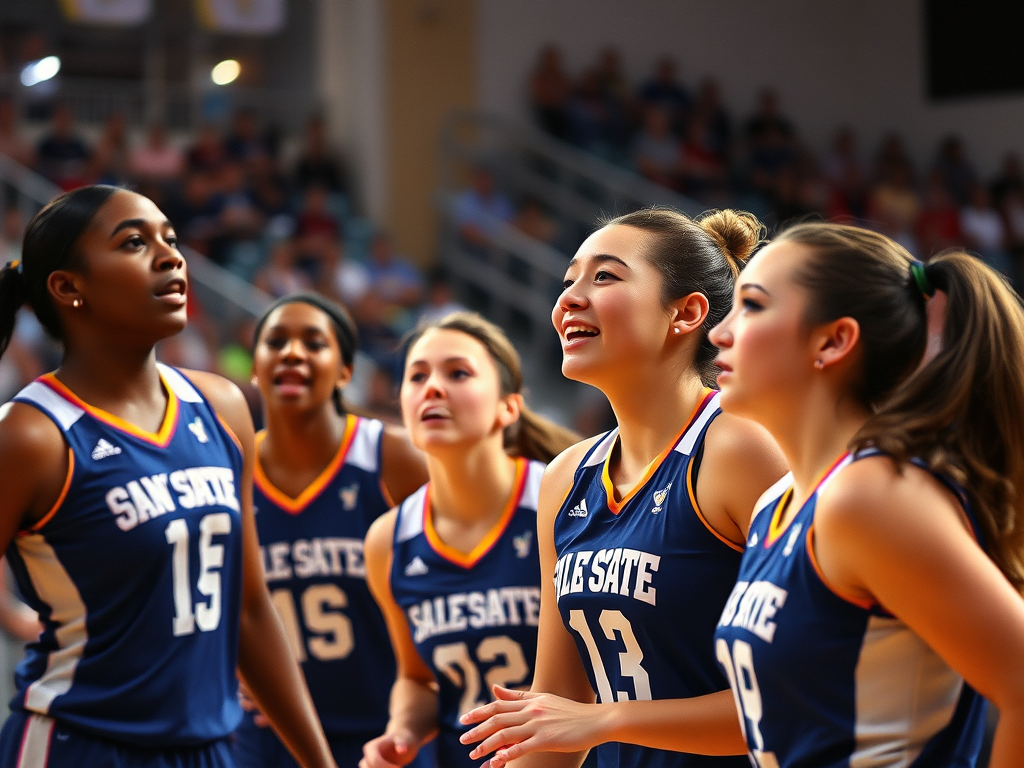

The women’s volleyball team at San Jose State University is aiming to reach the N.C.A.A. tournament for the first time in 23 years. However, they first face the challenge of securing opponents willing to compete against them.
The University of Nevada, Reno, recently became the fifth institution this season to withdraw from a scheduled game against San Jose State, citing concerns over a transgender woman on the team. Other schools that have opted out include Southern Utah University, Boise State University, the University of Wyoming, and Utah State University.
“We will not participate in any match that promotes injustice against student athletes,” the Nevada team stated on social media, expressing their belief that transgender women have an unfair advantage in competition.
These withdrawals have placed the San Jose State Spartans at the center of an ongoing debate about whether transgender athletes, particularly transgender women, should be permitted to compete on teams that align with their gender identity. This issue has gained significant attention in Republican-led legislatures recently and has become a prominent topic as the presidential campaign progresses.
According to Todd Kress, the Spartans’ head coach, the refusals to compete and the hateful messages directed at the team have negatively impacted every member of the squad. “It has been heartbreaking to witness this unfold for our student athletes,” he remarked to reporters after a recent match loss.
The university has not publicly confirmed the presence of a transgender player on the team. While some media outlets have named a player they allege is transgender, The New York Times has not independently verified this information. Attempts to contact the player mentioned by other sources were unsuccessful.
This player has been part of the Spartans, a Division I program, since the 2022 season. All five schools that forfeited matches against San Jose State have previously competed against the team when this player was active. Officials from the forfeiting institutions did not respond to inquiries for comments.
In the United States, 25 states have implemented laws prohibiting transgender athletes from participating in girls’ and women’s sports, according to the Movement Advancement Project, a group advocating for L.G.B.T.Q. rights that monitors state legislation. Many of these laws are currently facing legal challenges.
The N.C.A.A.’s guidelines for transgender participation vary by sport, as determined by the governing bodies of each sport. For example, in swimming and track and field, transgender women are essentially barred from competing in women’s events. In volleyball, transgender athletes are required to provide documentation proving they have “taken the necessary steps to transition to their adopted gender,” according to USA Volleyball guidelines.
Additionally, the N.C.A.A. mandates that transgender women meet specific testosterone level requirements, as testosterone is associated with muscle growth and speed.
In March, a group of athletes from swimming, volleyball, and track filed a lawsuit against the N.C.A.A., claiming it discriminates against women by denying them equal opportunities in college sports. The lawsuit references the N.C.A.A.’s decision to allow transgender swimmer Lia Thomas to compete for the University of Pennsylvania in the 2022 national championships and includes the San Jose State women’s volleyball team as part of the ongoing case.
Proponents of banning transgender athletes argue that transgender women maintain physical advantages acquired during male puberty, creating an uneven playing field.
However, there is considerable debate regarding the extent to which testosterone influences athletic performance. A recent study funded by the International Olympic Committee found that while transgender female athletes demonstrated greater handgrip strength—an indicator of overall muscle strength—they exhibited lower jumping ability and lung function compared to cisgender women.
In volleyball, opponents of transgender women competing assert that these players can jump higher and strike the ball harder and faster than those assigned female at birth, claiming that teams with transgender women possess an unfair advantage and present a greater risk of injury to opponents. (The N.C.A.A. allows male students to practice with women’s teams if they meet specific eligibility criteria that do not center on athletic capability.)
Brooke Slusser, a Spartans player and co-captain, is among the critics. She noted that she was often paired with her transgender teammate during travel and recently joined the lawsuit against the N.C.A.A., stating that her teammate hit the ball “far harder than any woman she had ever faced” and expressed concerns about potential injuries. Slusser added that the physical disparities she encountered in previous seasons were not as pronounced as they are this year.
A representative from San Jose State indicated that there have been no significant injury reports involving teammates or opponents during games or practices over several seasons involving the teammate in question.
Slusser was unavailable for further comment, and most of San Jose State’s players have not publicly addressed the issue. However, she expressed support for Nevada’s decision on social media, declaring it “another great step in the right direction for women’s sports!”
On Saturday, hundreds rallied in support of Nevada’s decision not to compete. Nevada’s team captain, Sia Liilii, spoke at the event alongside the state’s Republican lieutenant governor and a prominent conservative opponent of transgender athletes in women’s sports.
The following day, Liilii participated in an event in Pennsylvania focused on the future of women’s sports, sharing the stage with Tulsi Gabbard, a former Democratic representative now supporting Donald J. Trump.
San Jose State’s spokesperson released a statement condemning targeted campaigns against its students, stating, “We abhor that our students would be used for political purposes and are concerned about the implications of doing so. We will continue to take steps to ensure our students’ safety while they pursue their right to compete, and we remain dedicated to fostering an inclusive and caring environment for our student athletes.”
The spokesperson also emphasized that all athletes on the team are eligible to play under N.C.A.A. and Mountain West Conference regulations.
In the lead-up to the election, Trump and other Republican candidates have heavily spotlighted transgender issues, particularly concerning sports participation. During a recent town hall, Trump referenced a video of a San Jose State player spiking a ball that hit another player, asserting he would ban transgender women from competing in women’s sports.
Democratic candidates, including Vice President Kamala Harris, have largely opted to steer clear of the criticisms from Republicans, focusing instead on other topics such as abortion.
“This isn’t truly about sports,” remarked Tom Temprano, a spokesperson for Equality California, an L.G.B.T.Q. civil rights organization. “This is about politics and creating panic around the L.G.B.T.Q. community.”
Temprano emphasized that anti-L.G.B.T.Q. policies and rhetoric negatively impact the mental health and safety of transgender athletes. “Ultimately, trans athletes simply want to work hard alongside their teammates, just like everyone else,” he said.
The remainder of the season for the Spartans remains uncertain. Their regular season is scheduled to conclude on Nov. 21 with a match against Boise State, which boycotted a game earlier in the season. The Mountain West Conference tournament kicks off on Nov. 27, leading into the N.C.A.A. tournament beginning on Dec. 5. Currently, the Spartans hold a record of 11 wins, including forfeits, and three losses, which likely qualifies them for the tournament.
Following one match against Colorado State this month, Coach Kress expressed to The Denver Post his frustration over the lost opportunities. “It’s not just us losing chances to play; it’s also about those who choose not to compete against us, which is unfortunate for these young women who have earned their place on the court.”




Leave a Reply