
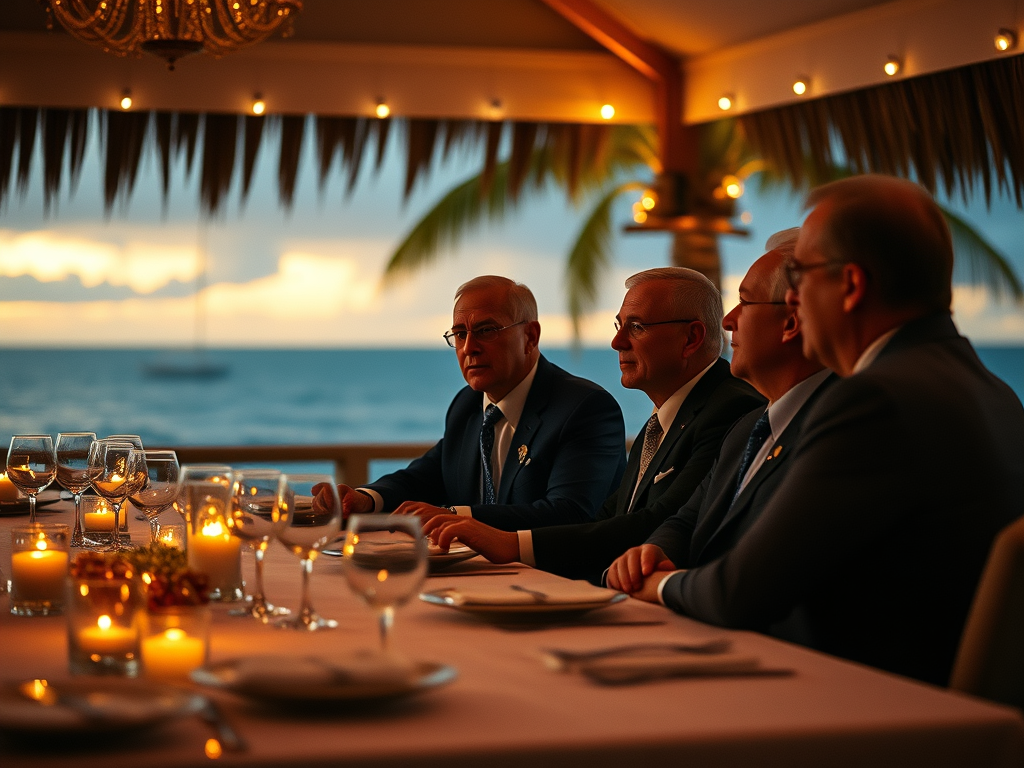

In late September, as a tropical storm approached Florida’s Gulf Coast, senior news and opinion leaders from The Washington Post gathered in Miami for a meeting with Jeff Bezos, the billionaire owner of the newspaper.
During their visit—which included a working lunch at Mr. Bezos’ expansive home on a private island in Biscayne Bay and dinner at a local restaurant—David Shipley, The Post’s opinion editor, and Will Lewis, the paper’s chief executive and publisher, discussed the future of the opinion section. With the election looming in less than 45 days, the topic was pressing.
By the end of the meeting, sources familiar with the discussions indicated that both Mr. Shipley and Mr. Lewis sensed Mr. Bezos had reservations about endorsing any candidate in the presidential race, though they believed he might be open to persuasion.
Mr. Bezos’ eventual decision to discontinue The Post’s long-standing practice of endorsing presidential candidates became public on Friday, sparking backlash from reporters, editors, and readers alike, including a rare criticism from legendary journalists Bob Woodward and Carl Bernstein.
This decision followed further discussions between Mr. Bezos and The Post leaders, who argued against abandoning such a tradition so close to an election. The editorial board had already prepared an endorsement for Vice President Kamala Harris, but Mr. Bezos did not review it prior to his final choice, according to Mr. Lewis.
The decision had been developing over several weeks, although the specific motivations and timing remain unclear.
Mr. Bezos has had ongoing conflicts with Ms. Harris’s electoral opponent, former President Donald J. Trump, who has frequently expressed hostility towards him on social media. In 2019, Amazon sued the Trump administration, claiming that Mr. Trump’s animosity contributed to its loss of a $10 billion cloud computing contract.
Mr. Bezos’ businesses, including Amazon and Blue Origin, his aerospace firm, often compete for lucrative government contracts. On the same day as the meeting, Blue Origin executives met with Mr. Trump, and the company holds a $3.4 billion contract with NASA to develop a lunar lander.
A spokesperson for The Post stated that the decision to halt presidential endorsements was made by the newspaper itself. In a subsequent statement, Mr. Lewis remarked that, as publisher, he does not support endorsements.
This decision marks another significant event for The Post this year. In June, its executive editor, Sally Buzbee, unexpectedly resigned rather than accept a new position overseeing a division focused on social media, which was dubbed a “third newsroom.” Ms. Buzbee had disagreements with Mr. Lewis regarding coverage of a British case related to his role in addressing a phone-hacking scandal involving Rupert Murdoch’s media empire.
The choice to eliminate presidential endorsements came on the heels of Patrick Soon-Shiong, owner of The Los Angeles Times, deciding to forgo such endorsements as well.
Following the meeting with Mr. Shipley and Mr. Lewis, members of The Post’s editorial board, who write editorials including endorsements, assumed they would be backing Ms. Harris. Two members had drafted an endorsement awaiting final approval.
That approval never materialized.
Instead, during a regular editorial board meeting conducted via video on Friday morning, Mr. Shipley announced the new policy regarding endorsements with little enthusiasm, as noted by attendees.
The board members were shocked and pressed him for explanations—why would the newspaper not endorse any candidate? There was little support for the decision among the editorial board, which had not been consulted prior to the announcement.
Mr. Shipley attempted to clarify the rationale, stating that The Post would refrain from directing how readers should vote, a stance meant to uphold the paper’s independent credibility. Several board members requested the opportunity to write dissenting statements under their own names, either together or individually. The meeting concluded without a resolution on how to express their disagreement.
The announcement was disseminated to the entire newsroom around noon. In his memo, Mr. Lewis stated that The Post was reverting to its prior policy of not issuing endorsements, trusting readers to “make up their own minds.” The newspaper has endorsed candidates in every presidential election since 1976, with the exception of 1988, and supported President Biden in the most recent cycle.
The news, which NPR reported before Mr. Lewis’ email was sent, triggered immediate backlash. Martin Baron, the former Post editor featured in the film “Spotlight,” tweeted that it amounted to “cowardice, with democracy as its casualty.” Robert Kagan, a long-time contributor, promptly resigned via email to Mr. Shipley.
In an interview, Mr. Kagan expressed his view that the decision to forgo an endorsement was “clearly a sign of pre-emptive favor currying” with Mr. Trump, the Republican nominee.
“The Post has been emphasizing that Donald Trump poses a threat to democracy,” Mr. Kagan noted. “So now, during this critical election, we choose to remain neutral?”
By early afternoon, top editors at The Post were addressing inquiries from their colleagues regarding the decision. During a meeting about election coverage, Matt Murray, The Post’s executive editor, was questioned why the paper would discontinue presidential endorsements while still recommending candidates in other races.
In the office’s Slack channel, employees faced a sudden influx of reader inquiries about the non-endorsement. Vineet Khosla, The Post’s chief technology officer, directed staff to prevent their experimental artificial intelligence tool from responding to questions about the decision.
“Let’s block it,” Mr. Khosla wrote, effectively halting AI-generated responses on the matter.
A spokeswoman for The Post later stated it would have been “irresponsible to provide our audience with an AI-generated summary based on just one article” regarding the non-endorsement decision.
In a late afternoon news meeting, Mr. Murray addressed further questions from an unusually large audience, noting that he had not been involved in the decision-making process, as the newsroom operates independently from the Opinion department. He revealed he had only learned of the decision on Thursday night but reassured staff that “this newsroom’s work is supported all the way to the top of the company.”
Later that evening, Mr. Woodward and Mr. Bernstein weighed in, stating that while they respect the independence of The Post’s editorial board, the decision “ignores the overwhelming evidence produced by The Post regarding the threat Donald Trump poses to democracy.”

By day’s end, The Post’s opinion department had made its dissent clear. Eighteen columnists signed a piece denouncing the decision not to endorse as a “terrible mistake.”
Ann Telnaes, The Post’s Pulitzer Prize-winning cartoonist, captured the prevailing sentiment succinctly. On Friday evening, she shared a cartoon featuring a rectangular block entirely covered in ominous gray strokes.
The title echoed The Post’s renowned motto: “Democracy Dies In Darkness.”




Leave a Reply