
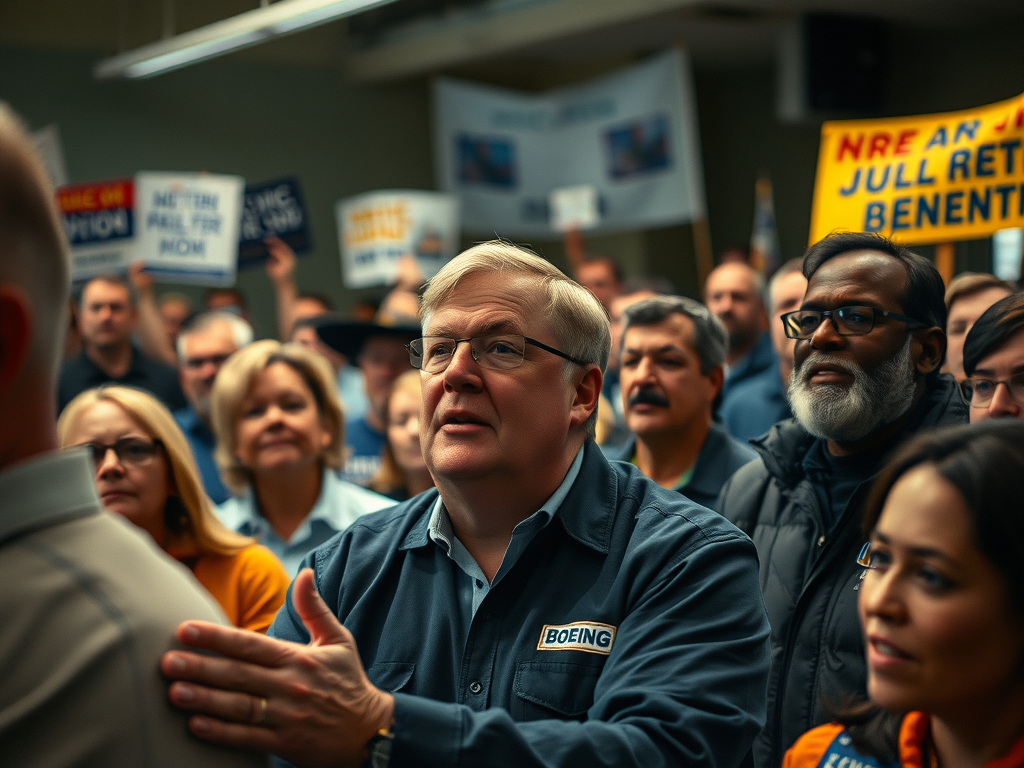

Ten years ago, Boeing discontinued its premier pension plan, which once ensured retirees guaranteed payouts. The move continues to frustrate many members of the company’s largest union.
On Wednesday, union members voted by a large majority to reject an updated contract proposal from management, primarily because the proposal did not reinstate the pension. This decision extends a five-week strike, hindering Boeing’s recovery efforts after a prolonged period of difficulties.
Retirement benefits have now become the main obstacle between Boeing and its employees. While the company has nearly met other union demands, including significant pay raises totaling close to 40% over the proposed four-year contract, the lack of pension reinstatement remains a sore point. Experts on retirement and labor predict that resolving this issue will be challenging, as Boeing is unlikely to accept the increased costs of traditional defined-benefit pensions, which most companies in the U.S. have replaced with defined-contribution plans. Meanwhile, union members, part of the International Association of Machinists and Aerospace Workers, appear firm in their insistence on stronger retirement benefits.
“All workers deserve a defined-benefit pension,” declared Jon Holden, president of District 751, representing most of Boeing’s workers. He noted that restoring the pension was a just cause, with 64% of voting members rejecting the offer.
Boeing has previously stated that restoring its defined-benefit pension, frozen since 2014, would be too costly, adding that most private employers have moved away from such plans. Boeing expressed “disappointment” following the vote but did not provide further comment.

Like many corporations, Boeing now offers 401(k) plans, which don’t guarantee post-retirement payments. These plans rely largely on employee contributions, with the company matching up to a set amount, which keeps employer costs predictable but places the burden of saving on employees.
Although Boeing executives want the strike to end to focus on recovery efforts following financial losses and reputational setbacks from two tragic crashes, few expect a change in the company’s position on pensions. According to Harry Katz, an expert at Cornell University’s School of Industrial and Labor Relations, Boeing remains focused on cost control.
Most investors are unlikely to support reinstating defined-benefit pensions, which could pose financial risks. Bank of America analysts estimate that such a plan could add $300 million to $400 million to Boeing’s annual expenses over its 401(k) plan costs.
In the 1970s, defined-benefit pensions were widespread, with nearly 62% of private-sector workers exclusively receiving these plans, per the Employee Benefit Research Institute. But beginning in the 1980s, corporations pivoted to 401(k) plans, which are more affordable to manage. By 2021, only 1% of employer-sponsored retirement plans were defined-benefit, with 84% offering solely 401(k) options.
With tighter funding and accounting rules implemented in 2006, defined-benefit plans became even less appealing to corporations, and many phased them out, freezing benefits for existing participants and closing them to new employees.

In 2014, Boeing’s machinist union agreed to freeze the defined-benefit plan under the pressure of potential job relocations. Many union members now regret the decision, believing Boeing would have struggled to move production out of the Seattle area. Today, 42% of Boeing’s unionized workforce is still covered by the frozen pension, and in its recent offer, Boeing proposed a small increase in payouts for those eligible.
Though the return of the defined-benefit pension appears unlikely, the union and Boeing could potentially reach a compromise on retirement benefits. Holden indicated a willingness to consider “other defined-benefit options” and alternatives to meet workers’ needs.
It’s unclear what Boeing could offer to win majority approval from union members. Some retirement experts suggest a cash balance plan, which guarantees a set account balance rather than lifelong payouts, as a middle ground.

“There are hybrid options that could be viable,” Holden noted. “I’m open to any defined-benefit solution for our members.”
Alicia Munnell, head of Boston College’s Center for Retirement Research, pointed out that workers and management must ultimately share resources between wages, retirement, and other benefits. If workers prioritize overall compensation, cash wages could be a viable resolution; if the focus is on retirement security, a cash balance plan could serve as a technically defined-benefit compromise, offering portability and predictable payments.




Leave a Reply