
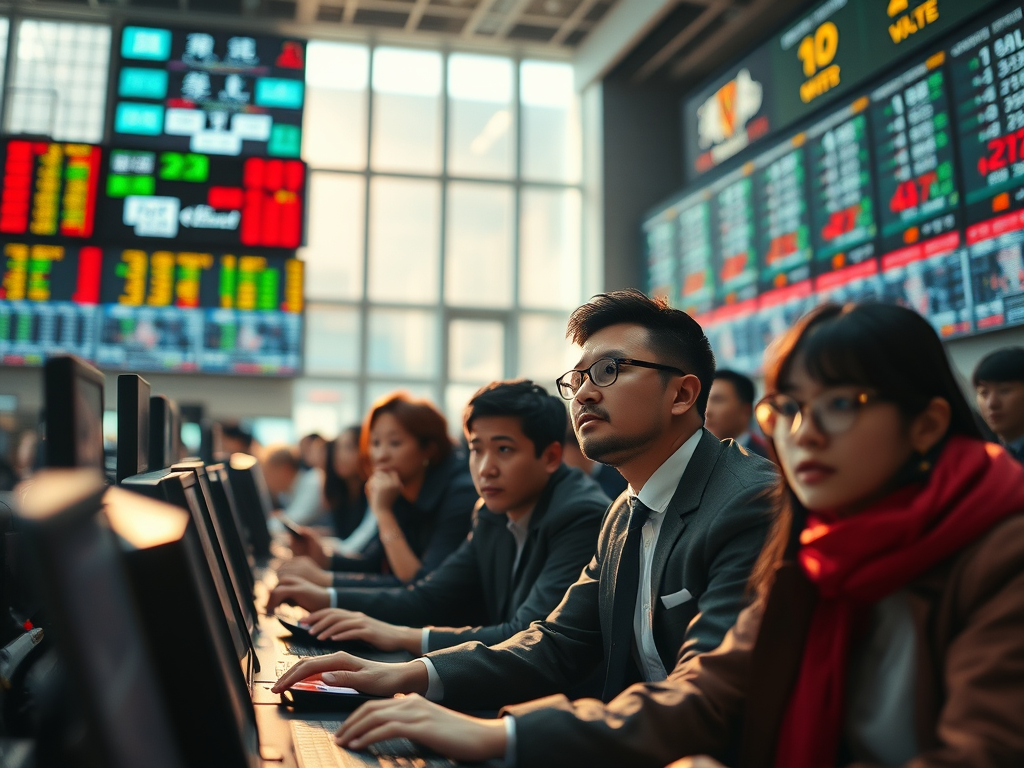

They often refer to China’s stock market as a “casino,” yet many are eager to participate. Investors are wagering that the government truly intends to emerge from its current struggles. This speculation reflects a desire for quick profits, accompanied by a palpable sense of anxiety.
In recent weeks, a series of policies from Beijing aimed at boosting the domestic economy have prompted an increase in stock investments from the middle class, leading to the most significant market surge since 2008.
In interviews, investors expressed that engaging with the market—even in a high-risk environment—provides them with a semblance of control amid the nation’s turbulence. While there are concerns that the government is prioritizing market stabilization over genuine economic recovery, many are clinging to the comforting yet precarious sense of optimism during this deflationary period.
Wang, a resident of Beijing who invested over $150,000, remarked, “We are all like ‘garlic chives’ waiting to be harvested by our rulers,” referencing a popular meme that depicts Chinese citizens as vegetables ready to be picked. “Yet by choosing to engage in the market, I feel I can influence my own fate,” he added.

Wang was among ten investors I spoke with last week, some through video and others via email or text. They are professionals or business owners—not exceedingly wealthy, but capable of investing.
All chose to be identified only by their last names due to fears of repercussions. The government has suppressed articles and comments critical of its recent strategies, which some believe are contributing more to the market rally than to true economic revival.
China reintroduced stock trading in the early 1990s as part of its economic reform. At that time, eager investors would queue for hours or even days to participate.
Today, there are over 200 million trading accounts in the Chinese stock market, nearly all held by individual investors. However, less than a quarter of these accounts are active. The stock exchanges have not proven to be profitable avenues for the public, who have largely steered clear due to volatility.

Due to strict regulations, many of China’s competitive firms have either refrained from or struggled to list domestically. Consequently, the market’s performance has often diverged from the actual economy. The SSE composite index peaked in 2007, long before China’s economic growth reached its apex, and it notably excluded major startups like Alibaba and Tencent, which opted for listings abroad.
As a result, many opted to invest in real estate, which constitutes around 70 percent of household assets. While property values soared, the government—owner of all land—reaped the majority of financial benefits. With the housing market now in decline, the government is enticing citizens to invest in stocks.
The investors I spoke with acknowledged the risks involved but felt compelled to act in a nation where the government dictates land ownership, banking, and company listings.
“It’s worse than a casino—at least casinos have rules, while ours do not,” Mr. Wang observed. “Moreover, the ‘owner’ of this casino can intervene and see our cards.”

He recognized the recent rally might be a “trap,” but felt he had no alternative. “This way, I can position myself closer to the exit, ready to flee when necessary,” he explained.
Another investor, also named Wang from Shanghai, invested in Chinese stocks on September 30. He encapsulated the prevailing sentiment: “People are not investing now because they trust the government; it’s simply a gamble they’re willing to take, accepting whatever outcome may come,” he shared via email.
An, a software engineer in Shanghai, lost his job and stock options at an online education startup following the government’s crackdown on the sector in 2021. His new apartment also faced construction delays, and when he and other buyers protested, he was detained.
When the stock rally began in September, An’s wife suggested they take a risk. After reserving some cash for credit card debts and emergencies, they invested nearly 90 percent of their savings—over $300,000—into the market, despite concerns about potential inflation from future government spending.
They reasoned that doing nothing could also result in financial loss if inflation diminished their savings’ value. But there remained a glimmer of hope for a fortunate outcome.
Xie, a small asset management firm founder from Shandong, viewed the rally as a rare chance for investment.
He shared that during his childhood in the 1990s, both his parents lost their jobs at state-owned enterprises. They invested their savings in the nascent stock market and experienced significant volatility. After starting to trade in college, he began managing funds for others in 2018.
Detecting a policy shift in early September, Xie began accumulating stock positions, sensing potential profits. However, he was troubled by the rampant opportunism on social media, where some suggested the SSE index could surge from just above 3,000 to 10,000.
He predicted the rally would be fleeting. “Financial markets cannot resolve the fundamental, long-term issues facing China,” he remarked, noting increasing obstacles for citizens seeking wealth and freedom of expression. He advised younger investors to adopt a more skeptical view.
Cheng, another investor, expressed belief that China’s challenges extend far beyond a mere market rally.
When Cheng first contacted me in February, he had just lost over $500,000 in the stock market. As the owner of a corporate consultancy, he observed the business environment becoming increasingly unfavorable for the private sector under Xi Jinping’s leadership. “I’ve never seen anyone mishandle such a good hand,” he reflected on Xi’s leadership.
In a recent conversation, Cheng likened his stock market approach to playing mahjong: “I’m watching this as a spectator. I’ve paid for the ticket,” he said, referring to his earlier losses. “I might as well endure this tragic show until the end.”




Leave a Reply