
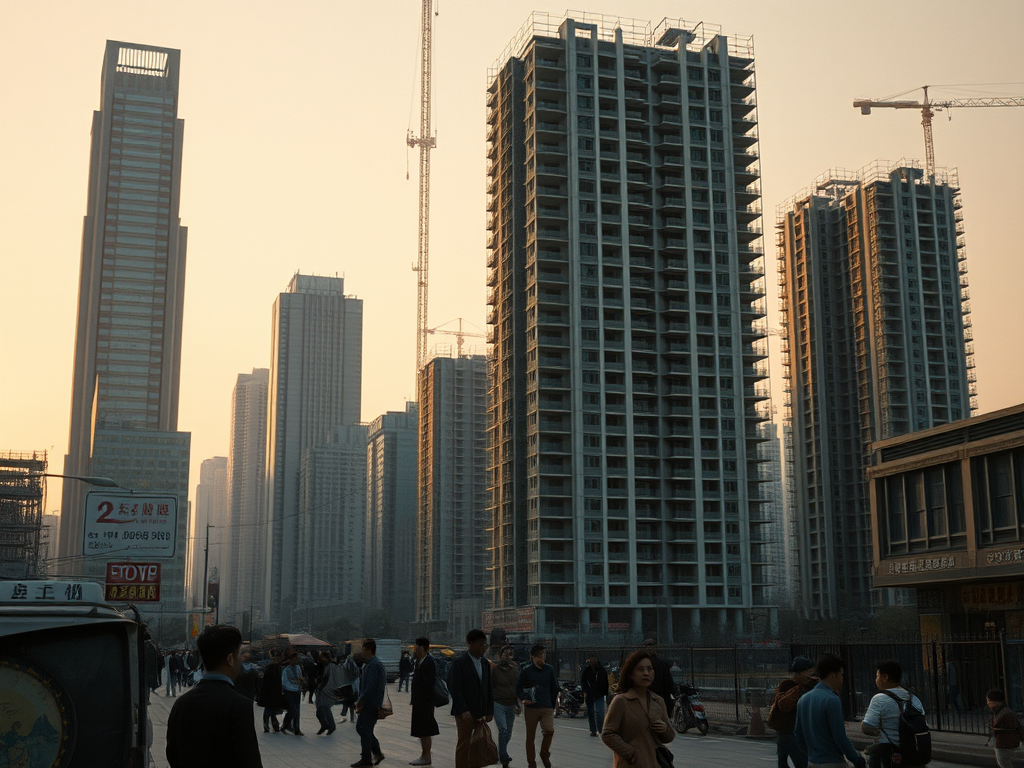

China’s economy continued to grow sluggishly over the summer, according to data released on Friday, highlighting the urgency behind the government’s recent efforts to stimulate growth.
The construction sector has slowed due to a severe housing market downturn. Millions of recent college graduates are struggling to find employment, and many local governments are facing financial difficulties, unable to fund infrastructure projects or pay wages for teachers and other public workers.
The National Bureau of Statistics reported that China’s economy expanded by 0.9% from July to September compared to the previous quarter. On an annualized basis, this indicates a growth rate of approximately 3.6% in the third quarter.
However, part of this growth can be attributed to an official revision that downgraded the second quarter’s performance. Growth from April to July was revised to an annual rate of 2%, down from the initially reported 2.8%.
Since September 24, Beijing has introduced a series of measures to address the economy’s ongoing challenges. The central bank has lowered interest rates and reduced minimum mortgage down payments, while the finance ministry has committed to issuing more bonds to help local governments pay salaries and convert vacant apartments into affordable housing.
“The timing of the stimulus shows the government is aware of the economy’s worsening condition,” said Louise Liu Qian, CEO of Wusawa Advisory, a Beijing-based consultancy.
Despite the overall slowdown, there were some positive signs. In September, factory output rose, and sales of appliances and electronics surged due to consumer trade-in subsidies.
However, deflation continues to complicate policymaking efforts. Prices for everything from real estate to consumer goods are falling, making it difficult for businesses and households to meet their debt obligations. According to Friday’s data, prices were down about 0.5% from a year earlier, marking the sixth consecutive quarter of price declines as measured by the GDP deflator.
New apartment prices in China’s 70 largest cities dropped by 7% annually in September, with prices for existing homes declining even faster in some cities.

Although recent stimulus measures have focused on expanding credit, consumers and businesses remain hesitant to borrow. The government has yet to take decisive action on one of the real estate market’s largest problems: how to handle the millions of unfinished and unoccupied homes. Investors and economists doubt the government’s willingness to shift spending away from national priorities, such as technological advancements and military upgrades, and towards consumer needs.
Initially, investors reacted indifferently to the release of economic data on Friday. But stock prices later surged following the central bank governor’s announcement of a new program aimed at increasing lending for stock purchases.
Retailers have been cutting prices in an attempt to boost sales, though many report little success. “We have no transactions now,” said Yu Xingjun, a wallpaper dealer in Zibo, as he sat idle in his shop. “When real estate declines, everything else follows.”
Retail sales rose 3.2% in September compared to a year earlier, an improvement from August’s 2.1% gain. Sales of household appliances and electronics were especially strong, jumping 20.5% year-over-year.
The government doubled trade-in subsidies over the summer, particularly for energy-efficient items like washing machines and refrigerators. Shoppers had previously dismissed smaller rebates introduced last spring as insufficient.
Falling prices are not only a domestic issue but are also starting to impact China’s exports. By September, the value of China’s exports was up just 2.4% year-on-year, as growing shipment volumes were offset by lower prices for Chinese goods.
For the past four years, China has relied on exports to compensate for weaknesses in its domestic economy. But now, Chinese companies are slashing prices to clear their inventory. For instance, vehicle exports rose 36% in the last three months compared to a year ago, but their total value increased by just 29%, indicating falling average prices. Similarly, exports of flat-panel displays were up 12%, but their total value grew at half that pace.
This situation presents a dilemma for China’s leaders. Although export volumes are rising, the increasing market share has triggered backlash abroad, leading to tariffs in some countries.
Chinese officials maintain that they are prepared to take the necessary steps to address the problem, which many economists believe lies in strengthening the domestic economy. A key challenge is stabilizing the construction and real estate industries, which made up a quarter of the economy before the property market began to collapse three years ago. Real estate investment fell 10.1% in the third quarter compared to the previous year.

The total square footage of newly started construction projects has dropped by 66% in the first nine months of 2024 compared to the same period in 2019, prior to the pandemic. These figures are important as they indicate future economic activity in the sector.
Some effects of loosened credit policies are beginning to appear. On October 13, Shanghai recorded the highest number of existing apartment sales since September 2023, according to state media reports. Nevertheless, buyers remain cautious after three years of stagnant or falling home prices.
“The investment appeal has disappeared. Now, people are only buying homes for practical needs,” said Cao Longquan, a real estate agent in Shanghai. “While there are more apartment viewings, buyers are still wary.”
The economic slowdown is less noticeable when viewed through the government’s preferred metric—year-over-year quarterly growth. By this measure, the economy grew 4.6% in the third quarter compared to the same period last year, down slightly from the 4.7% growth rate in the second quarter.
Many analysts warn that China’s economic difficulties are reminiscent of Japan’s experience with mounting debt and stagnation in the 1990s. However, some believe the government’s recent measures may help avoid a worsening outlook.
“China is in the midst of a debt-deflation spiral, but Beijing’s recent policy changes will likely prevent the country from repeating Japan’s 1990s experience,” said Diana Choyleva, chief economist at Enodo Economics, a London-based firm specializing in China.




Leave a Reply