
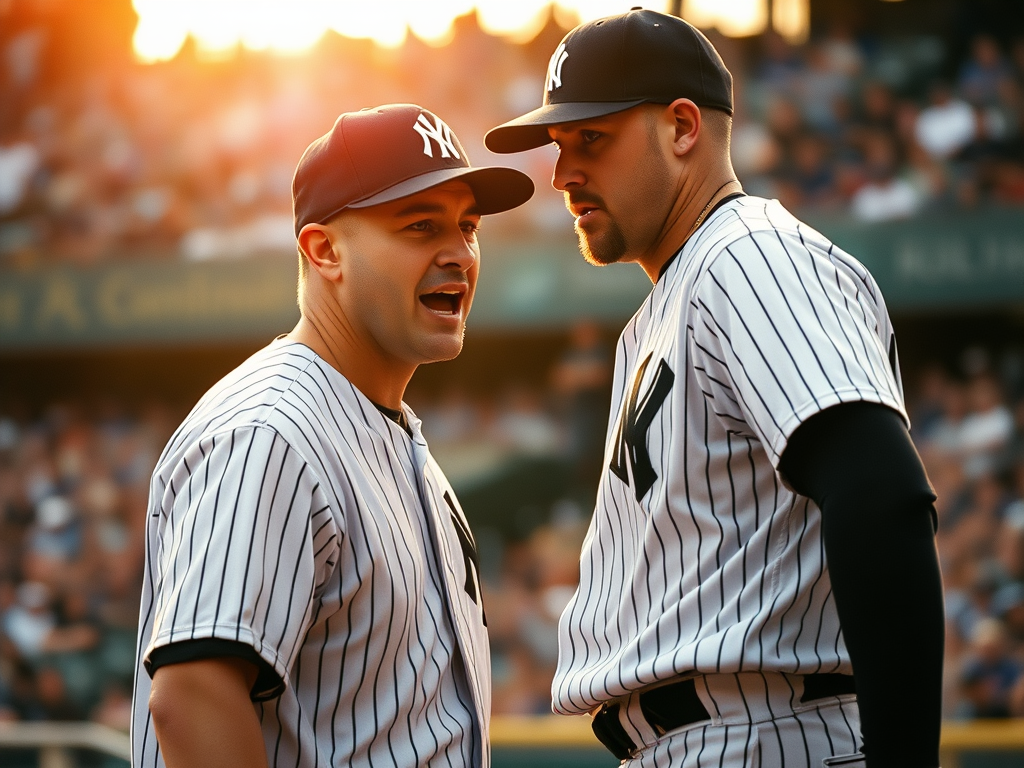

NEW YORK — Clarke Schmidt was in disbelief. The Yankees pitcher turned to shortstop Anthony Volpe and exclaimed, “What is happening? This is crazy.”
In Game 2 of the American League Championship Series, Cleveland Guardians manager Stephen Vogt made a daring decision by intentionally walking Juan Soto to load the bases for Aaron Judge in the second inning, with only one out. At that moment, the Yankees were up 2-0, and giving Judge, who had hit a league-leading 58 home runs in the regular season, a chance to break the game wide open seemed like a huge gamble.
Guardians starter Tanner Bibee was having trouble getting outs. The Yankees had already collected five hits and a walk against him. Vogt later explained that his decision was driven by the hope that Judge would ground into a double play, as Judge had hit into 22 double plays that season and was just 2-for-16 in the postseason before that at-bat. After walking Soto, Vogt brought in Cade Smith, one of the top relievers in baseball this season, to face Judge. While Judge didn’t crush the ball, he did manage to drive in a run with a sacrifice fly.
That moment, however, may have fueled Judge for the rest of the game. The Guardians chose to face the presumptive AL MVP despite Soto’s higher ground ball rate. Additionally, left-handed hitters had performed worse against Smith this season compared to right-handed hitters. Ultimately, the Guardians believed they had a better shot against Judge than Soto.
“When you walk someone to face the best hitter in the world, after intentionally walking another player, it’s going to make him mad,” Schmidt said. “It’s like poking the bear.”
Schmidt, who is slated to start Game 3 for the Yankees on Thursday, noted that he wouldn’t have agreed with walking Soto if he were on the mound. He believes that facing Judge instead of Soto doesn’t really improve a team’s odds, given how dangerous Judge can be, even during a slump.
“He’s been the best hitter on the planet this year,” Schmidt said. “It’s just a matter of time before he sends one out of the park. If anything, moves like that wake him up.”
Five innings later, Schmidt’s words proved accurate. Judge hammered a Hunter Gaddis fastball over the center field wall for a two-run home run—his first of the postseason.
This wasn’t the first time an opponent had walked Soto to face Judge, only to have the plan backfire. In August, the Chicago White Sox tried the same tactic, and Judge responded by hitting his 300th career home run. While the stakes were lower then, walking Soto in the ALCS was a much riskier move.
“Why would you intentionally walk to get to the best player in baseball?” Jazz Chisholm Jr. asked rhetorically.
“We all know that’s the kind of moment we want to see happen,” said Oswaldo Cabrera. “I think Judge wanted that chance to prove he’s the captain and show what he can do for us. It was a good thing.”
Judge wasn’t shocked by the Guardians’ decision to walk Soto, given his own postseason struggles. Soto had stepped to the plate with a 1.111 OPS and had hit a home run in Game 1 the night before. Judge mentioned that he would likely have made the same decision if he were in the Guardians’ shoes. Yankees first baseman Anthony Rizzo, however, felt that neither choice—Soto or Judge—offered a clear solution. Still, he respected Cleveland’s approach.
“I have a lot of respect for Stephen Vogt,” Rizzo said. “He’s done a great job in his first year as manager. It took a lot of guts to make that move, and while we got the sac fly, you’ve got to respect the strategy.”
Yankees second baseman Gleyber Torres suggested that moment could spark a typical Judge hot streak. When asked about his reaction to Soto’s intentional walk, Torres said, “They woke Judge up.”
Although Judge downplayed any frustration, his teammates believe he felt differently deep down.
“He might not say it, but as professional athletes, we all have a bit of an ego,” Schmidt said. “Especially when you’re the best, like Judge. He finds motivation in all kinds of situations, and I’m sure this was one of them.”
In ESPN’s “The Last Dance,” which chronicled the 1997-1998 Chicago Bulls and Michael Jordan, there’s a part where Jordan responds to perceived slights by saying, “I took that personally.” While Judge doesn’t trash talk like Jordan, he certainly commands respect on the field, making sure his actions speak for him.
“That’s exactly it,” Schmidt said. “It’s the Jordan meme.”




Leave a Reply