
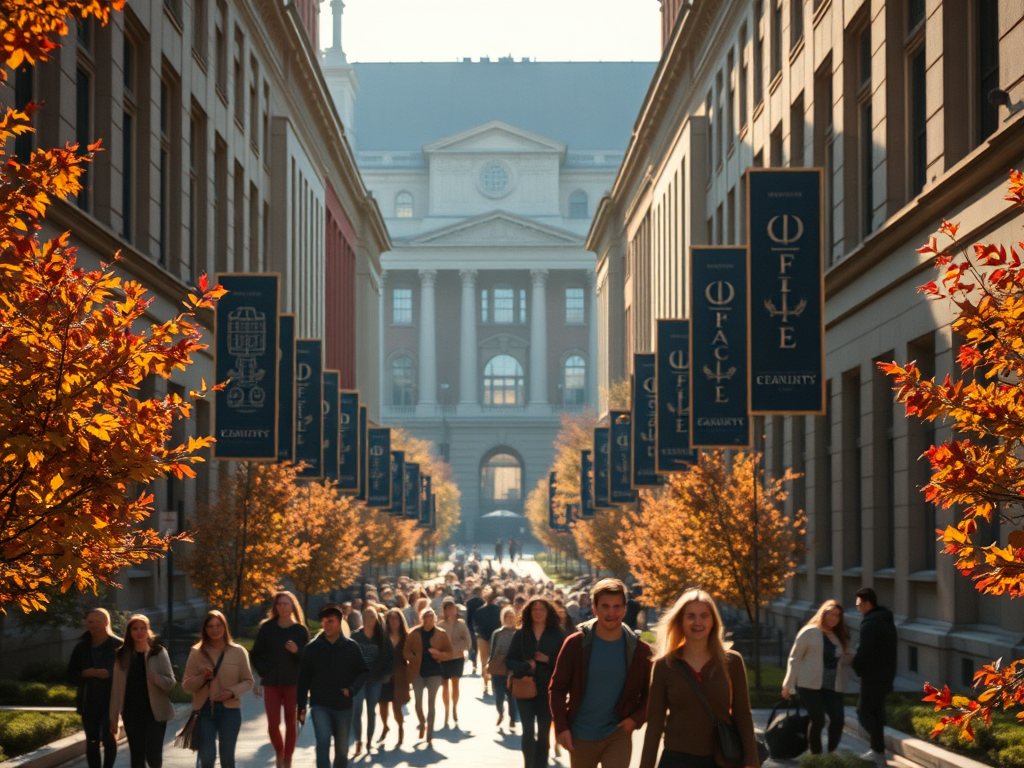

After months of turmoil on American college campuses, a sense of stability returned on Tuesday when U.S. News & World Report released its often criticized but widely followed rankings.
Most top schools maintained the same, or nearly the same, positions as they held last year.
Princeton was once again ranked as the top national university, followed by MIT and Harvard. Stanford, which shared third place last year, dropped to fourth. U.S. News also ranked Williams College as the best among national liberal arts colleges, Spelman College as the leading historically Black institution, and UCLA as the top public university.
Few aspects of American higher education spark as much debate as the U.S. News rankings. Over the years, the publication has faced accusations of data manipulation, complaints about its unclear methods, and criticism over whether ranking colleges is even appropriate.

For U.S. News, which stopped publishing its print magazine in 2010, the rankings remain a key source of influence and revenue. Universities often pay licensing fees to advertise their positions, even though U.S. News claims its business relationships do not affect the rankings. The publication insists it provides a public service by simplifying the complex college selection process for prospective students.
To students and parents, the rankings can help narrow down college choices and symbolize prestige. However, while university leaders publicly celebrate strong placements, many privately dislike the rankings. Critics, including Education Secretary Miguel A. Cardona, argue that the rankings contribute to an unhealthy focus on selectivity and reinforce an “obsession” with status.
Despite ongoing criticism, the rankings remain a powerful force. U.S. News reports that its education website attracts over 100 million users annually. In the coming weeks, many universities will undoubtedly promote their rankings through brochures, social media, and campus tours.
U.S. News’ system is designed so that hundreds of colleges can claim some form of distinction. For instance, nearly 350 schools this year can boast having one of the nation’s best undergraduate nursing programs.
In the top categories — such as national universities, liberal arts colleges, and historically Black colleges — the rankings see few changes each year. However, last year U.S. News made significant adjustments to its methodology, its most extensive overhaul since the rankings debuted in 1983.
Responding to criticism that its previous model did not adequately prioritize ideals like social mobility, U.S. News gave more weight to retention and graduation rates for students receiving Pell Grants. This led to some public universities rising significantly, with over a dozen climbing more than 50 spots, while some private institutions saw their rankings drop.
This year, U.S. News made fewer significant changes. Its most notable shift was dropping first-generation students’ six-year graduation rates from certain formulas, citing a lack of standardization in the metric.
As a result, this year’s rankings largely returned to a state of stability — at least until U.S. News revises its formulas again.
Among national universities, four schools — Caltech, Duke, Johns Hopkins, and Northwestern — moved up to tie for sixth place. The University of Pennsylvania dropped four spots to No. 10, and Brown University, another Ivy League institution, fell four places to tie with Columbia at No. 13.
Columbia’s history with U.S. News has been particularly complex. Last year, the university stopped submitting data for the rankings after a professor accused it of providing inaccurate information. This led to Columbia falling from No. 2 to No. 18.
Although the top rankings remained mostly unchanged, some schools experienced notable shifts. Tulane University, which criticized U.S. News after falling to No. 73 last year, improved by 10 spots. Meanwhile, the publisher highlighted that nine schools jumped by at least 40 places, though none rose higher than a tie for No. 209.
U.S. News noted that schools ranked in the middle tended to experience more significant changes due to similarities in their data, while top- and bottom-ranked institutions are statistical outliers with distinct characteristics.
Two recent reports further fueled the debate over the rankings. A study by higher education consultancy Art & Science Group found that about 40% of students do not consider rankings when choosing colleges, and only 3% rely on them throughout their entire search. Meanwhile, Vanderbilt University, frustrated by its five-place drop last year, commissioned a review of the methodologies behind several rankings, concluding that they often rely on flawed data and subjective criteria.
Rankings publishers maintain that their lists are useful, but they should not be the sole factor in choosing a college. U.S. News advises students to use its rankings alongside other sources of information and personal priorities when making their decisions.




Leave a Reply