
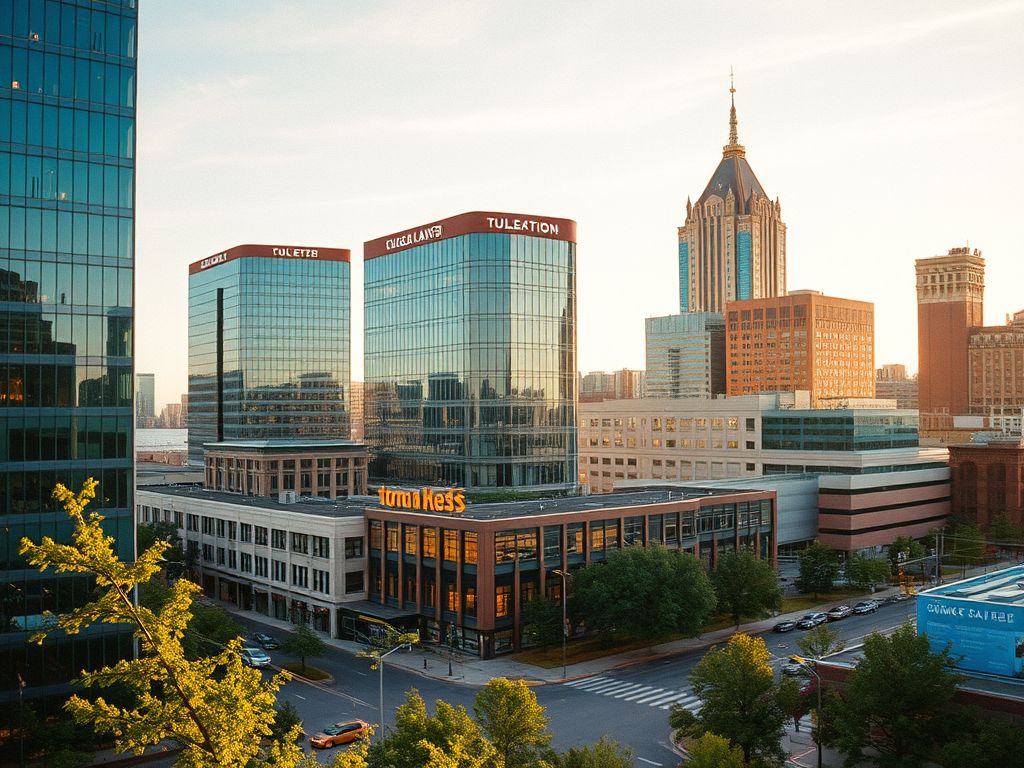

For years, business leaders and local officials in Tulsa, Oklahoma, were perplexed by the problem of young people moving away to larger coastal cities, leaving a void in the local workforce. They wondered what could be done to keep talented professionals in the heartland.
Instead of trying to retain native Tulsans, they decided to flip the approach: rather than holding onto locals, they began recruiting newcomers. The expansion of remote work created a fresh opportunity to address the city’s talent shortage.
Since the George Kaiser Family Foundation launched a program offering $10,000 to remote workers willing to relocate to Tulsa for at least a year, approximately 3,300 individuals have taken up the offer over the past five years.
One such individual is Steven Briggs, a 55-year-old data scientist who was working remotely from Dallas. He and his wife moved to Tulsa in 2021 through the Tulsa Remote program. Steven humorously likens his new home city to New York, saying, “If you can’t make it anywhere else, you can make it here.”
The pandemic-induced surge in remote work led several cities and states, such as Topeka, Kansas, and Savannah, Georgia, as well as states like West Virginia and northwest Arkansas, to introduce their own cash incentive programs to attract new residents. However, Tulsa’s initiative stands out as one of the most prominent. Researchers from Harvard and other institutions recently analyzed the program’s impact to determine its benefits for both participants and the city.

Their study, released this month, surveyed 1,248 people—including 411 Tulsa Remote participants and others who either were accepted but did not move or were not accepted but applied. The results indicated that remote workers who moved to Tulsa saved an average of $25,000 per year on housing costs compared to those who were accepted but didn’t relocate. The influx of remote workers also significantly benefited the local economy, with an estimated $14.9 million in annual state income tax revenue and $5.8 million in sales taxes.
“Every mayor in the heartland should pay close attention to this,” noted Prithwiraj Choudhury, an associate professor at Harvard Business School and lead author of the study. “Remote work has made it possible for a large portion of the workforce to move, which presents an opportunity to reverse the brain drain.”
Attracting and retaining professionals has long been a hurdle for mid-sized, non-coastal cities. From 2015 to 2019, Tulsa experienced a net loss of around 1,000 college-educated residents each year. The majority of new residents during that time were over 45 and had incomes below the state average, according to data from the Federal Reserve Bank of Kansas City.

Around 2011, local philanthropists began brainstorming how to bring in new residents. They noticed that some participants in the Teach for America program—a program that places recent graduates in underserved areas—ended up staying in Tulsa after completing their two-year commitments. This observation sparked the idea that if other knowledge workers were given a similar reason to move to Tulsa, they too might choose to stay.
“It was a lightbulb moment,” said Justin Harlan, managing director of Tulsa Remote and a former Teach for America employee. “We realized that if we could incentivize people to come here for a year, many would choose to remain and contribute to the community.”
Mike Neal, president of the Tulsa Regional Chamber of Commerce, initially had his doubts. “When I first heard the idea, I thought, ‘Are you out of your mind?’” Mr. Neal said. “I didn’t think there was a snowball’s chance it would work.”
But the concept gained traction as remote work surged from 4% to 43% of the U.S. workforce in spring 2020. That year, 380 people moved to Tulsa through the program, followed by 939 in 2021, and 643 in 2022.
Oklahoma as a whole saw an influx of younger, working-age residents and high earners during the pandemic, with 40% of new arrivals between the ages of 25 and 44 since 2020.
The Tulsa Remote team selects applicants who are interested in community engagement, whether through volunteer work or starting local businesses. Almost 75% of those who completed the program still reside in Tulsa. The program also offers social events like farm-to-table dinners and movie nights to help participants build community, given that they don’t have traditional offices to connect with colleagues.

Jasmine Renae Ball, 32, is one of Tulsa’s recent remote-work transplants. Previously living in Los Angeles and struggling to afford a home, she joined Tulsa Remote in 2020. She purchased a three-bedroom house for around $185,000—about a third of the price of smaller apartments she considered in L.A.—and even convinced her retired parents and younger sister to move from Northern California.
“Everything was just so expensive,” Jasmine said of her time in California. “You either had to compromise your lifestyle or go into debt trying to achieve it.”
Cities like Spokane, Austin, and Portland have also experienced spikes in housing costs due to incoming residents from pricier markets. In Tulsa, the median home price has risen 9% since last year, compared to a 3.2% increase nationwide.
Choudhury cautioned that the current scale of the program—3,000 knowledge workers in a city of one million—hasn’t yet caused significant gentrification.
“Gentrification is a concern,” he said, “but the scale is still small.”
However, some of Tulsa’s newcomers feel they haven’t fully integrated into local culture, leaving the long-term impact unclear.
“I’m still very much a Wisconsinite at heart,” said Tricia Jimo, 45, who moved from Madison’s suburbs to Tulsa and initially planned to stay for just one year. “Four years later, people are now asking me, ‘Are you going to stay in Tulsa forever?’ Maybe.”




Leave a Reply