
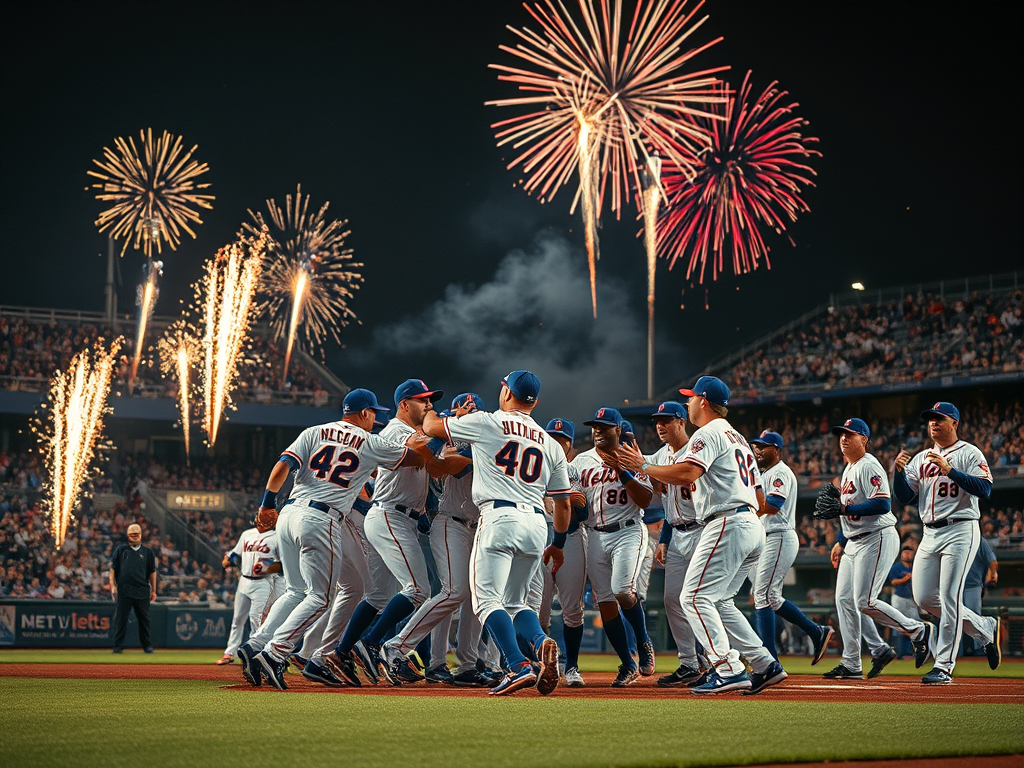
NEW YORK — It had a familiar feel, almost like we’d seen it happen before…

There they were, the unexpected wild-card team, celebrating and embracing on the infield as fireworks burst in the sky and a crowd of 44,000 fans screamed themselves hoarse.
Meanwhile, across the field, in what felt like a different reality, the 95-win powerhouse team sat stunned in their dugout, trying to come to terms with the abrupt end of their World Series aspirations.
Yep, we’ve definitely seen this story unfold before. And once again, it happened last Wednesday at Citi Field, where the Mets sent the mighty Phillies packing—not to the NLCS, but perhaps to a golf course instead.
Now, let’s be honest—it takes some serious mental gymnastics to paint a $346 million team like the Mets as underdogs. But let’s roll with it for the moment, shall we?
Why? Because for the third straight October since MLB introduced its new playoff format, a No. 6 seed—the last team to qualify—has advanced to the League Championship Series after taking down the No. 2 and No. 3 seeds in the earlier rounds. If the Mets also eliminate the Dodgers, it’ll mark three consecutive years that a No. 6 seed reaches the World Series.
So, is Major League Baseball okay with that? With three seasons to reflect on, is this format working as intended? Let’s break down what we’ve learned about this system since the Division and Wild Card Series.
How many ‘upsets’ have there been?

We’re now in the third year of MLB’s 12-team playoff structure. The goal was to give the best teams a short rest and make the road tougher for lower-seeded teams. But has that actually played out as expected?
Are top seeds simply getting sent home after their byes? Are the lower seeds struggling through the road games? Let’s take a look at the evidence.
Underdogs’ Success — Let’s start with the No. 5 and No. 6 seeds—the last teams to enter the tournament and the ones forced to play all their Wild Card Series games on the road. That should be a serious disadvantage, right? Well, here’s what has actually happened:
No. 6 seeds — They’ve won 10 series over the past three years, including three this year alone. And as mentioned, if the Mets take the NLCS, it’ll be the third straight season with a No. 6 seed in the World Series (following the Phillies in 2022 and the Diamondbacks in 2023).
Remember, before 2022, these teams wouldn’t have even made the postseason. Now, they’ve become the most dangerous squads once MLB opened the door.
No. 5 seeds — These teams, typically the second-worst records in each league, have won seven series in three years. Among them, the Royals knocked out the Orioles this season, and the 2023 Rangers went on to win the World Series. The 2022 Padres even reached the NLCS, taking down the 100-win Mets and Dodgers on their way.
So, to do the math: No. 5 and No. 6 seeds have competed in 27 series over the last three postseasons and won 17. Impressive? Absolutely. In fact, their success rate has been better than the top seeds—those who got five days off before starting their postseason.
No. 1 seeds — Teams that averaged 103 wins. Yet before this year, only one No. 1 seed had won a series—the 2022 Astros, who went on to win it all. At least in 2024, the Yankees and Dodgers joined them by advancing to the LCS, though the Dodgers faced some challenges.
No. 2 seeds — Averaging 96 wins, these teams have produced zero World Series appearances and won just three series in three years. One of those victories was a dramatic one, with the Guardians defeating the Orioles over the weekend.
Let’s calculate again—since the introduction of this playoff format, the top two seeds have participated in 17 series and won nine of them, but four of those victories belong to the Astros from 2022-23. The Braves, Dodgers, and Phillies? A combined 0-4 as No. 1 or No. 2 seeds—until the Dodgers figured it out last week against the Padres.
If we focus only on how they’ve performed in the Division Series, immediately following their bye, the top seeds have won 6 of 12 matchups. Not stellar, considering they’re supposed to be the best teams in baseball.
Is the best-of-three Wild Card Series fairer than the old one-game format?

From 2012-2021 (except for 2020), wild-card teams had to survive a one-game showdown to advance. While that format provided intense drama, it was also unforgiving.
Now, baseball has replaced it with a best-of-three Wild Card Series, with all games hosted by the higher seed. Good idea, right? Well…
How you’d expect it to go — Playing all games on the road and having a worse regular-season record should be huge disadvantages, right?
How it’s actually going — Not quite. Over the last three years, the higher-seeded teams are 4-8 in Wild Card Series, and this year, they went 1-3, with only the Padres advancing. So, this change has not made things easier for the favorites.
Does the bye help or hurt?

As we’ve seen, teams coming off a bye have a 6-6 record in the Division Series over the last three seasons. It could have been worse if not for recent wins by the Yankees, Dodgers, and Guardians. But does it make sense that these top teams, with an average of 99 wins, are struggling against opponents who averaged 89?
Phillies catcher J.T. Realmuto noted that in 2022, they were the hot team as a No. 6 seed and just kept rolling. Mets reliever Ryne Stanek agreed, saying the teams fighting to make the postseason are often in a stronger mindset when they get there.
But is momentum really worth more than rest? There’s no definitive answer yet, but it’s a question worth considering.
Should the Division Series be best-of-seven?
In 2021, the MLB Players Association proposed making the Division Series best-of-seven, but the league declined due to concerns about extending the postseason calendar. However, a longer series might give the better teams a greater chance of winning, as we see in the NBA and NHL.
Yet in baseball, top teams have won their Division Series only 50% of the time under the current format. Clearly, it’s a different sport, with its own quirks.
So, while there’s no perfect answer to this playoff puzzle, it’s still worth examining as the postseason continues to unfold.




Leave a Reply