
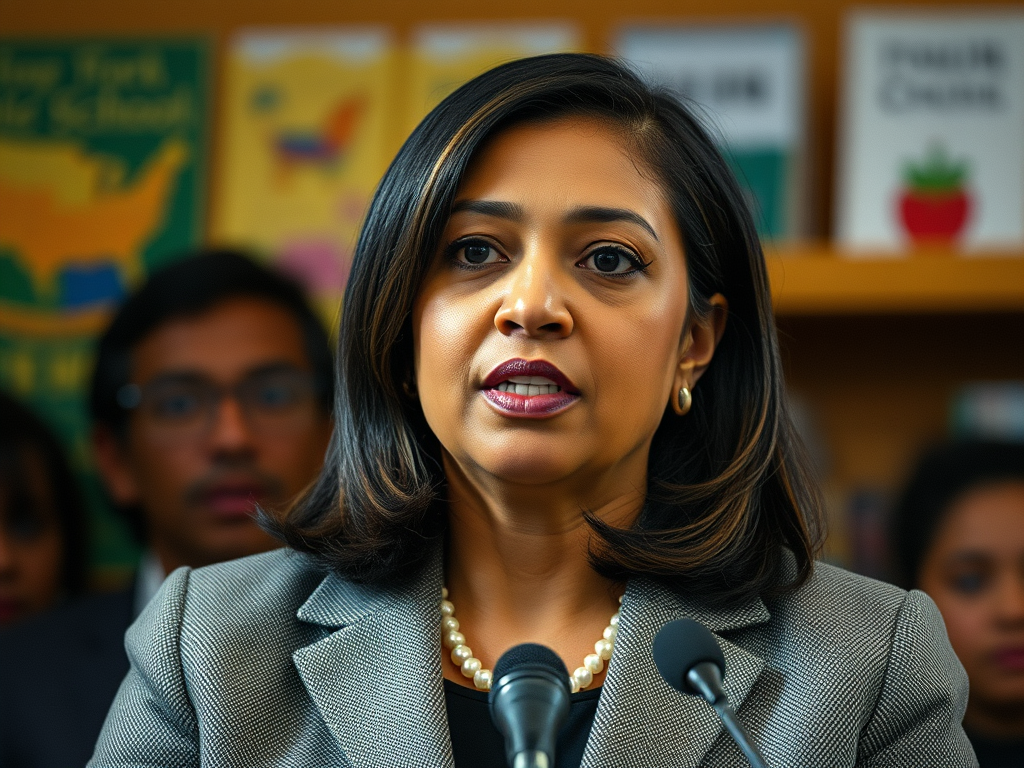

Melissa Aviles-Ramos, set to assume the role of chancellor of New York City’s public school system in January, is a veteran New York educator who played a key role in managing the district’s response to the influx of tens of thousands of migrant children.
Her appointment on Wednesday to lead the largest school district in the country came swiftly, less than 24 hours after David C. Banks unexpectedly announced his resignation. Banks stated that he would step down in the middle of the academic year amidst four separate federal corruption investigations affecting Mayor Eric Adams’s administration.
Aviles-Ramos is widely recognized in New York’s education circles for leading the efforts to enroll and support the over 40,000 migrant children who have arrived in the city over the past two years, a responsibility that has drawn ongoing criticism of the administration.
A lifelong New Yorker, the 42-year-old Aviles-Ramos has an extensive understanding of the city’s complex educational bureaucracy, which can often prove challenging for outsiders. Her career path includes roles as an English teacher, high school principal, and superintendent in the Bronx — experiences that are expected to serve her well in her new position as chancellor.
At a press conference on Wednesday, Aviles-Ramos conveyed a calm and confident demeanor.
“My mission is to ensure we follow through on all the promising beginnings and bright futures,” she said. “To build the pathways for our children, to strengthen the connections between communities and families, because everything we do is in the service of our children.”
While it’s unclear which issues Aviles-Ramos will focus on as chancellor, she is expected to maintain Banks’s major initiative — the overhaul of reading instruction. Current and former Department of Education staff suggested that she may bring a more administrative approach, rather than pushing for large-scale changes.
What to know about Melissa Aviles-Ramos:
A close ally of the former chancellor:
During Wednesday’s press conference, Aviles-Ramos expressed gratitude to Banks for his mentorship. She previously served as his chief of staff from January 2023 to February 2024, before taking on a vice president role at a for-profit college in the Bronx.
Just 24 weeks later, Aviles-Ramos returned to the Department of Education as a top deputy. Upon her return, Banks commended her ability to “bridge the gap between schools and communities.”
In recent weeks, she stepped in to handle press inquiries for Banks, helping manage the increased scrutiny following an FBI raid on his home as part of a bribery investigation involving his brothers and fiancée.

Her educational background:
Aviles-Ramos began her education at a Catholic school in the Bronx before earning an English degree from Fordham University. She went on to receive a master’s degree in English from The City College of New York and a certification in education from the College of Saint Rose in Albany, according to her LinkedIn profile.
She joined the New York City public school system in 2007 as an English teacher, rising to become a principal, a superintendent, and eventually joining the chancellor’s office in 2022.
Leading efforts for migrant student integration:
Aviles-Ramos often represented the school system’s response to the growing number of migrant students, answering questions about enrollment, housing, and transportation at City Council hearings and press briefings.
The school system, like the city itself, has struggled to accommodate the arrival of new students. A shortage of Spanish-speaking teachers and mental health counselors has been a particular challenge, and many educators have expressed frustration over insufficient guidance from the Department of Education on supporting migrant students in classrooms.
Schools may look to Aviles-Ramos to develop a stronger strategy for the nearly 150,000 students who are learning English for the first time.
Highest-ranking Latina in the Department of Education:
When Aviles-Ramos became a deputy chancellor in July, she also became the highest-ranking Latina and Spanish-speaking official in the Department of Education.
She began her remarks on Wednesday by thanking the Latino community in Spanish for their support.
“When you say it in Spanish, it sounds even better,” she said.
In recent years, the Hispanic student population in the city’s public schools has grown significantly. During his recent “State of Our Schools” address, Banks highlighted that 42 percent of public school students in New York identify as Hispanic, underscoring the need to better serve this growing demographic.




Leave a Reply