
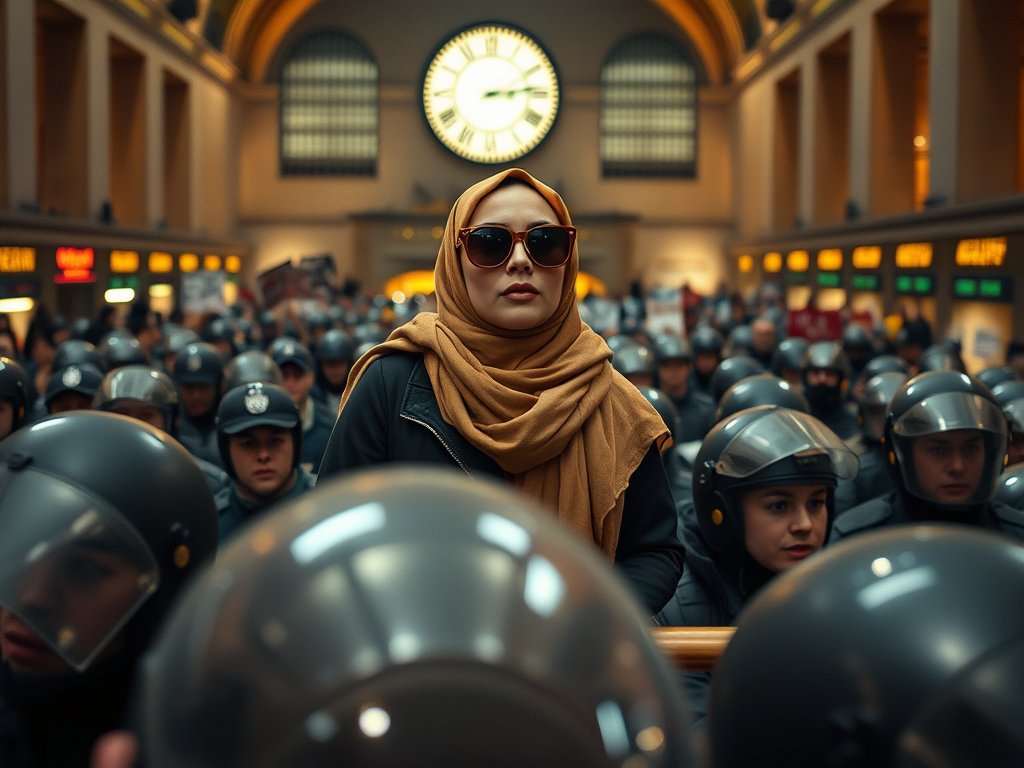
On a Thursday evening in July, Nerdeen Kiswani and her pro-Palestinian group, Within Our Lifetime, managed to cause a shutdown of Grand Central Terminal without even stepping foot into its grand main hall.
The catalyst for the disruption? A simple online flier urging supporters to gather by the famous clock at the station at 5:30 p.m. Police preemptively closed off the area to commuters and tourists, barricading the space. Overhead, three helicopters and a drone circled.
Kiswani, a 30-year-old Palestinian-American law graduate, shifted the protest outside. Clad in a tan hijab secured with oversized sunglasses, she stood atop a bench, surveying the chaos she and her fellow demonstrators had triggered — honking traffic, lines of police in riot gear, and pro-Israel counter-protesters blaring air horns to drown her out.
“I guess they achieved our goal for us,” she called out to the crowd, who echoed her words to amplify the message. “Our objective was to draw attention to the U.S.-funded Israeli genocide in Gaza.”
The crowd then took up her chant: “Judaism, yes, Zionism no! The state of Israel has got to go!”
New Yorkers have grown accustomed to the tactics of Kiswani and her group, which she co-founded in 2015. Even if her name isn’t widely known, their marches have shut down the Brooklyn and Manhattan Bridges and caused gridlock in Midtown. Their chants of “Long live the Intifada!” outside an event honoring victims of the Oct. 7 Hamas attack on Israel drew rebukes from figures as prominent as those in the White House. Some protesters associated with her group have been seen burning Israeli flags and flying banners of Hamas and Hezbollah.

Kiswani openly advocates for the liberation of Palestine “by any means necessary,” including armed resistance. This stance has made her a primary target for Jewish and Zionist groups such as the Anti-Defamation League and Canary Mission, as well as a familiar figure to the NYPD.
“If you’re going up against what is essentially a killing machine, love and peace slogans alone won’t cut it,” she explained in a recent interview. “People need the means to defend themselves.”
While Within Our Lifetime has only a few dozen official members, its protests often attract hundreds of participants, and at times, when coordinated with other anti-Zionist groups, their numbers swell into the thousands, leading to numerous arrests.
Before Meta suspended their Instagram account in February, Within Our Lifetime boasted around 180,000 followers. A spokesperson for Meta said the account violated platform guidelines against promoting “dangerous organizations or individuals,” which includes U.S.-designated terrorist groups.
Critics argue that Kiswani’s group has discredited the pro-Palestinian cause with its aggressive rhetoric and violent undertones. According to Oren Segal, vice president of the ADL’s Center on Extremism, “The rhetoric has escalated to the point where it’s no longer fringe to see terrorist group symbols and flags at events.”
On social media, Within Our Lifetime has mourned the deaths of figures like Hassan Nasrallah, the Hezbollah leader killed by Israel last month, referring to them as martyrs.
Despite this, the ongoing war in Gaza has thrust Kiswani into the spotlight, with her influence spreading across the country and forcing political leaders to confront the growing unrest in the streets.
A New Generation of Activism
Kiswani views herself as part of a bold new generation of Palestinian-American activists, pushing for what she says earlier generations wanted but were afraid to vocalize: the replacement of Israel with a state called Palestine, encompassing all the land between the Jordan River and the Mediterranean Sea.
“Talking about a two-state solution might make us seem more moderate,” she said, “but that’s been dead in the water for years. It’s already a one-state reality, controlled by Israel.”
She believes there’s no reason to water down her message. “Those in our community who tried to appease politicians were still marginalized, still called terrorists,” she explained. “So if we’re going to face backlash no matter what, we may as well demand full liberation for our people.”
Kiswani and her allies played a role in the campus protests earlier this year that led to the resignation of several university leaders. (She even attended a protest at Columbia University on her wedding day, still dressed in traditional red and white attire.)
Their activism has also become a source of concern for Democrats, who fear that divisions over Gaza could cost them crucial votes in a closely contested election.
“They tell us that voting for the lesser of two evils is the right choice,” Kiswani declared to a crowd in August, standing atop a stack of police barricades outside a campaign event for Vice President Kamala Harris in Harlem. “So we divest from this system.”

While Kiswani insists her activism is not antisemitic, stating that she only opposes Zionists, Jewish groups like the ADL argue that anti-Zionism is inseparable from antisemitism, as Zionism is central to Jewish identity.
The extreme nature of Within Our Lifetime’s protests has alienated even some prominent critics of Israel’s war in Gaza. Representative Alexandria Ocasio-Cortez, for instance, condemned the group’s protest at a memorial for victims of the Oct. 7 Hamas attack, calling it “plain and simple antisemitism.”
Yet Kiswani’s following continues to grow.
“The world is standing by as thousands of children are being slaughtered,” said Carolyn Antonucci, 64, who joined a Within Our Lifetime protest in New York on Labor Day. “Who am I to say what’s the right way to respond?”
Sarah Schulman, a playwright and advisory board member of Jewish Voice for Peace, an anti-Zionist organization, understands Kiswani’s point of view. “When you look at her,” Schulman said, “ask yourself: If it were my family being murdered and brutalized, wouldn’t I be doing the same?”
Life in Exile
Kiswani’s roots trace back to a Palestinian family from Beit Iksa, a village in the West Bank. Born in Jordan and raised in Brooklyn, she attended an Islamic private school before transitioning to public school in her teens. She later studied human rights and international relations at the College of Staten Island, with a focus on the Middle East, where she co-founded a chapter of Students for Justice in Palestine.
In 2015, Kiswani was barred from visiting her relatives in the West Bank, a punishment she attributes to her activism during her college years. “After that,” she said, “I felt like I had nothing left to lose.”
This incident prompted her to help create NYC Students for Justice in Palestine, which was rebranded as Within Our Lifetime in 2018. The group’s goal was to reignite the revolutionary spirit of Palestinians living in exile, but their inflammatory demonstrations have drawn intense criticism from pro-Israel factions.
Despite being labeled “Antisemite of the Year” in 2020 by StopAntisemitism.org, Kiswani was elected as her law school’s class speaker in 2022. Her speech, which criticized Israel and U.S. imperialism, gained national attention.
Kiswani, now preparing for the bar exam, continues to run Within Our Lifetime as a volunteer. Though the group does not publicly disclose its membership, activists such as Fatima Mohammed and Abdullah Akl have been associated with its leadership. Both have made public speeches against Zionism, capitalism, and imperialism.

The group’s demonstrations often follow a set pattern: lesser-known organizers warm up the crowd, followed by Kiswani’s own speech. Her height, at 5’11”, makes her easy to spot. At her signal, the group swiftly moves through the city, often outpacing police efforts to contain them.
Kiswani is occasionally arrested but always returns to lead the next protest, donning her signature hijab and bright lipstick.
Incidents of Vandalism
Although Kiswani’s chants are protected by the First Amendment, her opponents, like Oren Segal of the ADL, warn that her words could incite violence. “The more you normalize these kinds of extreme activities,” Segal said, “the more likely people on the fringes will take it to the next level.”
Physical altercations have broken out at some protests. In one case, a Jewish student was assaulted at Columbia University for wearing a T-shirt with the Israeli flag. During a separate protest, a member of Kiswani’s group told Zionists on a subway train to identify themselves and leave, an incident that led to misdemeanor charges.
Kiswani remains defiant. “We don’t want Zionists in Palestine, New York City, our schools, or anywhere,” she wrote on social media. When questioned later, she said the protester was joking.
Following a Within Our Lifetime protest at the Brooklyn Museum in May, homes of the museum’s Jewish board members were vandalized. Though a group claimed responsibility, Kiswani said none of those arrested were part of her organization.
As tensions rise, Kiswani continues to maintain that armed resistance is a legitimate part of any revolutionary movement, believing that her activism, however controversial, will persist in making waves.





Leave a Reply