
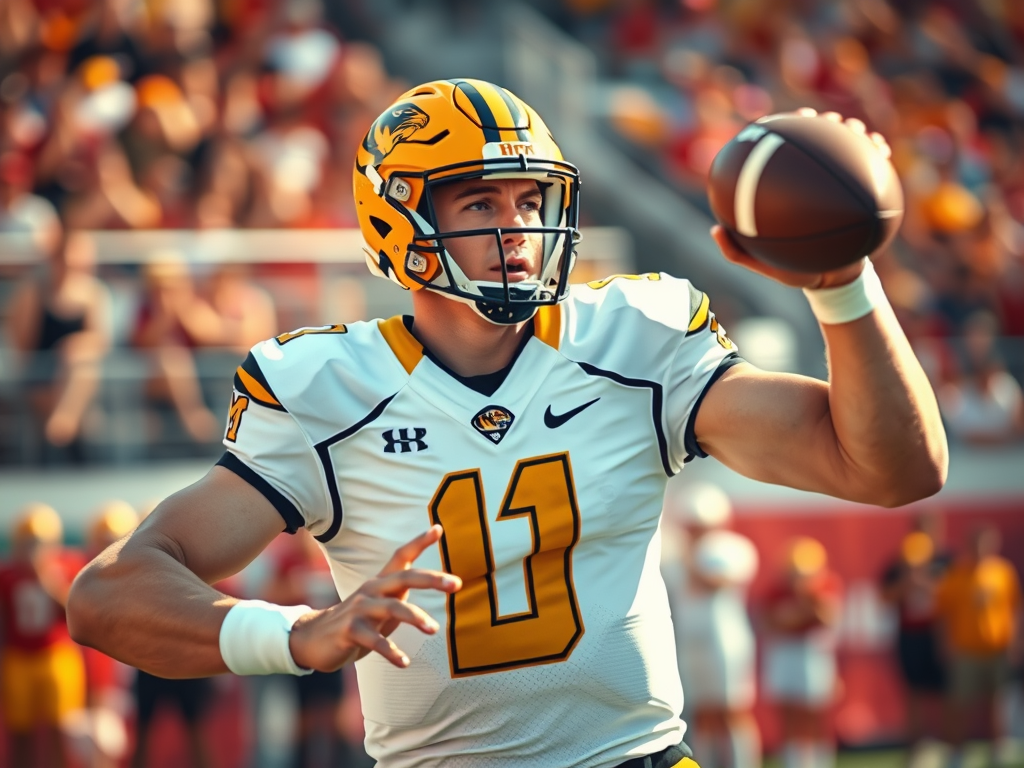

In his four-year tenure as Missouri’s starting quarterback, Brady Cook has amassed 7,603 passing yards and 43 touchdowns, leading the Tigers to a Cotton Bowl victory last year. Despite a surprising loss over the weekend, his team remains in the running for a College Football Playoff spot.
What’s even more remarkable is Cook’s growing real estate empire, with investments spanning Missouri, Georgia, and Texas. His portfolio includes interests in several apartment complexes, a medical facility, and a retirement home. Cook attributes his business decisions to the knowledge he gained while pursuing an MBA at the University of Missouri, which he will complete in December. However, he credits his arm for securing the financing.
“I won’t reveal my income,” said Cook, whose NIL (name, image, and likeness) deals are estimated to bring in around $1.2 million per year, according to multiple sources. “But I will say that I’ve learned more about business in the past year than I ever have before.”

The NIL era, which allows college athletes to monetize their athletic skills, is still in its infancy, but it’s already a booming industry, with over $1.7 billion circulating—80 percent of which flows through collectives, funneling booster money to players.
Thanks to Missouri’s legislature, the University of Missouri has established one of the most transparent ways to ensure its student-athletes are well-compensated. Unlike most donor-funded collectives that rely on boosters, Missouri’s state law has allowed the creation of a university-backed marketing agency, Every True Tiger, which distributes funds to its athletes.
This law also allows Missouri-based athletes to profit from endorsement deals while still in high school, provided they commit to attending a public university in the state. It even prevents the NCAA from investigating signees’ NIL benefits.
This strategy, known as the “Mizzou Model,” has paid off quickly.
Last year, the Tigers achieved their first 11-win season since 2014, dominating the highly competitive Southeastern Conference (SEC) and defeating Ohio State in the Cotton Bowl. The additional funds allowed Missouri to recruit top-tier players like receiver Luther Burden III, a projected top-10 NFL draft pick, and sign defensive standout Williams Nwaneri while he was still in high school.
Missouri’s head coach, Eliah Drinkwitz, acknowledges the transformative impact NIL has had on the program. “Without NIL, we wouldn’t have been able to land some of the elite players we have,” he said. “We embraced the new reality of college football, understanding it could be a competitive advantage, and it’s played a big role in our success.”

Kurtis Gregory, a state representative and former Missouri offensive lineman, helped write the law. He recognized the imbalance in how college athletes were restricted from profiting off their talents, despite the revenue they generated for universities.
“If I went to Missouri to play piano, I could still get paid for concerts,” Gregory said. “But a teammate who was a talented rapper couldn’t release a song on Spotify and get paid. That wasn’t fair.”
Gregory and his colleagues crafted legislation that benefits both the university’s athletic program and its athletes.
“Recruiting is always about incentives,” Gregory explained. “Schools promise new facilities and resources. Now, they can also offer real financial opportunities. We want our athletes to earn as much as they can while helping our school succeed.”
Gone are the days of under-the-table deals with boosters. The NIL era has brought transparency to team building, with a clear price tag attached to securing talent.

Oklahoma State head coach Mike Gundy, for example, cited financial considerations when discussing how linebacker Obi Ezeigbo transferred from a lower-division program to his. “He was a good value for us,” Gundy told reporters.

In Missouri, Drinkwitz acts as the CEO of Tiger Football Inc., managing a budget and knowing the market rate for each position in the SEC—$1 million for a quarterback, $710,000 for a receiver. With assistance from his staff, he identifies players to fill these roles, making financial offers under the law.
The complexities of the NIL system have already surfaced at other schools. UNLV quarterback Matthew Sluka, for instance, left his team over an unfulfilled $100,000 NIL promise, preserving his eligibility to find a better deal elsewhere.
“This new era changes the player-coach dynamic,” Drinkwitz admitted. “It introduces a business element into relationships, but I believe families and players understand that development and relationships still matter.”

For Cook, his relationship with Drinkwitz played a major role in his decision to stay at Missouri, even after a difficult 6-7 season in 2022 and a shoulder injury.
“It’s not just about the money,” Cook explained. “You have to enjoy the people you’re competing with and for.”

Last year, Cook was named the SEC football scholar-athlete of the year, and this year he’s applying his business school lessons in brand building and time management. He’s partnered with national companies like a supplement brand, a bank, a pizza chain, and a real estate firm in his hometown of St. Louis, ensuring all his promotional work was completed before the season began.
For Cook, the biggest takeaway he hopes to carry with him to the NFL is simple: “You win games, and you make more money.”




Leave a Reply