
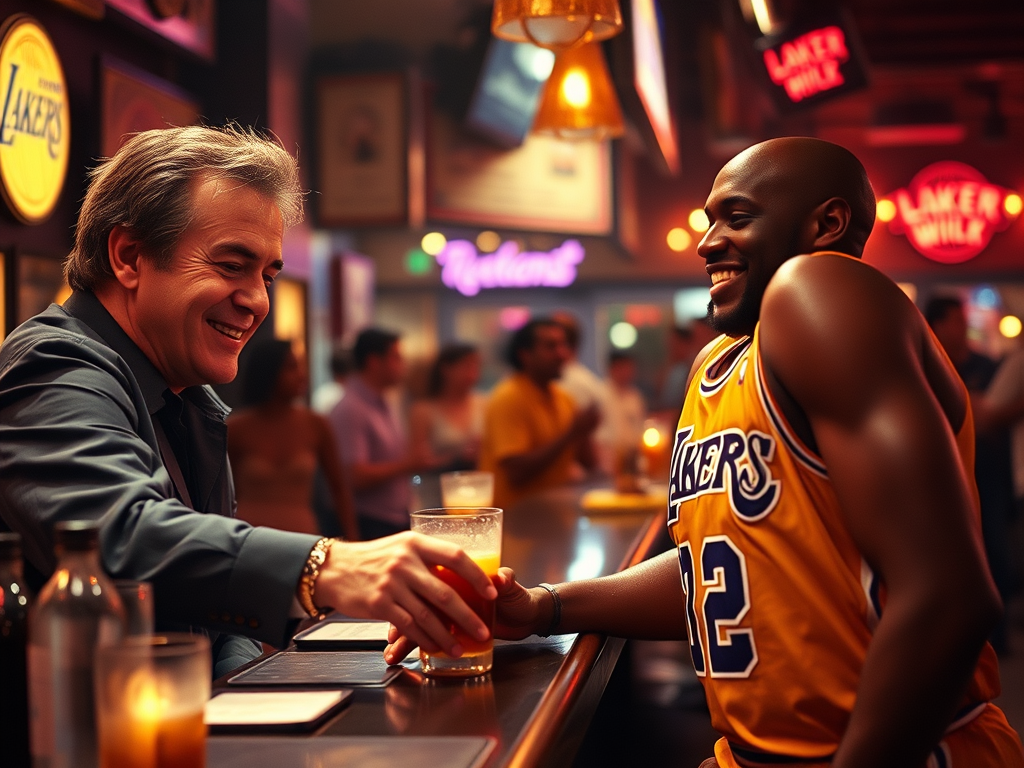

Jack Nicholson was closely linked with the Showtime-era Los Angeles Lakers, regularly seen courtside at their games at the Great Western Forum. He appeared in promotional photos and occasionally hosted team members at his Beverly Hills home for parties.
One summer night, Nicholson took on an unusual role—bartender.
The Lakers had just triumphed over the Detroit Pistons in an exhausting Game 7 to win the 1988 NBA championship. The celebration, which began in the locker room, spilled over to On The Rox, a private club on Los Angeles’ Sunset Strip.

Lakers forward Mychal Thompson approached the bar and was surprised to see Nicholson there, just a few months removed from his ninth Academy Award nomination. In a recent interview with The Athletic, Thompson reflected on that night, pausing as he recalled Nicholson’s famous voice: “Let me see if I can imitate him,” Thompson said.
“What’ll it be, Mychal?” he mimicked in Nicholson’s iconic drawl, the same voice that delivered some of the most famous lines in movie history.
Thompson laughed, remembering, “It was so cool I couldn’t believe it.”
In today’s world, celebrity superfans are common, but few have been as closely associated with a team, or a sport, as Nicholson was with the Lakers and the NBA. This Sunday, the Naismith Memorial Basketball Hall of Fame will induct Nicholson, along with fellow actor Billy Crystal, director Spike Lee, and businessman Alan Horwitz, into the James F. Goldstein SuperFan Gallery, recognizing his enduring connection with basketball.
Nicholson, now 87, has been a fixture in the NBA for most of his life, often seen at The Forum and later at the Staples Center (now Crypto.com Arena). A Los Angeles Times columnist once dubbed him “the best sixth man the NBA has ever seen,” a key player in the league’s unique culture. During the Lakers’ legendary matchups with the Boston Celtics, Nicholson was a central figure, as recognizable as Magic Johnson and Kareem Abdul-Jabbar—especially the night he supposedly “mooned” Celtics fans at Boston Garden.
“He wasn’t just any fan—he was Jack Nicholson,” former Lakers forward Jamaal Wilkes said. “We all knew that. He wasn’t treated like any other fan. We showed him respect because he was so invested in us.”
For many celebrities, attending Lakers games was about being seen, but for Nicholson, it was never about publicity. He had grown up in New Jersey playing basketball, and his love for the game only grew after he moved to the West Coast. Rolling Stone magazine once listed Nicholson’s passions as art, movies, skiing, books, and basketball. When asked by writer Tim Cahill what linked these interests, Nicholson replied, “There’s poetry in all of them. In a painting, in basketball, in skiing, it’s all about little moments of truth and pushing the limits.”
Much like his approach to art, Nicholson fully immersed himself in basketball. In 1982, he was invited to cast the first fan ballot for the NBA All-Star Game. At a luncheon, Nicholson proudly selected “E. Johnson,” believing he had voted for Earvin “Magic” Johnson. In reality, his vote went to Eddie Johnson, a young forward for the Kansas City Kings.
In 1986, photographer Andy Bernstein had a creative idea for a Lakers team poster—staging the players as fans at The Forum’s concession stand. Promotions manager Lon Rosen wanted Nicholson involved, and when Nicholson arrived at the shoot, Bernstein got the chance to direct him for 10 minutes. “For a moment, I felt like Martin Scorsese,” Bernstein recalled. “It was surreal.”
Back at On The Rox, Nicholson handed beers to Thompson and poured tequila for Michael Cooper, another Lakers player. Actress Daryl Hannah even joined him behind the bar. The party remained intimate, with only Lakers players, coaches, staff, and their wives present. As Byron Scott, a former Lakers guard, put it, “That was our team. We were close-knit. Jack was part of that inner circle.”
Nicholson’s courtside interactions became legendary. In a famous incident, former coach Dick Motta, now 93, recalled an altercation with Nicholson during a game in the 1980s. “Someone grabbed my leg, and I tried to kick them off. It was Jack Nicholson,” Motta laughed. Though officials suggested Motta apologize to the actor, Motta believed Nicholson owed him the apology. Looking back, Motta chuckled, saying, “I guess I should’ve been honored that a famous star took the time to grab my leg.”

Over the years, Nicholson’s seats, located near the visitors’ bench, became known as the “Nicholson seats.” Some coaches even suspected him of relaying plays to the Lakers. Suns star Steve Nash once joked that Nicholson was practically in their huddle, “trying to steal our plays.” Nicholson also enjoyed playful banter with officials, and many referees admitted feeling flustered when the iconic actor greeted them by name.
During the Lakers-Celtics rivalry of the 1980s, Nicholson was a true basketball villain in Boston. At one point in the 1984 NBA Finals, Boston fans taunted him, and Nicholson allegedly responded by mooning the crowd. Though this incident remains part of NBA lore, accounts vary, with some insisting it happened and others denying it.
Regardless, Nicholson’s presence at games has always been larger than life, whether he was entertaining Lakers players at postgame parties or engaging in banter courtside. His passion for basketball, much like his legendary film career, has left a lasting impact on the NBA and its fans.ain in the ass to opposing teams.”




Leave a Reply